





The founders of Saarbrücken, Germany-based Seawater Cubes, a startup that has developed a plug-and-play recirculating aquaculture system for fish, are seeking EUR 3 million (USD 3.3 million) in funding to scale up production and marketing.
Seawater Cubes was founded in 2018 by business and marketing specialist Carolin Ackermann, automation technologist Kai Wagner, and mechanical engineer Christian Steinbach. Through the development of their fully automated RAS design, they hope to decentralize small-scale fish farming, making commercial RAS fish production more feasible around the world.
“We wanted to break up established structures and revolutionize the way in which fish is produced and consumed, and after a stressful few years – as with any new business – we finally seem to be on our way to achieving our goal,” Ackermann, the company's CEO, told SeafoodSource.
The trio of founders met at the University of Applied Sciences in Saarbrücken, Germany. They all worked in the school’s aquaculture laboratory as part of their studies and jointly developed an interest in fish rearing.
“In the past, we didn’t really give much thought to where the food on our plate actually came from, but our studies made us aware of the fragility of the world’s fish stocks, the benefits of fish farming on land, and the technological sophistication of RAS [technology]. We wanted to get involved and to build something accessible to the agricultural industry,” Ackermann said.
After Wagner and Steinbach gained experience working at Infinite Sea – Europe’s first large-scale RAS company – the trio united and secured nearly EUR 1.5 million (USD 1.6 million) in funding from the German Ministry of Economics to develop a pilot “Seawater Cube” in Saarbrücken.
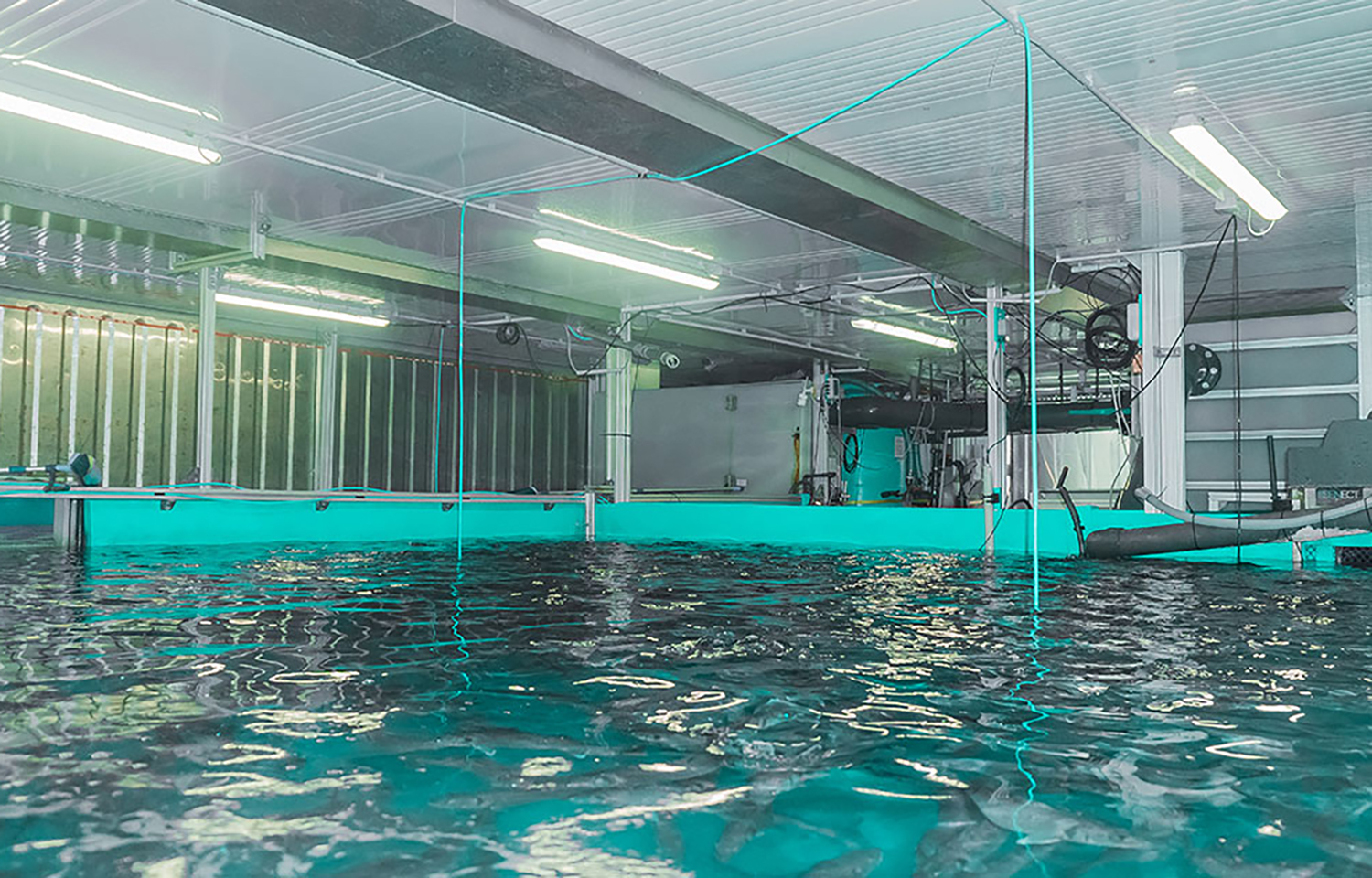
Their plug-and-play modular system is based on four recycled shipping containers, which form a 120-square-meter unit capable of producing 8 metric tons (MT) of fish per year. So far, the company has successfully grown sea bass and sea bream in a pilot unit and is experimenting with red drum, barramundi, and pompano.
The system is ideal for food production in urban areas where space is limited, according to Ackermann. Seawater Cubes currently sells a self-contained unit stocked with fish for around a EUR 500,000 (USD 543,000) price tag. However, Ackermann said as production volumes grow, she is confident the price will drop.
Once it's installed and running, minimal effort is needed to operate and maintain the Seawater Cubes system, monitor the fish, harvest, and pack, according to Ackermann. Referencing data from the pilot farm, she estimated it takes around one hour daily to maintain the system, even for someone without prior aquaculture experience. That means they can be operated as a supplement to terrestrial farming or as a community project or cooperative, Ackermann said – in fact, the company's first few customers include a pig producer and a group of engineers who want to increase urban food production.
Seawater Cubes offers interested customers pre-sales support advice and assistance on applying for a grant to purchase a system if requested, as well as training and technical services once the system is installed. The company also runs a hands-on training course at the pilot farm, as well as an online course, with an English language version being prepared for introduction in 2025.
Additionally, Seawater Cubes includes vaccinated fingerlings from France and Israel to stock the tanks, along with feed and spare parts, "making our offering a complete package,” Ackermann said.
Ackermann acknowledged that although fish raised through the system are organic, current E.U. regulations prohibit organic certification of fish grown from RAS technology. However, she said she has confidence this issue will be addressed and the company will eventually be able to service consumers who actively seek organically labeled products.
Within five years, Ackermann said the company hopes to see Seawater Cubes in operation all across Europe. As for the near term, Ackermann intends to concentrate her company’s marketing efforts toward agriculture shows in Germany in 2024.
“We really believe that our vision and goals are achievable and that we can be part of the blue-green revolution, with more food grown close to the consumer in the future,” she said.
