






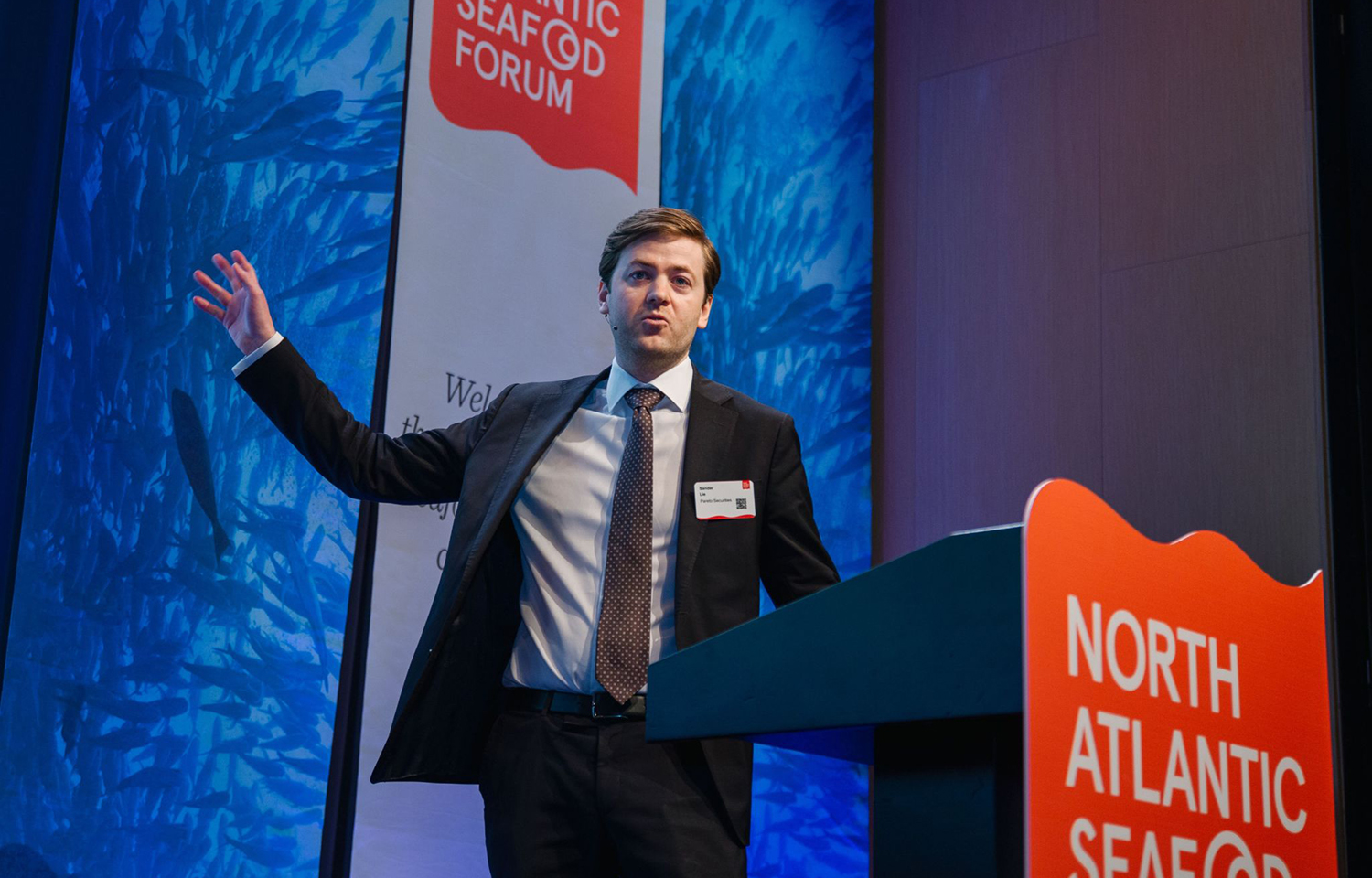
Though 2024 is unlikely to see large spikes in salmon production, an additional 1 million metric tons (MT) of the fish could be produced on an annual basis by 2030, according to Pareto Securities Analyst Sander Lie.
Speaking at the 2024 North Atlantic Seafood Forum (NASF) in Bergen, Norway, Lie said new technology will play an increasingly important role in achieving that production benchmark, citing “quite significant growth” likely to come from land-based farms and closed cages in the sea.
New technology will help the industry reach new heights, but Lie said conventional farming will continue to be the industry’s main driver for the time being.
“You’ll get the game-changing volumes from the new technologies that come after 2030,” he said.
For the near future, Lie said the current supply situation looks tight and that in Norway, biological issues remain “very high on the agenda,” with sea lice, anemia, winter wounds, and string jellyfish challenging several farming regions in 2023 and early 2024. This has affected average harvest weights, and when combined with the latest biomass data points, Pareto’s previous projection of 4 percent Norwegian salmon volume growth in 2024 is “a bit optimistic,” Lie conceded. However, Pareto maintains the opinion that farming conditions will improve this year and beyond and that some new licenses will be awarded.
Elsewhere, the Chilean market is looking at even worse growth projections, Lie said. In January, the South American country’s salmon biomass was down 7 percent year over year, with a lot of the fish now being harvested to minimize farming risks associated with the summer season.
“[Chile] actually entered the new year with the lowest biomass seen in several years,” he said. “On top of this, in the short term, temperatures are increasing as it moves into the summer season, and across some of the key farming regions in Chile, the temperatures are at the higher end of historical levels, which might put further pressure on the biology where we’ve already seen some algae blooms already.”
Pareto is predicting a 1 percent salmon volume decrease in Chile in 2024, which Lie said is probably also optimistic.
Overall, Pareto is forecasting the global salmon farming industry’s compound annual growth rate (CAGR) will be 4.5 percent over the next few years.
To get from 2023's farmed salmon global harvest of 2.8 million MT to 2030’s estimated 3.86 million MT will require investments of at least NOK 250 billion (USD 23.5 billion, EUR 21.6 billion), Lie said.
“[Experts] are solving a lot of the issues that we see in the sea from both an environmental and also biological perspective, but as of now, it's still quite capital intensive to grow, and the game-changing volumes still lie a bit further further ahead. With this backdrop – from a supply perspective – the market is looking tighter and tighter,” Lie said.
Tight supply has driven up salmon spot prices to historically high levels, but beyond this year, Lie anticipates prices will average between NOK 92 and NOK 93 (USD 8.64 to USD 8.74, EUR 7.96 to USD 8.04) per kilogram over the next few years, which would mark a “very strong spot price environment.”
“What this boils down to is higher earnings for the salmon farmers,” he said.
Despite its challenges, Lie said salmon farming remains a good sector to be in, especially as the impact of Norway’s recently imposed aquaculture tax has been clarified. But foreign capital is still not yet recommitted to the sector, Lie warned.
“You see that quite clearly across the Norwegian names, such as Mowi, Leroy, SalMar, and Grieg – the foreign ownership shares, pre-taxes versus post-taxes, are down,” he said. “We believe this will improve moving forward and might also lead to another uplift in the sector, as we get more color on how the tax works through the P&L of the Norwegian names. But, in general, we see an upside across several of the names.”
