


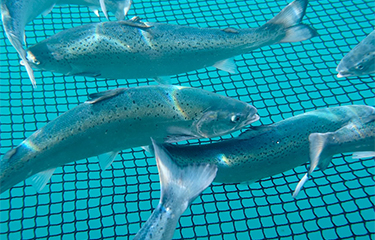
Despite government reports confirming high farmed salmon harvests of over 169,000 metric tons (MT) last year and a projected total for 2023 just shy of 188,000 MT, Scottish salmon production still has its challenges, and the industry is continuing to battle obstacles like small harvesting size, sea lice, and microscopic jellyfish blooms that have posed significant problems for farmers.
Sea lice is a well-known parasitic scourge of the industry, costing producers in Scotland around GBP 40 million (USD 48.8 million, EUR 46.3 million) annually.
More recently, though, microscopic jellyfish have become a competitively serious issue, and this year, higher-than-average seawater temperatures have exacerbated the threat of such blooms.
Fish breathe in the jellyfish, which sting their gills and reduce their capacity to breathe properly. These blooms were a major contributing factor for 2.8 million salmon deaths that occurred in September 2022 – the worst month for fish mortalities since farmers began publishing mortality statistics in January 2018. Those mortalities amounted to 4.6 percent of salmon farmed in Scotland that month.
Historically, September survival rates typically drop to their lowest annual level because this is when seawater temperatures peak, and this year has seen record temperatures, partly due to the El Niño weather-warming phenomenon. These high temperatures contribute to an increase in naturally occurring organisms, which can reduce oxygen levels and also compromise the health of the salmon in areas such as the west coast of Scotland.
Luckily, the latest figures on Scottish salmon survival rates show the sector has made progress in managing environmental challenges. Preliminary data for September 2023 indicates that survival was above 96.5 percent – up on the 95.3 percent recorded in September 2022.
According to industry body Salmon Scotland, the improvement comes after farmers adopted several mitigation measures to further boost fish welfare amid climate change.
These include aeration and oxygenation of the water, feeding strategies that minimize the time salmon spend near the water surface where they are more likely to come into contact with jellyfish or algal blooms, bubble curtains that use air to create a barrier that prevents jellyfish and algal blooms from entering salmon pens, and relocating salmon to safer areas when the presence of micro-jellyfish is anticipated or detected.
Other strategies include putting larger fish to sea, which reduces the amount of time salmon spend in seawater to just one summer; using offshore and semi-closed containment during the marine phase to separate salmon from naturally occurring organisms; and broodstock development to breed more climate-resilient salmon.
As a result of these measures, farmers have moved millions of salmon out of harm’s way this year and lessened the damage that an El Niño weather pattern would typically bring.
Salmon Scotland also stated that this year’s high seawater temperatures are not likely to last and should return to average levels in 2024. It explained the sector is constantly innovating to overcome challenges and has been investigating and deploying a range of short-, medium-, and long-term solutions to maximize fish survival.
“There is no question that 2023 has been a challenging year, but the ongoing hard work by our farmers has provided good conditions for their salmon, despite record-breaking seawater temperatures here in the U.K. and globally,” Salmon Scotland Head of Technical Iain Berrill said. “However, while there is always a level of fallen stock in any farming operation, the numbers this year are not where any farmer would want them to be. It is utterly devastating to the farmers caring for those animals when any fish are lost.”
The essential industry’s ability to address the environmental challenges facing its fish while they spend up to two years in the sea has improved, and it has a “track record” of being proactive and constantly adapting to environmental challenges; however, the industry can’t sit back after implementing these measures, as there’s always more that it can do to further improve survival, Berrill added.
Photo courtesy of Salmon Scotland
