




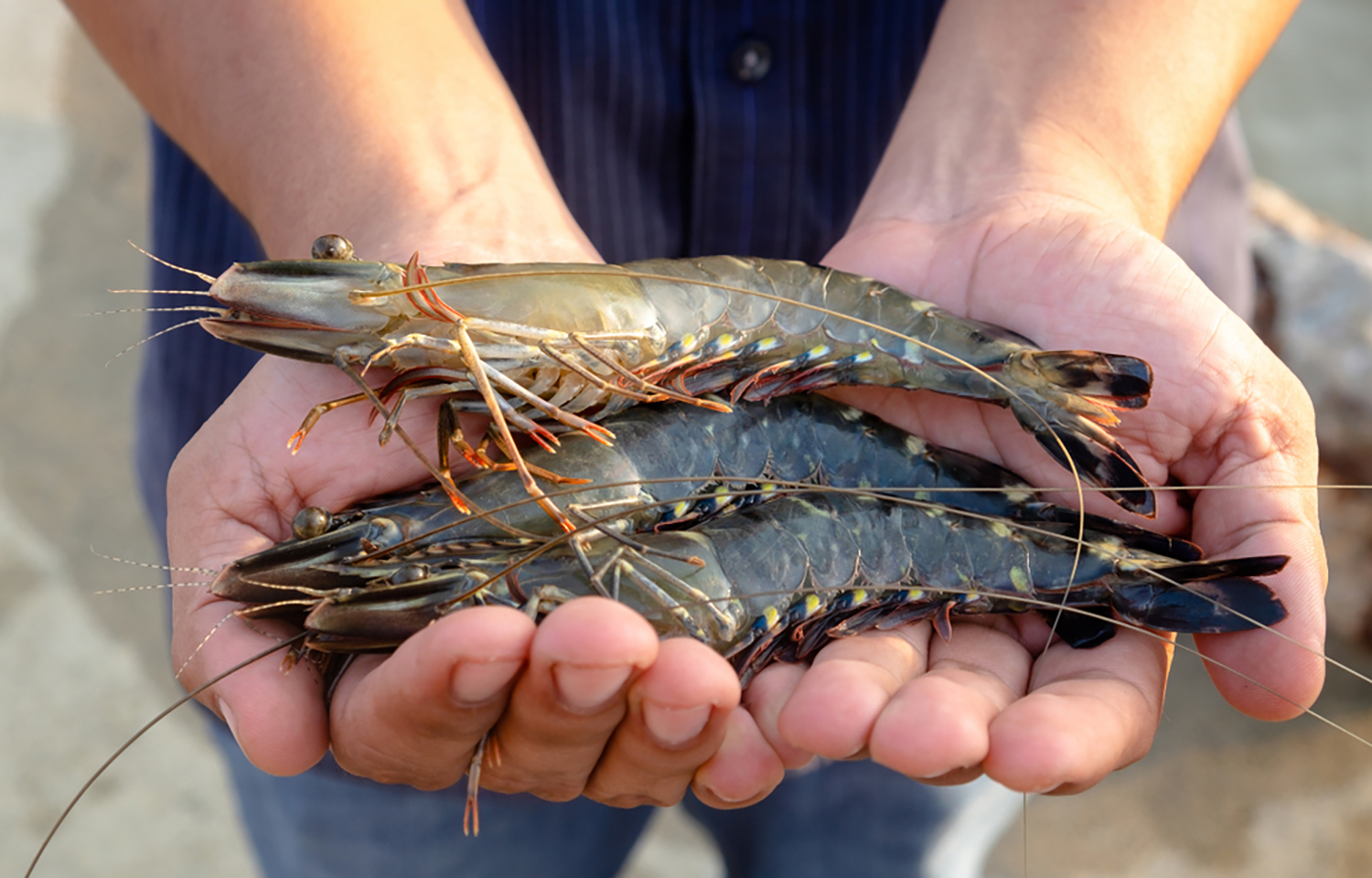
With farmgate prices for whiteleg shrimp (Litopenaeus vannamei) decreasing and production costs rising, black tiger shrimp (Penaeus monodon) farming is making a strong comeback, according to Kontali Shrimp Analyst Ida Seljevoll Skancke.
Black tiger shrimp is the second-most cultured shrimp species in the world after whiteleg, or vannamei shrimp, but until 2002, it was the dominant species of farmed shrimp. Disease challenges and the introduction of specific pathogen-free vannamei, though, led many farmers to switch to vannamei.
Now, those trends are flipping yet again as many farmers are finding it too difficult to make money farming vannamei, Skancke said during the recent Kontali webinar, “Seafood Explained: Unlocking Monodon Insights, a Deep Dive with Experts.”
There’s been increasing evidence of monodon’s return in recent years, including a rise in companies entering the broodstock market, she said. As a result, post-larvae (PL) prices should come down from around May 2024 onward, alongside greater availability of healthy stocks.
“There’s definitely some good reasons for farmers to go back to monodon,” she said.
Skancke while vannamei farming has been a “huge success” story, its rapid growth has created instability between current supply and demand. This has, in turn, driven down farmgate prices over the past few years.
“Higher prices for monodon and a lot of genetic improvements have led to a renewed interest, with an increase in production – from 500,000 metric tons [MT] in 2018 to just about 600,000 MT in 2023,” she said.
Kontali’s has found many of the larger shrimp-producing countries have remained stable in their monodon volumes in recent times, but there have been particular production increases in China and India, with India having grown its output by more than 60 percent since 2020. Between 2022 and 2023 alone, India grew its monodon production by more than 25 percent, Skancke said.
Manoj Sharma, the managing director of Indian aquaculture firm Mayank Aquaculture, said between 1988 and 2009, India was an “out-and-out” monodon-producing country, with a lot of freshwater fish producers converting to the species. But lack of high-quality broodstock precipitated the switch over to vannamei, he said.
“Shifting from monodon to vannamei was very easy because the monodon was a low-stocking model, the number of ponds were getting fewer, and the production in India was hardly 75,000 to 80,000 MT … so the vannamei came and there was a ‘vannamei tsunami;’ everything was suitable [for monodon production], so within six or seven years, India has reached almost 1 million MT,” Sharma said. “But now, comparing vannamei and monodon is like comparing day and night because the growth pattern is different, and the culture pattern is different. For example, vannamei can be at a marketable size in 100 days, but monodon is going to take almost double that.”
Amid India’s “vannamei tsunami,” almost everybody in the supply chain – farmers, feed millers, importers, processors, and more – made “huge money,” Sharma said. Nevertheless, in India in 2017 and 2018, there were a lot of farming bankruptcies due to intense competition. Furthermore, since the Covid-19 pandemic, the sector has seen feed prices go up 25 percent, alongside increased fuel, electricity, and sea freight costs.
“Everything has gone up, but on the other hand, the farmgate realization has dropped by 25 to 30 percent,” Sharma said. “It has become very difficult for farmers to survive. That’s why a lot of farmers aren’t doing very well … and when the profitability becomes almost nil, they look to switch back to monodon because of profits. Farmers are not making money in vannamei.”
India is already producing 50,000 MT of monodon, and Sharma said he would not be surprised to see a jump in annual production to between 100,000 MT and 150,000 MT in the near future.
Regarding sales trends, Skancke said most of the black tiger shrimp produced recently has stayed in domestic markets, but there’s been growing demand from the E.U. over the past few years, particularly in Belgium, the Netherlands, Germany, and France. The volume of black tiger shrimp exported into the E.U. increased from approximately 15,000 MT in 2019 to almost 32,000 MT in 2023.
“This shift is inevitable. Farmers will definitely shift to monodon,” Sharma said. “But, as a senior farmer and an experienced person, I would urge them not to rush and convert over to monodon too quickly because there is a limitation in the market.”
Sharma said while it was easy for farmers to switch from monodon to vannamei, going back to monodon production will bring bigger challenges. Farmers should, therefore be pragmatic in their decision-making and factor in the demands of the market, Sharma said.
“As a farmer, I appeal to all farmers to work for profitability. If vannamei is profitable, we should still continue and not be in any rush to covert largely to monodon. Farmers should not be species-specific; they should be profit-specific,” Sharma said.
According to Skancke, Kontali doesn’t expect rapid growth of monodon production until after 2024.
“We think it’s going to grow in India, for instance, and maybe also China, but we expect many of the other larger producing countries to be stable in production volume," Skancke said. "It also remains to be seen if the growth will come from more farmers farming monodon or improved efficiency among those already producing it."
