


The government of India, the world’s third-largest fish producer, second-largest aquaculture producer, and fourth-largest seafood exporter, has plans to become an even bigger seafood player.
India's seafood exports have been on an upward trajectory, with a compound annual growth rate (CAGR) of 17.2 percent between 2016 and 2021. Its export value more than doubled to USD 6.68 billion (EUR 6.3 billion) in fiscal year 2020-2021, from USD 2.9 billion (EUR 2.7 billion) in 2010. For the fiscal year 2022 India is expected to reach USD 8 billion (EUR 7.6 billion) in total seafood exports, despite the impact of inflation depressing global demand, harming India’s seafood sector, and forcing the Indian government to lower its previous export target of USD 8.8 billion (EUR 8.3 billion).
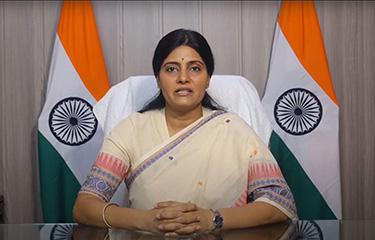
At the India International Seafood Show 2023 in Kolkata in mid-February, India Minister of State for Commerce and Industry Anupriya Patel announced an ambitious plan to push the country’s seafood exports beyond USD 14 billion (EUR 13.2 billion) by 2025. In the fiscal year ending 31 March, 2022, the country hit an all-time high in seafood-export value and volume, at USD 7.76 million (EUR 7.3 billion) and 1.36 million metric tons (MT), respectively.
India’s seafood export strategy will focus on the U.S. market, according to Patel.
“We are making moves to regain our seafood market-share in America. The government is moving fast in the right direction,” she said.
Beginning 1 April, the Indian government will allocate USD 271.7 million (EUR 256.5 million) to its Department of Fisheries, a 38.4 percent year-on-year increase. In addition, the fishery sector will also be allocated USD 725 million (EUR 684.4 million) through newly established Pradhan Mantri Matsya Kisan Samridhi Sah-Yojana (PM-MKSSY), a sub-scheme of the Pradhan Mantri Matsya Sampada Yojana (PMMSY) program, which was established in 2020 and has provided USD 2.4 billion (EUR 2.3 billion) to promote sustainable and responsible development of India’s fisheries sector.
Additionally, the Indian government moved to reduce aquafeed import duties, with taxes on for fishmeal and vitamin premixes trimmed from 15 percent to 5 percent and taxes on fish oil and algal prime reduced from 30 percent to 15 percent. And the government has extended its export-promotion scheme, the Remission of Duties and Taxes on Exported Products (RoDTEP), which ensures that exporters receive a refund on some taxes and duties.
India’s seafood promotion programs are also getting a boost through the establishment of a central quarantine facility in Chennai to ensure shrimp shipments from the country are pathogen-free. The country's Marine Products Export Development Authority (MPEDA) research unit, the Rajiv Gandhi Centre for Aquaculture, will also receive funding for a black tiger shrimp Broodstock multiplication center pilot in Visakhapatnam.
Additionally, in conjunction with India’s G-20 this year, it will be organizing a conference aimed at harmonizing regulations for seafood trading in the second half of 2023, a seafood-themed event for ambassadors from the world’s top 20 markets for marine products, and a conference focused on improving trade regulations and export prospects for India’s shrimp industry.
And as a supplement to the importance of its attendance at global seafood trade shows, MPEDA has arranged approximately 40 virtual buyer-seller meetings with key trading partners including Japan, China, Russia, the U.K., Vietnam, Germany, Malaysia, South Korea, Oman, Singapore, and Spain.
Chennai-based aquatech firm Aquaconnect Founder and CEO Rajamanohar Somasundaram said with strategic planning, an increased focus on value-added products, sustainable production, infrastructure and technology investments, and coordination on market access and promotion, India can continue its upward trajectory.
“It is important to approach the goal of doubling seafood exports by 2025 with cautious optimism, as the seafood industry can be unpredictable due to factors such as weather patterns and changes in global demand,” Somasundaram told SeafoodSource. “Additionally, ensuring sustainable and responsible production practices while increasing production will be a challenge that requires significant investment and collaboration among stakeholders.”
Other international events are also playing out in India’s favor.
China, ranked only behind the U.S. in its Indian seafood imports, withdrew its suspension of the export permits of 99 Indian seafood-processing and -exporting firms after receiving additional assurances regarding source control. MPEDA Chairman DV Swamy said he expects the move – plus the withdrawal of the suspension of the licenses of an additional 11 Indian seafood exporters earlier in 2023 – to provide a 5 to 10 percent boost to Indian seafood exports in the 2023-2024 fiscal year. Swamy credited efforts from MPEDA, the Indian Export Inspection Council, the Embassy of India in Beijing, and the Indian Department of Commerce, for the Chinese decision.
Separately, on 16 February, Qatar lifted a temporary ban on imports of frozen seafood from India originally imposed in November 2022 ahead of the FIFA World Cup, in response to alleged detection of vibrio in Indian seafood exports. Swamy said Qatar is expected to announce the lifting of a similar ban on Indian chilled seafood soon.
India’s government is also hoping to finalize FTAs with the E.U. and the U.K., and enhance its commercial ties with “friendly” partners, including Russia and Saudi Arabia, according to Seafood Exporters Association of India National President Jagadish Fofandi. And Indian Additional Director-General of Foreign Trade Tapan Mazumder said the government is in discussions with South Korea on an enhanced free-trade agreement, with the second round of talks taking place this month.
Several speakers at the 2023 IISS 2023 event also said India has potential to enlarge its own domestic seafood market, both due to the country’s large population and insulation it would give Indian seafood producers in absorbing global market fluctuations. India's domestic market could potentially absorb almost one-third of its shrimp production, which will help it better deal with stiff international competition, particularly from Ecuador and Indonesia, according to Swamy.
“We are optimistic about achieving new heights through a multipronged strategy hinging on sustainable fishing methods, value-addition, increased aquaculture production through diversification, and aggressively tapping into new markets,” Swamy said.
Photo courtesy of Economic Development Board of Maritius
