






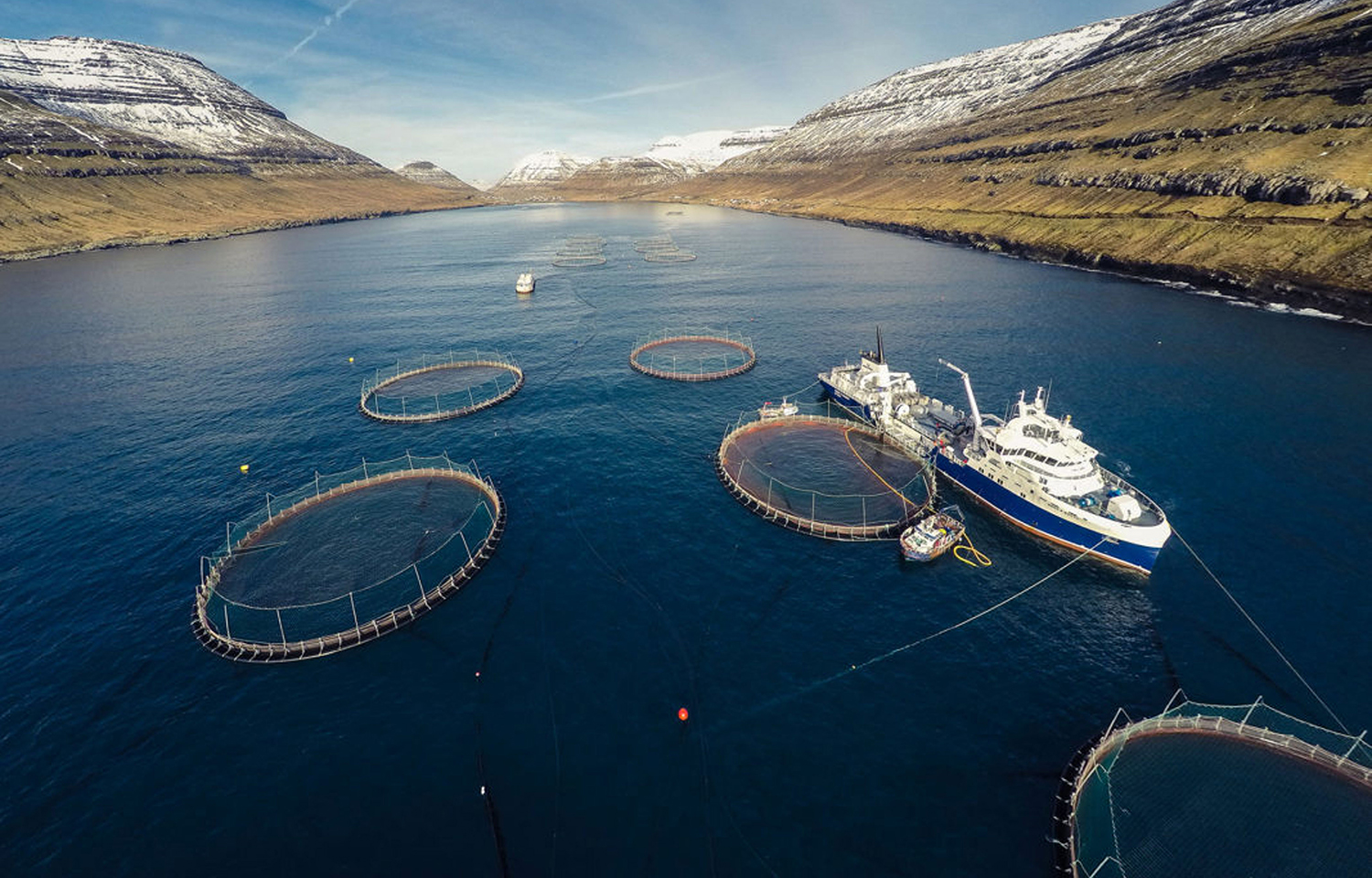
Glyvrar, Faroe Islands-based Bakkafrost Group delayed harvests planned for last year in both the Faroes and Scotland until early 2024, and the company said it hopes improved biological performance elicits a solid – albeit delayed – harvest and turns around what was a disappointing end to 2023.
For FY 2023, the company’s revenues amounted to DKK 7.14 billion (USD 1 billion, EUR 957.8 million), and its operational earnings before interest and taxes (EBIT) totaled DKK 1.5 billion (USD 217.3 million, EUR 201.2 million). Harvests, meanwhile, amounted to 73,006 metric tons (MT) gutted weight.
For the fourth quarter, Bakkafrost revenues totaled DKK 1.56 billion (USD 226 million, EUR 209.3 million), and the company’s operational EBIT amounted to DKK 356 million (USD 51.6 million, EUR 47.8 million). Compared with Bakkafrost’s results posted in the final quarter of 2022, those totals were down 19 percent and 5 percent, respectively.
Bakkafrost’s Farming Faroe Islands (FO) segment delivered quarterly revenues of almost DKK 1.48 billion (USD 214.4 million, EUR 198.5 million) and an operational EBIT of DKK 460 million (USD 66.6 million, EUR 61.7 million), both of which marked year-over-year decreases compared to the DKK 1.64 billion (USD 237.6 million, EUR 220 million) and DKK 525 million (USD 76.1 million, EUR 70.4 million) posted in Q4 2022. It also harvested 16,005 MT of salmon in the quarter – a more than 3,000-MT drop compared to the 19,276 MT harvested in Q4 2022.
The Farming Scotland (SCT) segment’s revenues for the period, meanwhile, fell year over year by DKK 214 million (USD 31 million, EUR 28.7 million), totaling DKK 84 million (USD 12.2 million, EUR 11.3 million). These operations harvested just 1,062 MT of fish, compared to 5,198 MT harvested in Q4 2022.
Delivering the firm’s results in Oslo, Norway, on 20 February, Bakkafrost CEO Regin Jacobsen noted that a heavy FO focus on fish health and welfare has resulted in a strong farming regime. The segment’s average monthly survivability for the full year was 99.39 percent, achieving an average harvest weight of 4.6 kilograms HOG and 90 percent superior grade salmon.
SCT continues to make progress, Jacobsen said, with a monthly survivability of 98.29 percent last year, an average harvest weight of 4.2 kilos, and 89 percent superior grade achieved.
He also confirmed that after a troublesome third quarter that featured biological challenges in Scotland, Q4’s solid biology enabled it to delay harvests in order to grow the fish to larger sizes for harvest in the first half of this year.
Moving forward, Bakkafrost will increasingly use large smolt from its Applecross hatchery over external sources. In 2024, Applecross is expected to supply 9.1 million smolts at 200 to 250 grams, which will make up 98 percent of the planned smolt releases in 2024.
When the Applecross 5 and 6 expansions are completed around the end of 2024, the hatchery will be able to produce smolts for Scotland at around 200 to 300 grams. Some additional broodstock facilities are also being built.
“The focus for Freshwater Scotland now is to produce healthy and robust large smolt and to be self-sufficient with smolt for our operations,” Jacobsen said.
To reduce biological risks, all smolts are being vaccinated and are timed so that they spend only one summer in the sea, he added.
At the same time, some farming sites may not be restocked until the company mitigates risks. The company said it expects this approach will reduce at-risk biomass in the third quarter, and result in around 70 percent of the planned 2024 volume being harvested in the first half of the year.
In the Faroes, Bakkafrost’s Norðtoftir, Glyvradal, and Viðareiði hatcheries have been expanded, with a capacity increase of over 50 percent. Additionally, in Q4 2023, Bakkafrost signed a contract to build a new hatchery in Skálavík, which will increase production capacity by around 7 million smolt at 500 grams.
Construction of this facility has just started, Jacobsen said, but when it’s finished in late 2026 – if all goes to plan – the annual smolt production capacity in the Faroe Islands will be 24 million smolts.
Bakkafrost has forecast a 2024 harvest of 91,000 MT gutted weight, with 66,000 MT coming from the Faroe Islands and 25,000 MT from Scotland.
“Fifty-two percent of this will be delivered in the first half of 2024, which is a bit different than we have done previously,” Jacobsen said. “We have many more large fish in the water at the moment, and this should be harvested in the first half.”
With ambition to grow its fish larger than before, Bakkafrost has forecast a smolt release in the Faroe Islands of around 17.8 million large smolts in 2024. In Scotland, the smolt release in 2024 is expected to be around 9.3 million, with an average weight over 200 grams.
The group has a longer-term harvest target to reach 165,000 MT by 2028.
“We are ramping up our volume,” Jacobsen said.
The fourth-quarter 2023 report also confirmed another period of strong performance from the Fishmeal, Oil, and Feed (FOF) segment, with its revenues increasing 22 percent to DKK 965.9 million (USD 139.9 million, EUR 129.6 million) and its earnings before interest, taxes, depreciation and amortization (EBITDA) climbing 121 percent to DKK 245.2 million (USD 35.5 million, EUR 32.9 million).
FOF produced 13,328 MT of fishmeal in Q4 2023, and 4,838 MT of fish oil.
