



Samuels Seafood has been involved in the seafood industry for over 100 years – and it’s all thanks to love.
In 1919, shoemaker Giuseppe Ippolito traveled to the U.S. and fell in love with the daughter of Gaetano Darigo. Darigo was a fisherman in Sicily and traveled to the U.S. to continue his trade and sell fish. He gave Ippolito an ultimatum: To marry his daughter, he’d have to get into the fish business.
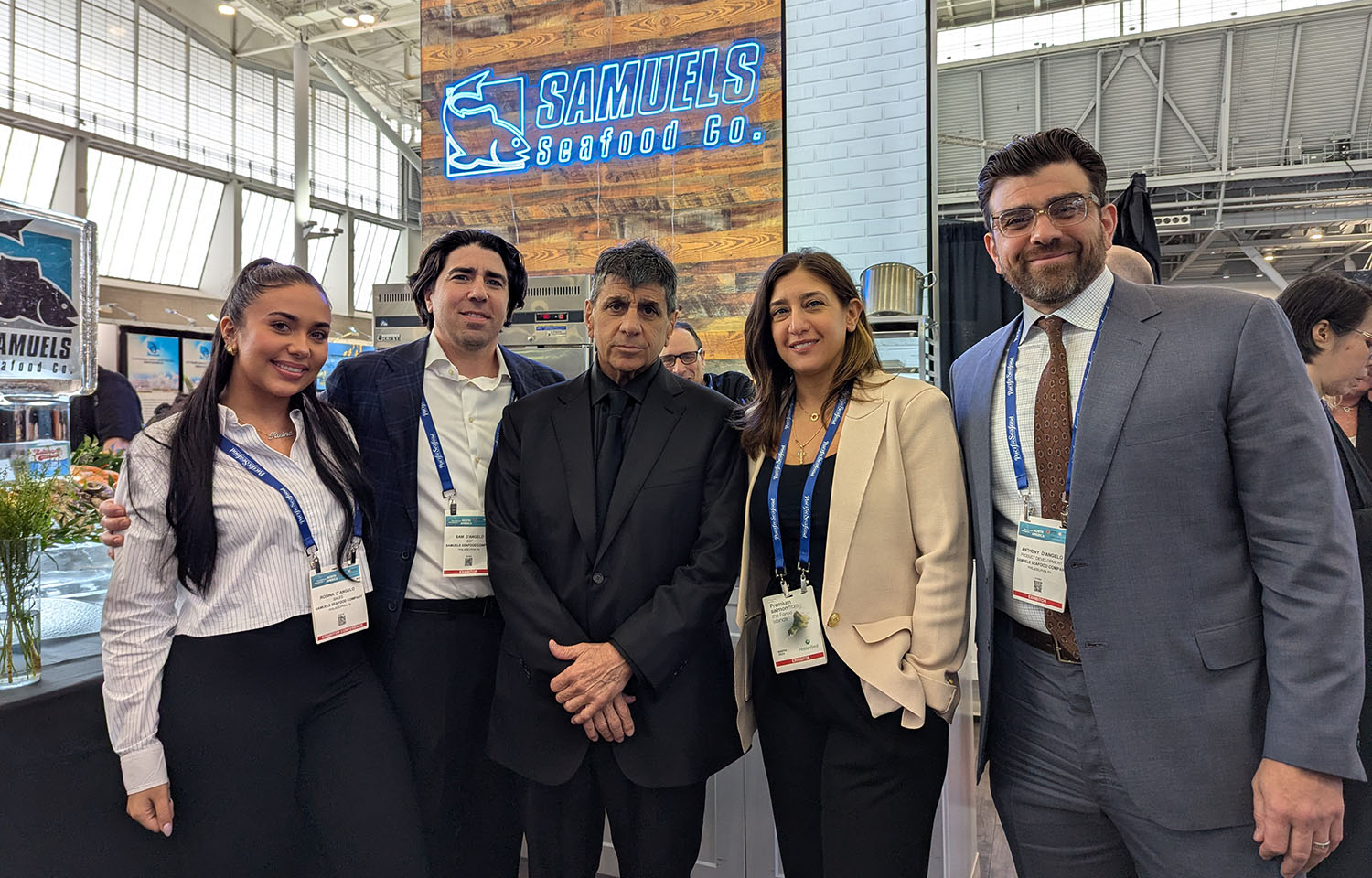
Over 100 years later, that original foray into the fish business has now become Samuels Seafood, Anthony D’Angelo, who currently works in product development for the company, told SeafoodSource.
Ippolito followed through on Darigo’s request and started selling fish in the streets of Philadelphia, Pennsylvania, U.S.A., using a pushcart. Business continued to grow until he upsized to a horse and wagon and eventually to a brick-and-mortar location in the early 1940s that he named Ippolito’s.
“He got his son to go out with the horse and wagon, and then at the time, his son-in-law – my grandfather – would go out with another horse and wagon setup,” Anthony said.
Decades later, in the 1970s, D’Angelo’s great-grandfather Gaetano Darigo moved back to Sicily and was planning to close up the seafood shop. Samuel D’Angelo – Anthony’s father – had worked in the shop as a child with his own father, also named Samuel, and decided to keep the seafood business going.
“My father was at Temple University for about six or seven months and said, ‘I hate school. I’ll go take over the business,’” Anthony said. “He bought it for a very small amount of money and took over the store.”
Samuel later got married, had his son Anthony, and started to push the business into becoming more than just a seafood store.
The business had an advantage early on, once again thanks to a relationship.
Samuel was friends with a waiter at the Four Seasons Hotel in Philadelphia, who happened to live near the store. At one point, the chef of the Four Seasons’ restaurant needed something on short notice, and they called up what was then still called Ippolito’s for help.
“My father got the stuff he needed and brought it up to the Four Seasons and started selling to restaurants,” Anthony said. “It just kind of took off. The service we have at the retail level, the chefs weren’t used to that. There were no real delivery services at that point; all the chefs would shop the market.”
When a stall opened up in that market, Samuel took a chance and decided to open his own spot.
“My father said, ‘Let me open up a stall, but I don’t want to ruin the family name Ippolito’s.’ At the time, that was a popular fish store in South Philadelphia, so he used his first name Sam to open up Samuels and Son,” Anthony said. “It was Samuels because it was my grandfather Sam, my father Sam, my brother Sam, and the son – me. That’s where the business started in 1989, and it’s been a wild ride ever since!”
Over three decades later, Samuels Seafood is still a family affair. All four of Samuel’s children still work for the company, and Anthony said that their kids are now getting involved, too.
Anthony said he thinks the long-time lack of real industry consolidation – such as in the chicken industry – is part of why family businesses like Samuels Seafood can continue to thrive. That is also, in part, thanks to the inherent volatility of wild-caught seafood. Though farmed seafood is starting to change that, and the industry is beginning to consolidate, family-owned businesses are also still sticking it out because trends have shifted.
“I think when the consolidation started, there was also a trend of family businesses sticking it out, where that wasn’t happening 15 years ago. When I was a kid, everybody laughed and said, ‘Why do you want to be in your father’s business?’” Anthony said. “When he [Samuel] did it, for sure everyone was laughing.”
Another reason the family business has worked for so long is the passion the family has for the business, Anthony said.
“We’re all in the building every day loading trucks. Last week, I was in Florida working overnight with my staff, loading trucks and working in the cutting room,” Anthony said. “My father still buys a lot of the frozen products.”
That intensity can be intimidating for some, but it’s a part of the core philosophy of how Samuels Seafood conducts business and why it’s succesful.
“We’re not looking at spreadsheets every day and saying, ‘You’ve got to get your margin up half a point, or we have a problem. We don’t do business that way; we don’t do business on the bottom line,” Anthony said. “We know the needs of the industry, and we know what we’re good at. We know where to find other people who are good at something if we’re not good at it.”
That philosophy applies both in business relationships and in relationships with the customers.
“If you’re a regular consumer walking into the retail store, the most important piece of advice I’d say to you is find a fishmonger you can trust. Because it’s not about price; it’s not about variety. It’s about going somewhere and the monger saying, ‘This came out of the water on Thursday. This is a great product out of Norway,’” Anthony said. “If you don’t have that relationship with your fishmonger, you’re going to the wrong fish store. I think that applies whether we’re talking about a chef, we’re talking about a cruise line, or we’re talking about a hotel chain.”
From those early days of selling from a pushcart in Philadelphia, Samuels has grown into a cross-continental business with facilities on both the West and East coasts of the U.S. It provides seafood for cruise lines, restaurants, and retail in frozen and fresh formats.
As the business continues past its 100-year anniversary, it’s planning to make sure it maintains its roots and reopen the original store in Philadelphia that started it all.
“My father’s main reason for opening that store? He wants the grandkids to all work in there together,” Anthony said. “It’s not profit-driven. Because he grew up in that store, his mom grew up in that store, we grew up in that store, and he wants the grandkids to grow up in that store.”
