




At the June meeting of the North Pacific Fishery Management Council (NPFMC), council members made a motion to continue research on the effects of midwater trawling in Alaska but failed to take concrete action on the matter, despite public pressure.
According to documents from the meeting, the reason the council gave for not reducing bottom contact in pelagic trawl gear fisheries is due to a lack of data “regarding the magnitude of unobserved crab mortality from interactions with pelagic trawl gear.” The council has previously stated that reducing bottom contact is a goal in the Bering Sea and Gulf of Alaska, where nonpelagic trawl gear is already banned.
In addition to asking for more research, NPFMC said it is “considering additional regulatory measures and intends to work with the pollock industry on adaptive approaches that focus on reducing uncertainty as well as incentivizing gear modifications.”
Before the meeting, Anchorage, Alaska, U.S.A.-based SalmonState encouraged NPFMC to take action on "closing a notorious loophole” that allows midwater trawlers to drag the ocean floor in protected areas. SalmonState said that in the Bering Sea, 40 percent of all bottom contact by fishing operations is from midwater trawlers.
“No one should be allowed to drag the ocean floor in protected, sensitive areas closed to that practice. It’s far past time to close this colossal loophole,” SalmonState Executive Director Tim Bristol said in a release.
SalmonState added in the release that the majority of trawling in Alaska happens 3 to 200 miles offshore, which falls under the discretion of NOAA and not the state of Alaska, with NOAA taking recommendations from NPFMC in its decision-making process. SalmonState claimed that “the majority of voting members on the council are tied, economically, to the trawl fleet” and the majority of trawlers do not come from Alaska.
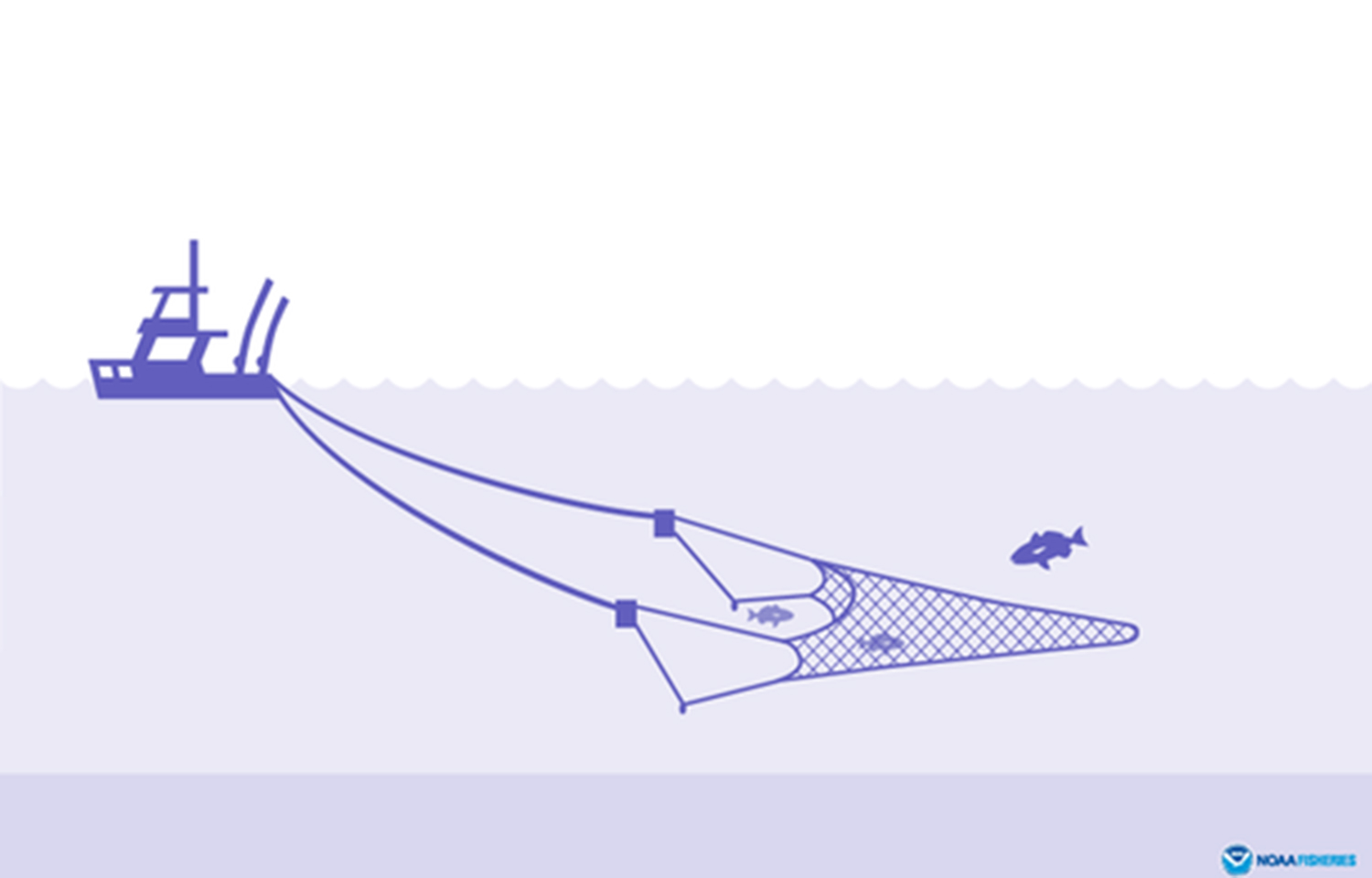
“The term ‘pelagic’ refers to marine ecosystems not near the coast or seafloor. Pelagic or 'midwater' trawling needs to stay off the bottom of the ocean,” SalmonState Operations Director Ryan Astalos said in a release. “If ‘midwater’ draggers can’t uphold this basic definition, the NPFMC needs to manage them as bottom trawlers.”
Washington, D.C., U.S.A.-based conservation nonprofit Ocean Conservancy spoke out against the NPFMC’s lack of regulation after the meeting, saying the motion for a discussion paper and further research “includes no enforceable standard” and “relies on a highly uncertain output from a single model to claim that habitat is not meaningfully damaged by trawl nets.”
Both SalmonState and Ocean Conservancy said the size of midwater trawlers, often “wider than a football field” with weighted chains stretching up to a quarter of a mile, cause environmental destruction.
“There are a lot of complicated issues before the council, but this is not one of them,” Ocean Conservancy Fisheries Scientist Megan Williams said in the release. “Huge nets and heavy chains should not be allowed on the seafloor in protected areas where bottom trawling is prohibited. It’s that simple. Bottom trawling has long been recognized as one the most harmful forms of fishing, and these areas were protected from that for important reasons. The idea that trawling on sensitive corals and sea whips with a heavy chain won’t damage them goes against both common sense and global science.”
Meanwhile, SalmonState said that “commercial, sport, subsistence, personal use, and charter fisheries across Alaska” face shutdowns and restrictions, but the same rules do not apply for out-of-state trawlers entering Alaska’s waters.
Next steps for NPFMC include a discussion paper to build on previous trawling research, “identifying options for viable and enforceable mechanisms to reduce bottom contact.” Goals for the discussion paper include research on a “maximum bottom contact rate’s feasibility” for vessels in the Bering Sea, possibilities for implementing a swept-area cap in the Bering Sea, and verifying pelagic trawl gear modifications, technologies, and operational standards.
