






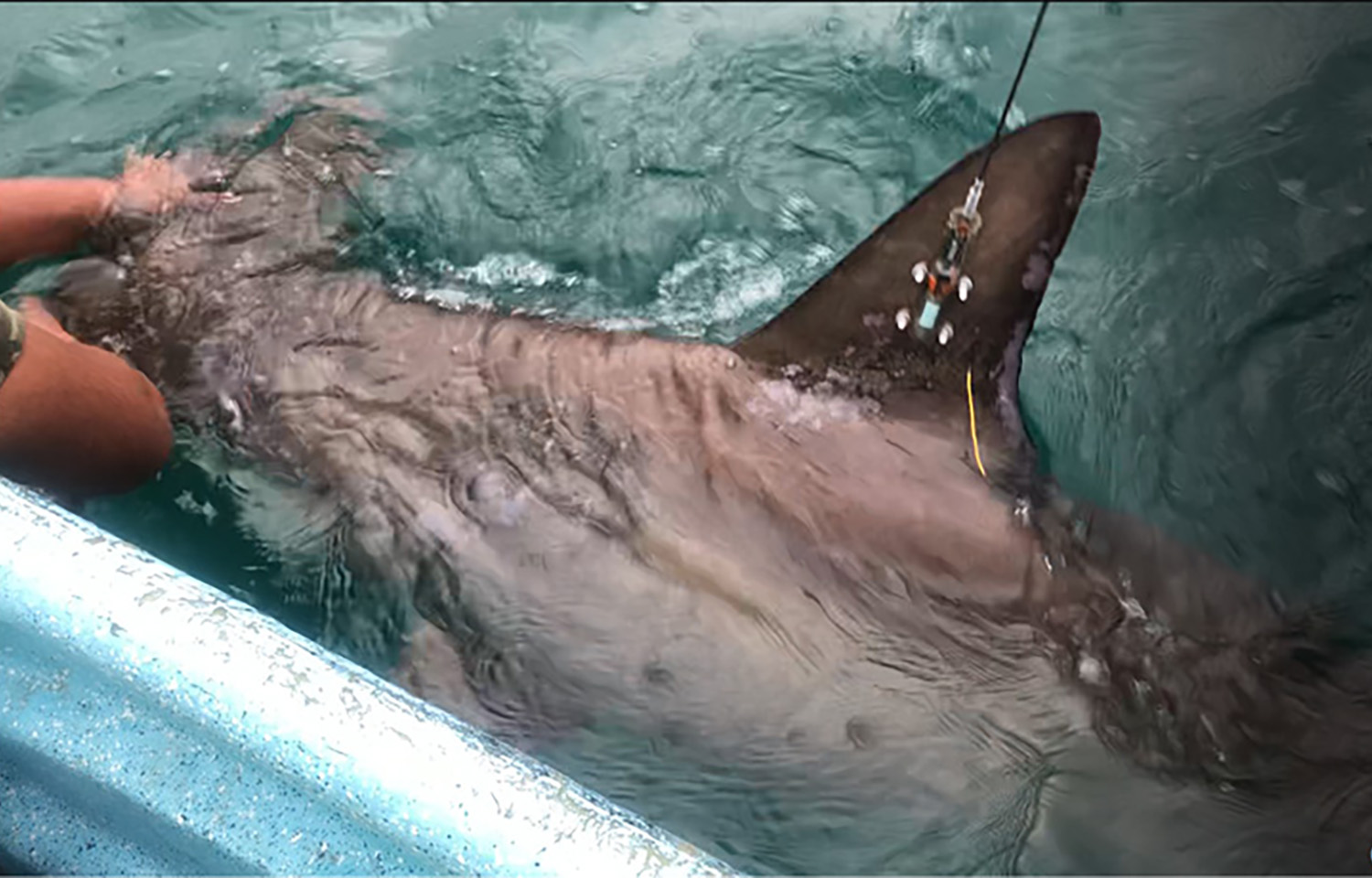
New research by Panama City, Panama-based Twin Oceans Research (TOR) has documented an endangered scalloped hammerhead shark’s migration from Panama to the Galápagos Islands for the first time.
The landmark finding, discovered via satellite documentation during three years of research funded by The Center For Responsible Seafood (TCRS), finally proves the species migrates between the two locations. Scientists had long believed that the species used Panamanian waters as a birthing ground before migrating to the Galápagos through Cocos Ridge and the Galápagos seamounts, but thus far they had not been able to prove this theory.
TOR Research Project manager Mike Bolton called the research “a victory for science, conservation, and Panama’s role in protecting Eastern Pacific shark populations,” and said the team hopes it will influence fishery regulatory policy, contributing to the protection of birthing grounds and migration corridors.
TCRS President George Chamberlain told SeafoodSource that TOR first alerted his organization to the overfishing of scalloped hammerheads off the Panama coast, prompting it to commission a review of published scientific literature which revealed a 75 percent decline in the population in the Eastern Tropical Pacific.
The review "also indicated that artisanal fishing of newborn and juvenile sharks in mangrove nursery areas was a primary contributor, but the connection between nursery populations in coastal mangroves and congregations of adult hammerhead sharks around oceanic islands and sea mounts was poorly understood," he said.
TOR's work, Chamberlain said, confirms the migratory connection between coastal nurseries and declining oceanic congregations, emphasizing "the urgent need for greater fishing protection of newborn and juvenile hammerhead sharks in nurseries."
Scalloped hammerhead sharks are, according to the Consortium for Wildlife Bycatch Reduction, threatened by fishers who target them for their highly prized fins, and by bycatch from fishing vessels working with longlines, trawls, purse seines, and gillnets. The species is listed under Appendix II of the Convention on International Trade in Endangered Species of Wild Fauna and Flora (CITES), marking it as likely to become threatened if trade is not controlled, and the shark is also listed as endangered by a number of countries, including Panama.
The path to acquiring the migration data was anything but simple, the research team said in a release about the news.
The bulk of the three years of research were devoted to the process of developing safe, minimally invasive capture and tagging procedures, testing various baits, and developing a community of volunteers – drawn from Shark Defenders Panama – to support the project.
In a report about the findings, TOR said that the years of trial and error did produce some useful results, including a more in-depth understanding of juvenile shark behavior. Prior to the study scientists believed shark pups would not travel far from their mothers, but satellite data of tagged juvenile sharks showed this was not always the case.
In May 2025 the team finally successfully satellite-tagged an adult female scalloped hammerhead shark off the coast of Chame, Panama.
The shark, who the team named Shannon Rain, traveled over 1,300 kilometers, ending her migration thirty-eight days later in the northern Galápagos Islands. The satellite transmission showed that she surfaced in predictable patterns in the migration corridor, traveling an average of 2.5 kilometers per hour.
The TOR research team said it believes that the satellite information provided by their study strengthens their long-held theory that members of the species born near Panama are part of a larger migratory population that returns to potential mating sites around Darwin and Wolf Islands in the northern Galápagos.
TOR said that one of its next research goals is to establish exactly when juvenile sharks begin to migrate independently. The researchers also collected DNA samples from adults and juveniles, hoping to track lineage between the individuals.
TOR said that it will continue to pursue research related to shark conservation in Panama, and especially to “filling the information gaps that exist regarding scalloped hammerhead sharks,” and thanked TCRS for its critical support of the project.
