





Since being introduced as a recreational species in the 1960s, invasive blue catfish in the Chesapeake Bay have come to dominate the local ecosystem, driving out other species and swelling to an estimated population of around 100 million.
Efforts to control the issue have included grant funding to improve processing capacity, legislation aimed at making it easier to operate a commercial fishery for blue catfish, government-backed pilot programs to stop the spread of the species, and attempts to promote its use in pet food.
With the population showing no signs of slowing, however, efforts are continuing to expand, including outside of the U.S.
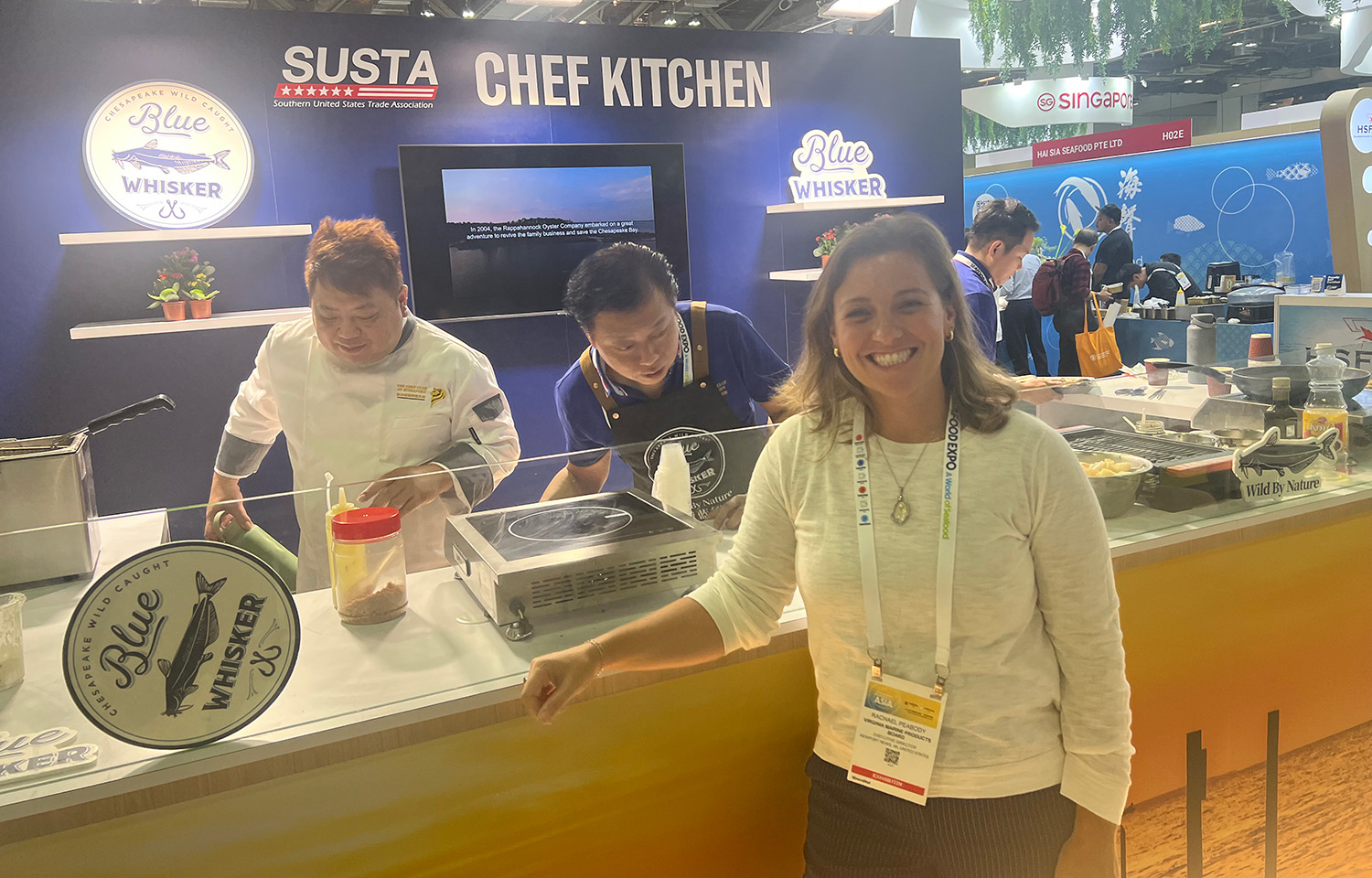
Led by the Southern United States Trade Association (SUSTA), the fish is being marketed in Southeast Asia as Blue Whisker.
“We see Asia as a growing market that’s really interested in high-value, nutritional, and ecological seafood,” Rachael Peabody, the executive director of the Virginia Marine Products Board, told SeafoodSource at the 2026 Seafood Expo Asia (SEA). “We’ve been speaking with Singapore, and Vietnam has been interested, too.”
Peabody explained that the marketing term Blue Whisker was rolled out last year and aims to differentiate blue catfish from other species like pangasius that are already present in the market, emphasizing the fact it represents a premium offering compared to locally produced aquaculture products.
“We’re trying to differentiate ourselves considerably. We feel the value we can offer is higher than a farmed catfish, and that’s why we’ve remarketed it as Blue Whisker so it’s not something compared to other catfish,” Peabody said. “We have chefs here [at SEA] who are showing that once you try it, you’ll know this is not the catfish you’re getting from farms.”
Another goal of the marketing effort is to highlight the ecological benefit of eating blue catfish to customers.
“If price is the only consideration of the buyer, we’ll be outcompeted, but if they’re looking for something that has an ecological story and a better taste profile, we might have a chance to [gain market share],” Peabody said.
The campaign also aims to align with food trends playing out in the region. Through a collaboration with the Virginia Seafood Agricultural Research and Extension Center, operated by Virginia Tech University, blue catfish stakeholders have gained a better understanding of Southeast Asian consumption trends, which include consumers preferring fried and spicy preparations of the fish.
“[Virginia Tech] is fully in. They’re looking at all aspects of how we do valuation, taste profiles, and where there are other opportunities,” Peabody said.
The export push comes as fishing effort for blue catfish is ramping up in the Chesapeake Bay.
Harvests currently total around 4 million to 5 million pounds per year, but according to Peabody, plans are in place for an increase to around 8 million to 9 million pounds per year, with export opportunities, among other efforts, making those types of harvest numbers possible.
“We’re not going to be able to get rid of it, but we’re trying to get it to a more sustainable place, as in we fish it until it’s not outcompeting [other species]. The goal is to try to make it a more natural part of the ecosystem,” she said.
