





New research suggestst that good gut health could be the key to keeping shrimp healthy and enabling them to grow faster.
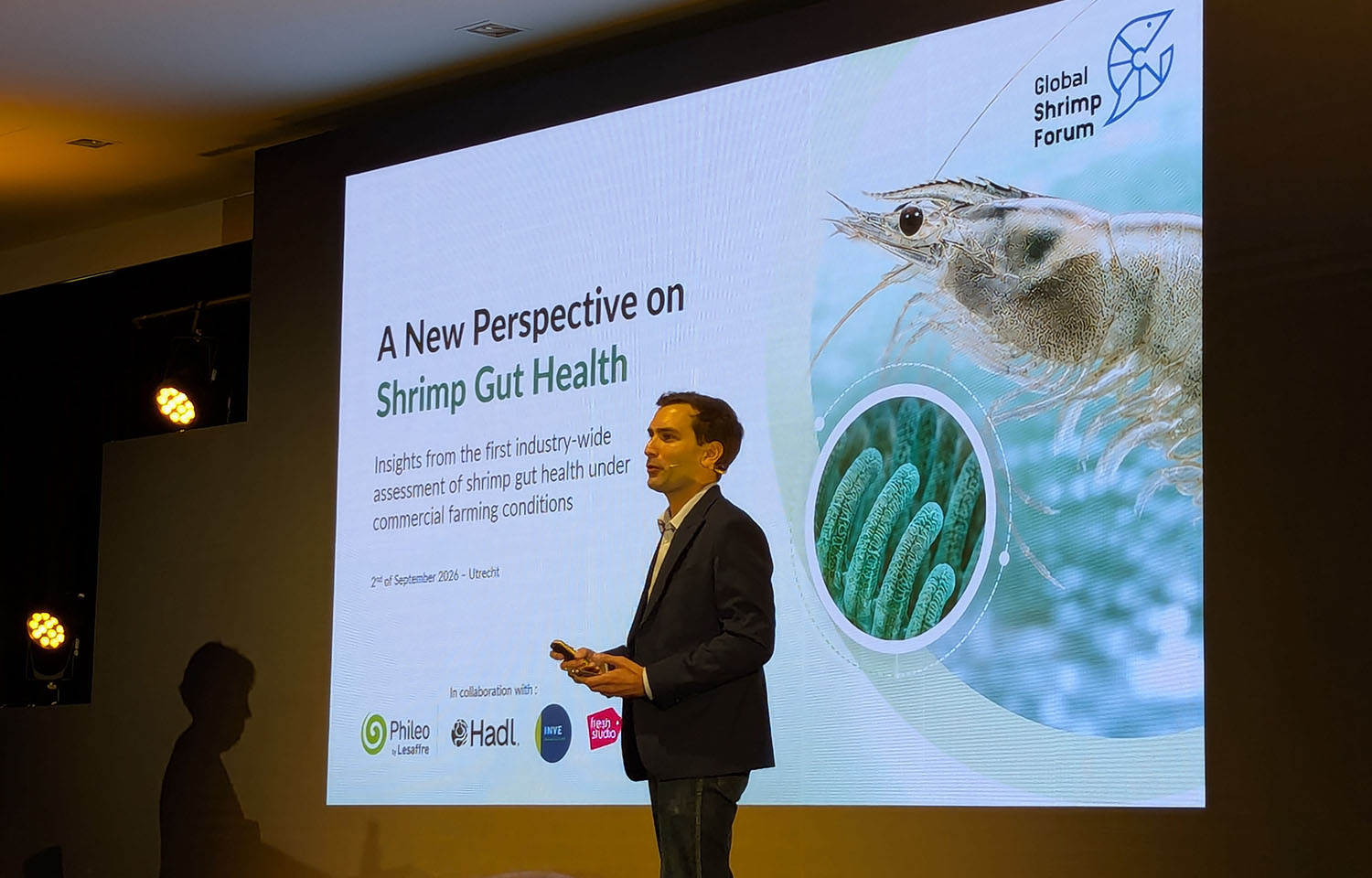
Jean-Benoit Darodes de Tailly, the global business developer for shrimp at French animal biotechnology solutions firm Phileo by Lesaffre, presented the findings of a widespread study by the company at the Global Shrimp Forum in Utrecht, the Netherlands, which showed shrimp gut health has a big impact on overall health. Researching 110 shrimp aquaculture operations across several countries, the study worked to get a better understanding of the relationship between potential gut health problems and wider welfare issues.
“We know what we give shrimp, but we barely understand what’s happening inside,” Darodes de Tailly said.
The study generated thousands of images and roughly 170,000 different data points across three months of the study. It also covered a huge breadth of shrimp-farming operations. Of those studied, 80 percent had pond liners, 91 percent used probiotics, 26 percent had some form of water management, 93 percent were checking water quality daily though affordable tools like probes and test kits, and 72 percent were checking gut health weekly, though they mainly relied on visual assessments.
Darodes de Tailly said many of the farms the research looked at were cutting edge in terms of current shrimp-farming knowledge.
“These were well-managed, well-equipped, and modern farms,” he said. “These farms were doing everything right.”
Of the farms researched, 95 percent also said they considered gut health to be important to their shrimp farm.
But, despite doing everything right, following the newest nutritional guidance, and using modern technology, optimal gut health on shrimp farms is far from the norm, according to Darodes de Tailly.
The analysis looked inside shrimp to get a direct view of gut health and ranked them from “optimal” to “severely compromised.” Of the farms studied, 60 percent ended up having either compromised or critical gut health issues.
“This is once again on well-managed, modern, and well-equipped farms, so the problem is systemic,” he said.
Those problems can have knock-on effects for shrimp farmers.
Poor gut health can directly impact the performance of an aquaculture operation, with shrimp that have better gut health on average having 20 percent higher bodyweight at the same age as shrimp with worse gut health. Poor gut health can also contribute to other problems, such as potential nutritional issues.
Examining the parameters further, Darodes de Tailly said the poor health did not follow any singular pattern and is not one-dimensional but is likely caused by a collection of factors.
“Gut health is more than just a nutrition issue; it reflects the entire production environment of the shrimp,” he said.
One piece of solving gut health issues is recognizing when they’re happening in the first place, and that is where some of Phileo by Lesaffre’s research comes in. The company has created an objective, AI-powered tool that can use survey data to automatically analyze shrimp gut health based on imagery. Current screenings are still extremely dependent on what a human observer sees and their skill at identifying issues, but the tool removes those biases and makes the assessment much faster.
Darodes de Tailly said the company is now teaming up with key players in the shrimp industry to deploy a diagnostic tool so that shrimp farmers can transition from reacting to gut health problems after they’ve already become problematic to preventing them before they occur. The tool uses a microscope that can be used with a phone and produces results quickly.
He told SeafoodSource that part of the company’s mission is to raise awareness of the problem so that shrimp farms can begin addressing them.
“Nutrition is 60 percent of the operating costs of a shrimp farm, and we optimize what we give shrimp but we rarely look at how they receive it,” he said.
