


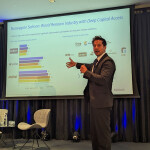

AquaBounty has identified new opportunities in selling salmon eggs to aquaculture operations, AquaBounty CEO Sylvia Wulf told SeafoodSource.
Wulf said her company has identified an opportunity in its egg-production capabilities, to the point that it’s converting its facility in Prince Edward Island, Canada away from salmon production.
“We had two cohorts [of salmon] that were harvested [there] and sold, similarly to what we do in the U.S. We have since made the decision to convert that facility to egg production,” Wulf said.
The company has begun production cycle with non-transgenic "normal" salmon eggs that have nothing to do with the company’s genetically engineered AquAdvantage salmon brand.
“Because we don’t have a vertical integration demand for all those eggs, we’ve made the decision to sell non-transgenic eggs,” Wulf said. “The facility is pathogen-free, and there is a demand for non-transgenic salmon eggs, so we’re pursuing that and in conversations with a number of different companies that are producing non-transgenic salmon, both net-pens and potentially those that are building RAS facilities in the U.S.”
The company sees an opportunity in selling eggs thanks to its years of experience developing successful its RAS operations, including at its Indiana, U.S.A. That farm, while not as technologically advanced as newer RAS operations, has been successful in raising salmon, Wulf said.
“I think that the team there has done an excellent job of retrofitting and raising salmon with what we have to deal with, and to date we’ve been able to sell all of our output from Indiana,” Wulf said.
AquaBounty has been in the business of producing salmon in an RAS for over a decade, and that experience can benefit other up-and-coming companies, Wulf said.
“We understand how to operate a RAS farm, and all of our R&D is focused on how do we become more operationally effective, including the genetics of our non-transgenic broodstock,” Wulf said.
AquaBounty selling its eggs isn’t necessarily new. American Aquafarms, which is seeking to develop a large closed net-pen operation in Gouldsboro, Maine, U.S.A., had contracted to source its eggs from AquaBounty, but the contract and project were annuled after state regulatory authorities decided AquaBounty didn’t meet the state’s egg-sourcing criteria.
Wulf said the company has taken steps to ensure the problem doesn’t happen again.
“As we started to think about egg production, it became clear that we need to be having those conversations with the Department of Natural Resources in Maine to make sure that we understand what their requirements are,” Wulf said.
Wulf said part of the problem with the Maine DNR was based on misunderstandings related to AquaBounty’s ability to separate genetically engineered products from non-transgenic products.
“We’ve now clarified all of that and are ready to be able to import into Maine,” Wulf said.
If AquaBounty is contacted by a company looking to buy its eggs, the company now has a process to ensure that it qualifies as a valid purveyor in each U.S. state.
The company’s new focus on eggs hasn’t taken away from its plans to build salmon RAS facilities, Wulf said. AquaBounty announced big ambitions for the company in September 2022, including a roadmap of developing new recirculating aquaculture system (RAS) salmon farms every two years and an ambitious international expansion.
AquaBounty selected Pioneer, Ohio, U.S.A. as the location for a planned expansion in 2021, and according to Wulf, construction is proceeding smoothly there. Wulf also said that the company is making progress – albeit slowly – with a partner to build an RAS facility in Israel.
“It has slowed down because ... we are a small organization and there’s only so much we can do. But it doesn’t mean that we’re not continuing to pursue Israel and that relationship with a commercial partner,” Wulf said.
The Israeli company is also “species agnostic” and is pursuing other opportunities, including shrimp raised in an RAS environment.
“We’ve been evaluating a number of different technologies to see what we believe will provide the right capital cost, the right operating cost, and allow us to pursue that in the United States,” Wulf said.
One area where the company is pulling back is its plan to pursue a partner in China. Wulf told SeafoodSource in 2019 about its plans to build an RAS in China, but Wulf said the Covid-19 pandemic had complicated Aquabounty's pursuit of business opportunities there..
“With respect to China, given everything that’s going on from a geopolitical perspective, what we’ve made the determination what we need to do is to finish the field trials required for Chinese approval,” Wulf said. “We’re continuing and we have a local partner that will be conducting those field trials, but we have put the search for a commercial partner on hold.”
Without the opportunity to visit the country during the Covid-19 pandemic, progress in China was hampered, she said.
“We have an excellent relationship with a partner there and have created the parameters for a field trial, but to vet commercial partners and sites really requires the ability to visit the country,” Wulf said. “At this point in time, that doesn’t make good use of our resources.”
Wulf also added that the company is not worried about its potential de-listing from the Nasdaq Stock Exchange.
“We’re fortunate in that we have a very strong balance sheet where many of the other companies in the space don’t – and we all have long timelines to cashflow or breakeven,” she said. “That being said, we believe that as long as we continue to deliver against our milestones, investors will begin to recognize the fact that we’re doing exactly what we said we’re going to do. And our hope is that the stock price will recover as the markets recover.”
The company's stock price has risen from USD 0.79 (EUR 0.72) per share on 3 January to USD 1.14 (EUR 1.04) per share as of 1 February.
Still, Wulf added, the need for the company's stock to completely recover to earlier highs – its prices was above USD 12.00 (EUR 10.99) in January 2021 – isn’t urgent.
“We have time. We don’t need to do anything right away, and that’s the benefit of having a strong balance sheet,” Wulf said. “We’re not the only company in the biotech space that’s having to meet the challenge of a volatile stock market right now.”
Photo courtesy of AquaBounty
