





The Moretti family took a leap of faith purchasing Portland, Maine U.S.A.-based Bangs Island Mussels in 2010, one of the oldest mussel farms on the country’s East Coast.
Matt Moretti purchased Bangs Island fresh out of graduate school with his father, sharing a vision to revolutionize the stagnant company and sustainably grow multiple species via aquaculture. More than a decade later, Bangs Island employs fifteen people producing mussels and kelp in Portland’s Casco Bay, sold to a national market.
“That's our goal. That's our mission. That's our drive. We want to produce the best quality food we can in an environmentally sustainable way, and mussels are absolutely that,” Matt Moretti told SeafoodSource. “We got into it because we realized that mussels can produce a super high-quality protein that's affordable for almost anybody and has very little impact on the environment. It's something you can really feel good about.”
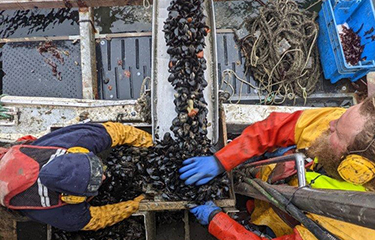
Bangs Island uses the raft culture method to grow its mussels using 40 -by-40-foot floating platforms with 400 or more lines hanging underneath to collect spat and support the mussels through all stages of growth.
“We like to think of our size in number of rafts,” Moretti said. “In the beginning, we were seeing excellent results with the product, excellent results with customers, and we knew we were doing good things for the environment. So, we started just to go all in and reinvest everything we made from the company and just work our butts off for years and years until we grew business to big enough size where it’s able to support itself.”
In 2010, Bangs Island had three rafts, and since then has successfully expanded to twenty-six rafts, four boats, and increased kelp infrastructure with modernized technologies in a 5,000-square-foot warehouse. The company produced approximately 30,000 pounds of mussels in the Moretti’s first year, and more than 600,000 pounds in 2022. The first year growing kelp produced approximately ten pounds, and they produced more than 100,000 pounds in 2022.
When the Morettis purchased Bangs Island, the company exclusively sold wholesale to local customers, and now exports to distributors nationwide. A valued part of the company’s mission is exclusively transporting by truck and eliminating airfreight shipments anywhere to reduce environmental impact.
“We just picked up different customers in various geographic hotspots around the country. And that's how we have continued to grow our business,” Moretti said.
Moretti said there is an increased variability around Bangs Island’s seed supply due to the complications of climate change, with Maine’s water temperature rising faster than 90 percent of bodies around the world.
“Our mussels come from wild seed. That is the entire basis of our mussel farm. We collect the seed on our lines underneath our rafts at very specific times of year and that's how we've done it forever,” Moretti said. “But things are changing, and we are trying to be ahead of the curve.”
As a part of its climate change mitigation strategies, Bangs Island has been working with the Downeast Institute and alongside other mussel farms to experiment with mussel seed grown in hatcheries.
“We have seen promising results and are integrating hatchery grown mussel seed into our farming operations. This will give us more control over the quality of our product and allow us to farm mussels much farther into an uncertain climate future," Moretti said. “If you grow mussels for the first bit of their life in the controlled environment of a hatchery or remote settlement facility (that we have now created at our wharf), they will have a much higher survival rate when we plant them in our open-ocean farm.”
Optimizing the use of hatchery grown mussels will give Bangs Island a more reliable seed supply and help them overcome some of the challenges of ocean acidification and climate change.
“We're really proud of our mussel seed efforts and excited to make them streamlined, commercialized and scaled.We're putting a lot of work,and investment into this project so that it can support a significant portion of mussel seed needs, Moretti said. “If we can make it work with our partners in a real scaled-up way, this could change everything for our company and other Maine farmers. It could lower a lot of barriers to entry into the industry, and allow for a more controlled consistent, year-round product. It will allow us to thrive as a as an industry in this region and I’m super optimistic about it."
Photo courtesy of Bangs Island Mussels
