

Cooke Aquaculture and the Jamestown S’Klallam Tribe have filed separate lawsuits challenging the U.S. state of Washington’s November 2022 decision to ban net-pen finfish aquaculture.
Cooke’s lawsuit also challenges the Washington Department of Natural Resources’ November decision not to renew its last two net-pen aquaculture leases in Puget Sound, and the DNR’s rejection of the company’s request to have more than 31 days to harvest the fish in the net-pens.
“Cooke is confident that the court will conclude that DNR had no basis in law or science to deny the Rich Passage and Hope Island fish farm lease renewal applications,” the company said in a statement.
The Saint John, New Brunswick, Canada-based seafood firm had originally farmed salmon in several net-pen sites in Washington it acquired from Icicle Seafoods in 2016, but switched to steelhead farming following a statewide ban on non-native finfish aquaculture was approved in response to a large-scale salmon escape in August 2017 from a Cooke farm near Cypress Island, Washington.
In its suit, Cooke alleges the denial of its permit renewals and the outright ban on net-pen farming were the result of a “punitive, arbitrary,” decision by Washington DNR Commissioner Hilary Franz.
“Upon hearing the evidence and reviewing the files and records Cooke has asked the court to compel DNR and Commissioner Franz to produce, Cooke is confident that the court will conclude that DNR had no basis in law or science to deny the Rich Passage and Hope Island fish farm lease renewal applications,” it said. “The decision is unjustified given the state legislature's confirmation that native species of fish can be farmed in Washington's waters and the extensive work done by Cooke and multiple state agencies, including WDFW, to strengthen the regulatory framework governing marine farms. Cooke has enthusiastically worked collaboratively and transparently with regulatory agencies to identify areas of improvement and implement regulatory and monitoring processes to ensure that its operations meet and exceed the highest standards.”
Cooke pointed to a ruling by the Washington Department of Fish and Wildlife affirming Cooke’s steelhead-farming would not have probable significant adverse impacts to the environment – a decision affirmed by the Washington Supreme Court in January 2021.
The WDNR’s decision also impacted the Jamestown S’Klallam Tribe, which in August 2021 formed the Salish Fish joint venture with Cooke Aquaculture to develop a net-pen farm to raise native steelhead, also known as rainbow trout, in Puget Sound.
In a lawsuit filed 16 December, 2022, the tribe alleges Franz and the WDNR failed to fully consult with it about its issuance of the net-pen ban, which effectively prohibits tribes from partnering with non-Indigenous commercial entities on net-pen aquaculture commercialization.
“All fish, whether found in nature or in farms, must continue to be available to harvest for cultural practices, commercial uses, and subsistence for Tribal people,” the tribe said in its lawsuit. “When development in the areas surrounding their home territory has threatened continuation of their historical use of these waters, Jamestown turned to hatcheries and aquaculture to mitigate those losses. Fish supplementation in the form of hatcheries and aquaculture is necessary – or the Tribe is forced into dependence on non-Indian food supplies. Dependence solely on non-Indian food supplies threatens Jamestown’s sovereignty. If Tribes are unable to procure culturally appropriate foods, this can increase disease in native people and threaten their physical health. Salmon, steelhead, sablefish, and other marine resources are integral to the native diet, and Tribes must be ensured fish in the future. “
Jamestown S’Klallam Tribal Chairman and CEO W. Ron Allen said WDNR’s decision impinges upon his tribe’s sovereign right of self-governance and self-reliance.
“As a Tribe, we have always been conscientious stewards of our natural environment and look seven generations ahead in all that we do. Modern, well-regulated aquaculture is the environmentally responsible solution for producing seafood and exercising our Tribal treaty rights – now and into the future,” Allen said in a statement. “Tragically, population growth, pollution, poor environmental protections and development activities in the Pacific Northwest have negatively impacted our wild fish stocks. We must have options available to take pressure off wild fish stocks through sustainable aquaculture which will aid listed stocks to regain sustainable levels and prevent their extinction.”
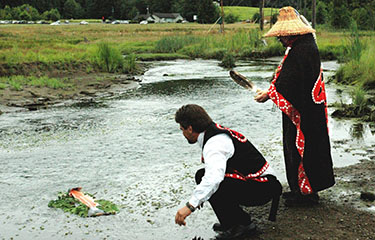
Photo courtesy of Jamestown S’Kallam Tribe
