

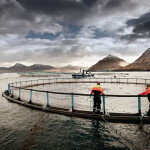

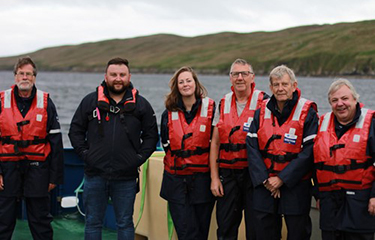
A multinational consortium has successfully completed environmental trials for a sea lice treatment concept at a Scottish Sea Farms site in Shetland, Scotland.
The new trial treatment is from BREEZE, a collaboration between Norway and Scotland, which brought together technology developer Pulcea, veterinary services and systems provider AquaPharma, and the Norwegian University of Science and Technology.
Driven by increasing resistance of sea lice to existing treatments, a growing demand for treatment methods with minimal environmental impact, and increased consumer awareness of fish welfare, BREEZE uses existing hydrogen peroxide (oxygenated water) bath treatments paired with sonic technology.
The trials validated results from extensive modelling and showed that the sonic technology can operate safely in an open marine environment, is effective against egg-bearing female sea lice, and does not harm fish, marine mammals, or human health.
“Contrary to what its name might suggest, hydrogen peroxide is extremely gentle both on fish and the environment. Administered at a low concentration, which is typically one-tenth of the strength used in an everyday mouthwash, it is highly effective at dislodging sea lice from the salmon, before rapidly breaking down into just water and oxygen,” Sea Farms Head of Fish Health Ralph Bickerdike said. “To learn that its efficacy might be enhanced further by pairing it with sonic technology is of huge interest to industry.”
An effective, non-medicinal approach to controlling the incidence of sea lice (Lepeophtheirus salmonis) has been sought after since the early days of salmon farming, and sea lice continue to be one of the biggest challenges for salmon farmers. Sea lice infestations cost Scottish salmon farmers millions of pounds each year, and worldwide it is estimated that losses due to ectoparasites cost upwards of USD 1 billion (EUR 941 million).
Sea lice infestations lead to a reduction in fish welfare, lower productivity, and reductions in growth. The value of salmon at harvest may also be reduced due to the damaged appearance of the skin and flesh.
The life cycle of sea lice is affected by water temperature, and sea lice are more abundant in summer and autumn months. There is concern that rising sea temperatures resulting from climate change may increase management challenges in the future.
Control measures for sea lice to date include in feed medication; bath treatments with licensed veterinary medicines; freshwater baths; physical removal using specialist equipment such as the hydrolicer, thermolicer and optilicer; biological control using wrasse and lumpsuckers; skirts around net pens to prevent early life stage sea lice reaching the salmon; and genomic selection to make the fish less susceptible to attack.
The BREEZE consortium said it is now ready to proceed to operational trials using the Pulcea technology in Norway.
“It is great news that the equipment has performed well in initial trials and we are a step closer to bringing a system to market that can really help make a difference to fish farmers,” BREEZE Global Innovation Manager and Project Activity Leader for Aqua Pharma Group Rachel Brown said.
Photo courtesy of the Sustainable Aquaculture Innovation Center
