






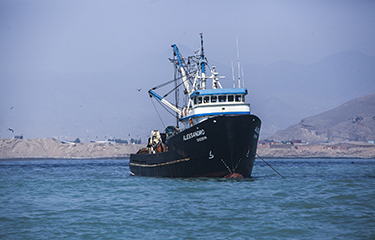
Peru’s Production Ministry (PRODUCE) has delayed the launch of the main anchovy fishing season in the country’s north-central zone due to the effects of El Niño.
The situation is causing consternation among industrial fishing fleets that are responsible for the world’s largest anchovy fishery.
“The situation is really complicated. El Niño is already hitting the [northern] Peruvian coast with a 2.5 degrees Celsius [rise] on average. The problem is that anchovy [biomass] remains deeper and closer to the shore, looking for colder temperatures,” Pablo Trapunsky, the CEO of anchoveta fishing and processing firm Pesquera Diamante, told SeafoodSource. “Add to the fact that most of the biomass found is considered juvenile and the result, for now, is a [fishing season] start in mid-June. The quota will be a joke and the catch even worse.”
El Niño has a strong effect on marine life off the Pacific coast. According to information from NOAA, during normal conditions, upwelling brings cold, nutrient-rich water from the depths to the ocean’s surface. However, during El Niño, this upwelling weakens or stops altogether. Without those nutrients, there are fewer phytoplankton – the main diet of many fish, including anchovies. This causes the biomass to look deeper and move to other areas in search of food.
PRODUCE usually opens the fishing season mid-April after confirming optimal biomass conditions. However, PRODUCE Minister Raúl Pérez-Reyes warned that only during the first week of June will he receive the monitoring report from Imarpe – a technical agency within the ministry that advises the state on marine conservation issues – regarding the anchovy biomass situation.
“We will have the report in the first week [of June] to see how the biomass is, which will allow us to define whether or not there will be a first fishing season of the year,” he said. “The conclusions of the first report were that it was not yet the time to define [a launch date] due to the large number of juveniles. Between the first week and the middle of June, we are going to see if it makes sense to issue the quota.”
Peru divides its anchovy fishing areas into two regions – south and north-central – with different capture limits and seasons set for each. The north-central is Peru’s main fishing region, with capture measuring several times that of the south region.
According to a 27 April release from Imarpe, two anchovy hydroacoustic evaluation cruises launched into Peru’s north-central region 19 February to 24 March and 17 to 21 April. The operations effectively confirmed an increase in sea surface temperature, accentuated during the second half of March and expected to continue through July. The anchovy biomass there concentrated in the first few miles of the coast and deepened, reaching depths of 100 meters in some areas, moving from north to south.
Juveniles measured 82 percent in number and 58 percent in weight; the evaluations also confirmed that summer spawning was less intense than expected for this season, and the somatic condition of the anchovy was lower than average.
The unfavorable results led Imarpe to launch the latest evaluation cruise at the beginning of May, which will conclude at the end of the month, to continue monitoring ocean-meteorological and biological conditions.
“These results were presented to the main anchovy fishing associations, which agree on the need to continue with the anchovy evaluation process, in order to recommend the most appropriate measures to guarantee the sustainability of the resource,” Imarpe said.
El Niño’s area of influence divides into different zones in Peru. Zone 1.2 is the coastal strip of Peru, while Zone 3.4 is farther west in the center of the Pacific Ocean.
“What we have now in Peru is the coastal one, which will decrease in intensity during the [Southern Hemisphere] winter. But the challenge comes in Q4 of this year, where both can act at the same time,” Trapunsky said.
At least a moderate El Niño effect is likely for Zone 3.4 during the May through July period and may continue into the Northern Hemisphere winter, news service Axios reported, citing the latest data from NOAA, with an 82 percent chance of El Niño forming during that period and above 90 percent odds later in the summer.
The reasons behind such confidence in El Niño's formation and intensity include increasing sea surface temperatures and the presence of unusually warm waters beneath the surface. It could lead to the first year in which the global average surface temperatures rise to or surpass the Paris Agreement's climate change target of 1.5 degrees Celsius above preindustrial levels, Zeke Hausfather, climate research lead at payments company Stripe, told Axios.
In 2022, Peru's catch total was an estimated 4.25 million metric tons (MT) – only 84 percent of the total allowable catch (TAC) established and well below the 5.1 million MT of anchovy Peru caught in 2021 – due to a late launch of the second season, coupled with challenging weather and oceanographic issues and a high presence of juveniles.
For 2023, the Central Reserve Bank (BCR) revised its expected sector growth downward from 11.5 percent to only 5 percent, local business paper Gestión reported.
Enrico Bachis, market research director at The Marine Ingredients Organization IFFO, said that the organization is “closely following” events in Peru, highlighting that the country accounts for 20 percent of global fishmeal and fish oil production.
“At this point, nobody knows what the Peruvian authorities’ final decision will be as the additional analysis of the biomass has just started. Quotas are always granted based on the status of the biomass,” he told SeafoodSource. “What is important is that the decision is taken based on the scientific advice of Imarpe, as that would be the only way to guarantee the sustainability of the fishery resources."
Photo courtesy of SNP
