


Saudi Arabia’s efforts to increase its aquaculture production volume to 600,000 metric tons (MT) by 2030 received a major boost after two state-controlled institutions signed an agreement with American global food corporation Cargill to expand fish farming in the country.
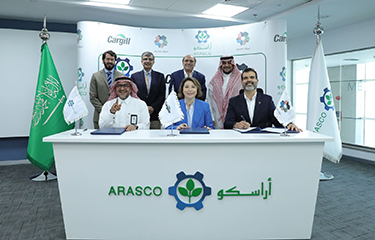
Cargill, the Arabian agricultural services company (ARASCO), a national food and closed joint stock firm, and the NEOM Company signed a memorandum of understanding (MoU) in early February 2023, covering aquaculture development in a region in northwest Saudi Arabia. The deal is focused on expanding Saudi Arabia’s overall fish farming to support the country’s drive towards seafood self-sufficiency by 2030 using environmentally friendly processes, a joint statement said.
“This agreement will ultimately lead to addressing the need to replace fishmeal by more sustainable fish feed,” NEOM Food Head Juan Carlos Motamayor said. “Additionally, it aligns with NEOM’s efforts to facilitate the production and supply of sustainable seafood while protecting the marine environment. We look forward to working with ARASCO and Cargill to transform the seafood-production industry and minimize the environmental impact.”
No further details are available on the agreement’s execution, but NEOM hinted in a statement the partners “will work together to explore and scale up sustainable ways to meet rising domestic demand for aquaculture, including through research and development into more sustainable feed sources.”
The NEOM Company – which is also the developer of a proposed USD 500 billion (EUR 459 billion) commercial and residential development in Saudi Arabia – has made forays into aquaculture in the past. In 2021 the company signed a MoU with aquaculture technology firm Tabuk Fish Company to develop a fish hatchery on the northwest shores of the Red Sea. The farm, the region’s largest fish farm, will operate with a capacity of 70 million fingerlings.
Saudi Arabia also made a deal with Dubai, United Arab Emirates-based Aqua Bridge Farms Co. for a hatchery project in Al-Lith, Makkah Province. That hatchery project will produce European sea bass and European sea bream hatchlings for aquaculture.
Saudi Arabia has also worked with Cargill in the past. In 2013, the company partnered with ARASCO to deliver products, with ARASCO using the deal to enhance food safety, nutrition, and sustainability in the region.
The deal, which was ARASCO’s first global joint venture, paved the way for it to restructure ARASCO Corn Products, which lead to it unveiling Middle East food solutions company, a partnership between ARASCO, the largest producer of corn starch and its derivatives in the Middle East and North Africa, and Cargill.
Elsewhere, Saudi Arabia plans to invest USD 4 billion (EUR 3.75 billion) to modernize and enhance aquaculture production through 2030, buoyed largely by the growth of the sector in the last five years. Aquaculture output in the region has increased by 183 percent – from 30,000 MT to 85,000 MT.
Currently, Saudi Arabia’s fish-feed market is dominated by National Aqua Group (NAQUA), formerly National Prawn Company, which has the capacity to produce 90,000 MT of shrimp feed and 30,000 MT of fish feed per year.
Those projects, and Cargill’s expanding foothold in Saudi Arabia, underscore the Saudi goernment's ongoing push to develop its aquaculture industry. To that end, Saudi Arabia is offering a raft of incentives to the private sector. In an attempt to attract investors, iit has unveiled the the Agricultural Development Fund Fish-Farming Support Program, which subsidizes up to 70 percent of the total cost of a greenfield aquaculture project.
The country’s overall development plan, dubbed Vision 2030, coincides with the country's effort to increase per capita annual seafood consumption from 9 kilograms to 20 kilograms. With increased consumption comes a need for an increased supply, which the country is hoping to secure domestically, ARASCO CEO Nasser A. Abanmi said. The new project will help the country reach those goals, he said.
“By 2050, there will 9.7 billion people on the planet, according to the U.N., and this growth will put huge pressure on food security and production in general, and fish in particular which is aligned with ARASCO's mission to support food security in a sustainable way within the Kingdom of Saudi Arabia, and in the Middle East,” Abanmi said. “We look forward to working with NEOM and Cargill in this noble mission.”
Photo courtesy of ARASCO
