






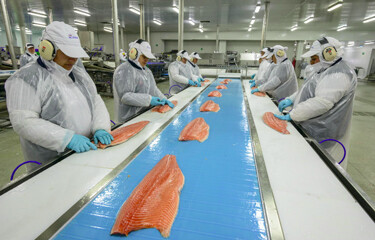
Santiago, Chile-based seafood firm Blumar saw its negative financial performance continue in the third quarter of 2023, replicating its Q2 2023 performance, with its fishing operations performing solidly but not well enough to make up for the company’s lackluster performance in its salmon-farming segment.
Blumar's Q3 2023 revenue was USD 152 million (EUR 139 million), down 15 percent compared to the USD 179 million (EUR 163 million) the company posted in Q3 2022. Blumar’s fishing division increased revenues 24 percent year over year by hauling in USD 78.3 million (EUR 71.5 million) during the quarter, while its salmon-farming division saw revenues drop 36 percent to USD 74.1 million (EUR 67.7 million).
Blumar's overall cost of sales dropped 6 percent in Q3 2023 when compared to the same quarter last year, giving it a gross margin of USD 26 million (EUR 24 million), down 42 percent from the same quarter of 2022. Distribution costs were relatively stable, while administration costs increased 14 percent year over year, and other costs jumped 136 percent, leading to earnings before interest and taxes (EBIT) before fair-value adjustments of USD 9 million (EUR 8.2 million), a 70 percent decrease when compared to Q3 of last year.
When adjusted for fair value, Blumar's EBIT represented a loss of USD 2.1 million (EUR 1.9 million), compared to a positive EBIT of USD 31.4 million (EUR 28.6 million) from the same period one year ago.
Considering taxes, Blumar fell USD 5.5 million (EUR 5 million) into the red in Q3 2023, a large downward swing from being USD 21.7 million (EUR 19.8 million) in the black during Q3 2022.
In the first nine months of 2023, Blumar said its total revenues reached USD 532 million (EUR 485 million). Revenue earned from sales of Atlantic salmon comprised 51 percent of that total, while fishmeal and fish oil made up 25 percent, frozen horse mackerel sales totaled 17 percent, and whitefish accounted for 6 percent of the group's total sales.
"[The results] show the solidity of our fishing segment, which has maintained a significant growth path, allowing us to face with greater flexibility and resilience the challenges that the global context brings for the aquaculture segment, which has been pressured by external factors such as price decreases and cost increases,” Blumar CEO Gerardo Balbontín said. “The company is addressing this with different initiatives that we hope will be reflected during 2024.”
Even so, the company remains realistic that 2024 could be another tough year due to a recessive market and weakened demand.
“All the indicators lead us to be cautious for next year,” Balbontín said. He said the company expected low growth in its salmon production as a result of regulatory uncertainty and unawarded concessions by Chile's government.
Blumar is expecting a more moderate El Niño phenomenon in late 2023 into 2024 to allow Peru – the world’s largest anchovy producer, a main ingredient in fishmeal and fish oil – to be able to recover pelagic catches, therefore normalizing prices on fish feed.
Regardless, the company will be looking to cut costs in the next 12 months, Balbontín confirmed.
Though Blumar plans to be cautious moving forward, it still tried to pursue growth opportunities in the third quarter. Blumar said that during Q3 2023, it “deployed an intense agenda” to continue growing in the markets in which it has a presence, having participated in the International Frozen Seafood Products Fair in Vigo, Spain, the second version of Seafood Show Latin America in Sao Paulo, Brazil, the China Fisheries Seafood Expo in Shanghai, and the IFFO - Marine Ingredients Organization's annual conference in Cape Town, South Africa.
“These instances are great opportunities to offer salmon products with superior sustainability credentials and show the market our progress in new developments and our sustainability strategy,” Salmones Blumar Commercial Manager Daniel Montoya said. “Chilean salmon is highly valued in international markets for its quality standards and high nutritional content. In these instances, we were able to generate new business opportunities and learn how the industry is working worldwide.”
Photo courtesy of Blumar
