






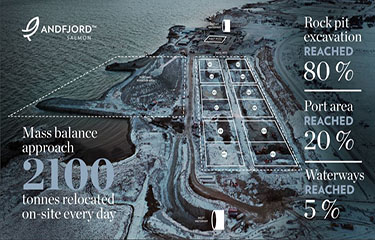
After a successful inaugural harvest early in Q3 2023 and its next smolt restocking not expected until 2025, Norwegian land-based salmon producer Andfjord Salmon is now focusing its attention fully on the construction taking place to expand production at its Kvalnes facility, which should dramatically increase the company’s output capacity, CEO Martin Rasmussen said.
Delivering the company’s Q3 2023 results on 30 November, Rasmussen said he expects the excavation of the site’s next 12 pool pits to be done during Q1 2024, putting it one quarter ahead of schedule. Contractors will also be able to initiate construction on the site’s first four pools in Q1 2024, increasing its production volume to 8,000 metric tons (MT) of head-on gutted (HOG) fish in the process.
“The most important thing for us now is the construction and to have a significantly increased production capacity in 2025,” he said.
Andfjord might even be able to release fish into its farm as early as 2024, but Rasmussen said his company will not do anything that compromises the positive biological results it has so far achieved.
“We see it as more beneficial to have access to all the pools in the second half of 2025, because then we can have a much better ramp-up of production volumes,” he said.
Achieving total production capacity of 40,000 MT head-on gutted (HOG) at Kvalnes is the long-term goal through a gradual volume increase between 2025 and 2030. To accomplish this, part of the initial construction phase will include the development of infrastructure, such as waterways and a harbor area, which is currently underway.
Rasmussen said Andfjord Salmon currently has production licenses in place for 10,000 MT maximum allowable biomass (MAB), giving it a potential production level of 19,000 MT HOG annually in its 13 pools. Without any additional investments, capacity could increase to 23,000 MT, and the company is working to secure additional licenses for the facility. At the same time, north of Kvalnes, the company operates two other sites – Breivik and Fiskenes – that could deliver a combined 50,000 MT long term. Work to attain permits for both is ongoing.
“We are doing the work at Kvalnes as fast as possible. At the same time, we also have the momentum to develop the other sites … but when you’re developing property and getting approvals from authorities, it’s a process that takes several years,” Rasmussen said.
The first harvest at Kvalnes, concluded in late July, produced around 530 MT HOG with a survival rate of 97.5 percent and a feed conversion rate (FCR) of 1.05, largely due to the site’s production system that uses specially designed feed with a low sinking rate, ensuring there’s always feed available for the salmon, Rasmussen said.
“It also means we can have very precise production; we don’t overfeed, and we don’t have feed waste,” he said. “This is why we can have 1.05 [FCR], compared to the industry average of 1.27 kilograms of feed per kilogram of salmon.”
Referencing the numbers from the first production cycle, Rasmussen said that the company achieved a cost benefit of around NOK 5.00 (USD 0.46, EUR 0.43) per kilogram of produced salmon.
“At the end [of the day], we are making food; we are producing a product, and the feedback from the market is also part of our proof of concept,” he said. “So, we are extremely proud of the fantastic feedback we have had on our salmon in the markets so far.”
Sales of Andfjord Salmon’s first fish delivered an operating income of NOK 27.7 million (USD 2.6 million, EUR 2.4 million) for Q3 2023, up from no sales completed in the same quarter last year. The company posted an operating loss of NOK 28.2 million (USD 2.6 million, EUR 2.4 million) for the period, compared to a loss of NOK 17.6 million (USD 1.6 million, EUR 1.5 million) in Q3 2022. In total, the first harvest generated revenue of NOK 37.3 million (USD 3.5 million, EUR 3.2 million).
“Good biology in combination with low feed conversion rates are the key to profitability; you don’t get paid for dead fish,” he said. “A good reputation is also extremely important in the market, and a high superior share equals a high average price.”
Andfjord Salmon’s flow-through, salmon-rearing system capitalizes on its close proximity to the oxygen-rich Gulf Stream. Through the company’s own patented technology, it has introduced a laminar waterflow system, whereby water is pushed through square-shaped pools from one side to the other. During its first production cycle, some 5,000 MT of water passed through the first pool every second. This system proved to be energy-efficient in the first production cycle, with 1 kilogram of salmon produced at roughly 1 kilowatt per hour, Rasmussen said.
The company posted a loss of NOK 28.3 million (USD 2.6 million, EUR 2.4 million) in Q3 2023, up from a loss of NOK 17.7 million (USD 1.7 million, EUR 1.5 million) in Q3 2022. Year to date, it has lost NOK 38.4 million (USD 3.6 million, EUR 3.3 million) , down from NOK 56.7 million (USD 5.3 million, EUR 4.9 million) through the first three quarters of 2022.
Photo courtesy of Andfjord Salmon
