






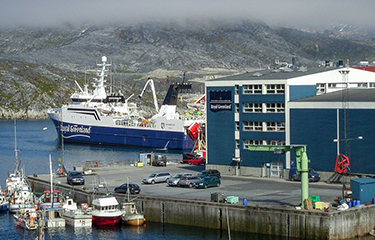
External factors such as rising oil and energy prices, inflation, and the Russia-Ukraine conflict – the latter of which resulted in the loss of the lucrative Russian shell-on prawn market – all impacted Royal Greenland’s earnings in the first half of this year.
According to the Nuuk, Greenland-headquartered seafood company’s H1 2023 financial report, it recorded a loss before taxes of DKK 113 million (USD 16.3 million, EUR 15.2 million) for the six months ending 30 June, 2023, which it called “unsatisfactory.” In the corresponding period of last year, it achieved a profit of DKK 96 million (USD 13.8 million, EUR 12.9 million).
Cost increases alone for the company totaled DKK 240 million (USD 34.6 million, EUR 32.2 million), and sales price increases of around DKK 130 million (USD 18.7 million, EUR 17.4 million) only partly compensated for the spike in costs. Another contributing factor to its tough H1 2023 was lower coldwater prawn catches in Greenland, which the company said may be due to a decline in the stock and poor ice conditions.
Royal Greenland suffered a loss of 1,000 metric tons of sales after hitting a pause on sales of its shell-on prawns to Russia, the world’s second-largest market for the product. Compounding the issue is that the Ukraine conflict and the subsequent boycott of Russian products by many Western markets has led to Russian crab exports flooding Asia, challenging Royal Greenland’s crab sales in the region, with a particular impact on sales prices in Japan, the company said.
In volume terms, Royal Greenland’s largest product category is prawns. A relatively strong market and high demand from markets like China were not enough to quell the tide of harmful external factors, with the company selling 25 percent fewer shell-on prawns in H1 2023 than in the first half of 2022.
Furthermore, highlighting that cooked and peeled coldwater prawns are “a distinctly European product,” the category has been “severely affected” by the market slowdown in Europe. This, the company stated, is a consequence of general economic conditions such as rising inflation, but is also due to Brexit.
“In times of crisis, consumers typically abandon more luxurious goods in favor of more basic goods,” the company said.
The “little immediate prospect” of a free-trade agreement (FTA) between Greenland and the U.K. also hurts Royal Greenland’s forecasts; H1 sales to the market were 27 percent lower than last year.
Higher catch landing prices, together with payroll and logistics costs, additionally burdened its prawn sector and are costs for which the company could not fully compensate with higher sales prices, it said.
In other categories, the loss of fishing opportunities in the Russian part of the Barents Sea resulted in a 1,500 MT deficit of frozen-at-sea cod for Royal Greenland.
The company said coastal net fishing in Greenland is increasing but cannot fully replace offshore catches in terms of earnings, and that it would not be possible for it to maintain sales prices at the record-high levels achieved in 2022.
The continuing external challenges and market conditions led Royal Greenland to state that it will not achieve an annual result in line with its “normal” level.
Despite the uncertainty, Royal Greenland said it expects the second half of 2023, which has historically been the company’s peak season, to be “significantly more positive.” Illustrating this point, North American sales of snow crab in the 2023 season have normalized in terms of both earnings and sales, while a strong market for Greenland halibut in Asia bodes well for the major sales season that leads up to the Chinese New Year, the company stated.
“Significant employee efforts are being made across all functions of the company,” Royal Greenland CEO Susanne Arfelt Rajamand, who took over as CEO in November 2022, said in a statement. “Once again, our diversification strategy shows that, across markets and categories, we have a balance in the business that enables us to come out of the overall financial year satisfactorily.”
According to the H1 report, earnings before taxes for the entire year are expected to total at least DKK 100 million (USD 14.4 million, EUR 13.4 million).
The company has another trawler build in progress, with the vessel due for delivery in 2025, after which it will have replaced its entire offshore trawler fleet.
Photo courtesy of Royal Greenland
