






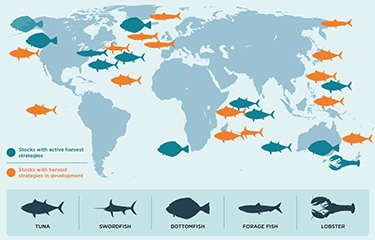
Numerous NGOs have been pushing for regional fisheries management organizations (RFMOs) to adopt harvest strategies as a means of effectively managing seafood stocks, but even their fiercest advocates admit the path toward their adoption isn’t easy.
A harvest strategy is a method in which RFMOs and other fisheries managers develop predetermined actions that trigger when stock assessments, catch data, and return on effort – among other metrics – reach certain thresholds. In recent years, RFMOs have been adopting them because they help eliminate the political wrangling that would otherwise dilute scientific advice.
In 2022, the Ocean Foundation and the United Nations Food and Agriculture Organization launched HarvestStrategies.org to provide information on current developments and implementations; recently, an interactive map has been posted on the site showing which RFMOs have thus far adopted harvest strategies.
When an RFMO implements a harvest strategy, it establishes a management procedure called a harvest control rule, which allows it to take action automatically, avoiding egotiations between RFMO member-states that can often stalemate, such as what transpired when some members of the Indian Ocean Tuna Commission attempted to ban the use of drifting fish-aggregating devices (dFADs).
“Members found it difficult to move forward without fully understanding the implications of the harvest strategies,” Pacific Island Forum Fisheries Agency (FFA) Director of Fisheries Management Ludwig Kumoru said during a 19 October HarvestStrategies.org webinar moderated by The Pew Charitable Trusts.
Not all harvest strategies have the same design. For example, the Western and Central Pacific Fisheries Commission (WCPFC) – the area with the highest tuna catch globally – agreed to adopt a management procedure for skipjack tuna in December 2022, but made it non-binding.
Kumoru said WCPFC decision-making is complicated because most fishing occurs within the exclusive economic zones of small island developing states. Small states are often heavily dependent on fisheries for as much as half of all national income and are cautious about locking into a harvest strategy that cannot be easily changed in the future. At the same time, small island states lack the technical capacity to understand the details of harvest strategy design – a topic in which the FFA tries to help. The FFA also aims to achieve a consensus when negotiating with distant-water fishing nations.
With the experience of the skipjack tuna harvest strategy behind them, Kumoru said Pacific states are more likely to embrace harvest strategies for other species in the future. He predicted the next one adopted will be for South Pacific albacore.
Blue Matter Science CEO Tom Carruthers said during the webinar said that multi-species management strategy evaluations (MSEs) – computer models that test potential harvest strategies under varying conditions to find the one that best meets management objectives – can be a helpful tool in the implementation of harvest strategies. But they have their own set of challenges, according to Carruthers.
Carruthers said each MSE has to consider several factors that may link different species. Some were biological, such as competition for food, predation, and competition for spawning habitat. Other interactions are technical, such as the likelihood of bycatch when two species are located in the same geographical area and are caught at the same depths with the same gear type.
“For the most part, biological interactions have not been the focus of multi-species or multi-stock MSEs,” Carruthers said. “[Usually], they’ve actually focused just on the technical interactions.”
Despite the obstacles that RFMOs must overcome to implement harvest strategies, the Marine Stewardship Council (MSC) has already, in some instances, begun pushing organizations to establish management procedures if they want fisheries to retain MSC certification. MSC warned the WCPFC skipjack tuna fishery might have lost its certification if it hadn’t established its harvest strategy.
“The reality is, there is not the scientific expertise available in individual RFMOs to handle as many management plans as you’re asking to be done,” Butterworth said. ”And a management procedure that is poorly put together is likely to cause more problems than not having one at all.”
MSC Senior Fisheries Standard Manager Adrian Gutteridge acknowledged MSC is focused on achieving compromises that advance progress on fisheries sustainability.
“I guess we’ve sort of landed in a place where we think there is a middle ground,” he said.
The new MSC standard allows up to five years for currently certified fisheries to adopt a harvest strategy and 10 years for newly certified fisheries, which Gutteridge said was a compromise between those who want to proceed more slowly and those who feel harvest strategies should be implemented as quickly as possible.
Image courtesy of harveststrategies.org
