


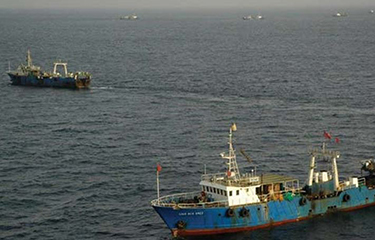
Chinese fishing company Dalian Ruitaifeng is sending three recently refurbished vessels to Guinea as part of an expansion of its operations in the West African nation.
Dalian Ruitaifeng launched the three vessels and what the company described as a “new dragnet trawler with onboard freezers.” The company told Chinese state-owned media that the vessels would fish for cuttlefish, horse mackerel, and hairtail, as well as grouper for both the Chinese and Guinean markets.
In 2019, the firm, then called Dalian Lianrun Ocean Fishery Co., but often shortened to Dalian Lianrun, changed its name to Dalian Ruitaifeng Pelagic Fishery Co. and renamed its fleet of vessels from Lian Run to Rui Tai Feng. Rui Tai Feng vessels 801, 905, and 906, formerly Lian Run 29, 43, and 44, respectively, received licenses to fish in Guinea under the Chinese flag in March 2020, according to research by the Environmental Justice Foundation (EJF), an NGO that aims to protect and maintain sustainable habitats and environments.
In February 2018, however, the Chinese Ministry of Agriculture and Rural Affairs suspended the distant-water fisheries certificate of Dalian Lianrun following repeated illegal fishing infringements in West Africa, including using illegal nets and fishing for species outside of its license conditions – specifically for sharks. Lianrun had licenses to fish in Ghanaian waters under the Ghanaian flag.
“The company’s vessels, Lian Run 43 and 44, continued to operate under the Ghanaian flag, receiving licenses to fish in Ghana from 1 January to 30 June 2018,” according to research published last year by EJF. “In 2019, the owners of Lian Run reportedly reflagged the vessel to China and relocated the vessel to Guinea without alerting the Ghana Maritime Authority and Fisheries Commission to delete the vessel from the fleet register."
EJF CEO and Founder Steve Trent told SeafoodSource that the growing prevalence of foreign-owned and Chinese-flagged industrial fishing vessels in Guinea has “significant implications” and could undermine Guinea’s efforts to improve fisheries governance.
Since 2013, the country has taken a number of steps to improve its ability to control vessels fishing in its waters, including the opening of a fisheries monitoring center and the introduction of a constantly operating vessel monitoring system (VMS). According to Trent, Guinea also introduced at-sea patrols and aerial surveillance in its exclusive economic zone (EEZ).
On broader fisheries governance, the country revised its legal and regulatory fisheries framework, “particularly including the introduction of stiff penalties for infringements,” Trent said. “It also ratified important international agreements such as the [Port State Measures Agreement] and developed a national plan of action on IUU fishing.”
In 2019, Guinean authorities impounded the Spanish vessel Portomayor for alleged illegal fishing. The vessel had access to Guinean waters in a direct deal with Guinea’s government. The company has stipulated the deal remains private because, in 2009, the E.U. canceled a long-running access agreement with Guinea over human rights concerns.
Even though the country has attempted crackdowns on IUU fishing, Trent said he worries that a surge in foreign fishing vessels will overpower Guinea’s ability to police them.
“The more vessels enter Guinean fisheries, the more it takes to control them. This means greater resources will need to be deployed to ensure that the important progress which has been made is not undone and that all the efforts of the last 10 years have not been in vain," he said
Dalian Ruitaifeng’s ability to fish in Guinea’s waters is possible because fisheries investments in the Gulf of Guinea center around direct deals between national leaders and their foreign counterparts, without the participation of legislative assemblies, according to Jorge Mendes, a researcher from Guinea completing a doctoral thesis on fisheries governance at Brazil’s Federal University of Tocantins (PPGDR/UFT).
African countries have prioritized foreign investments “which are being made without the voice of the people,” Mendes told SeafoodSource. He pointed to foreign investment in Guinea “mainly from China, Russia, and Senegal.”
At the same time, according to Guinean Minister for Fisheries Charlotte Daffé, foreign fishing companies may face challenges in exporting fish from Guinea due to tightening domestic supply. In March 2023, Guinea introduced a ban on fish exports – not including squid or shrimp – and followed that with a campaign to provide affordable fish to the domestic market.
Responding to shortages of fish before this year’s Ramadan holiday in March and April, Daffé pointed to a rising population and climate change as key reasons for the shortage, as well as the lack of a domestic fishing fleet. SeafoodSource made several attempts to contact the minister’s office by phone and email to assess how the export ban will impact foreign fishing firms, but did not receive a response.
China’s embassies in the region remain active in engaging Guinea’s government on behalf of fishing companies. Beijing’s ambassador to Guinea, Wang Hui, recently met with officials from the Guinea Fisheries Union to discuss cooperation between the two countries, according to a statement from Wang’s office.
China has emphasized its desire to be a key source of fisheries expertise for West African states, and 25 officials from Sierra Leone’s fisheries ministry, a country bordering Guinea to the south, traveled in April 2023 to the Chinese Academy of Fishery Sciences for training in fisheries management and aquaculture.
Photo courtesy of Greenpeace/Pierre Gleizes
