






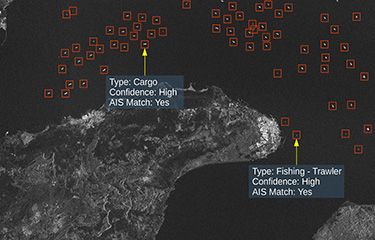
Efforts to reduce illegal fishing through improved transparency and monitoring will have to be matched with increased funding for enforcement by poorer coastal states, according to the head of a program helping detect illegal, unreported, and unregulated (IUU) fishing in several regions.
The increased capacity of monitoring systems has made detection of illegal fishing more doable “but funding is badly needed to help coastal nations act on the information,” said Ted Schmitt, director of conservation at the Allen Institute for AI (AI2) and head of the Skylight program, which has helped detect illegal fishing recently in Ecuador, Fiji, Panama, and Sri Lanka.
Skylight was developed by Seattle, Washington, U.S.A.-based AI2) (set up by the late Microsoft co-founder Paul Allen) using Computer Vision and AI to create a powerful tool in the fight to curb illegal fishing. It’s part of the Joint Analytical Cell, a collaboration of data-driven campaign groups seeking to end IUU.
Outlining recent monitoring work by Skylight, Schmitt told SeafoodSource how his team recently discovered illegal transhipment of fish from Ecuadorian trawlers to Chinese vessels in the waters near the Galapagos Islands. Skylight passed on its data to Ecuadorian authorities.
“These catches are not going through Ecuadorian customs,” Schmitt said.
In part because it is offered as a donor-backed service free of charge to numerous developing nations., Skylight is being used to monitor and identify illegal fishing in coastal nations without resources to conduct extensive maritime policing operations.
In Sri Lanka, which lost its access to the European market after receiving a red card from the European Commission in 2015, has adopted Skylight as a means of regulating the country’s fleet to the standards required for the E.U. market, as required by the terms of its 2016 agreement rescinding the red card.
The country, which has been enmeshed in a debt crisis, has been able to hold onto access to the E.U. market thanks in part to Skylight
Elsewhere, Skylight has been invited by the Bangladeshi authorities to help them improve fisheries governances. The country was the focus of a recent report by the Fisheries Transparency Initiative (FiTI) suggesting a lack of transparency on fishery governance is hampering the development of Bangladesh’s seafood sector.
More funding for developing nations is vital if the global target of conserving 30 percent of ocean space is to be met, Schmitt said.
“The factor inhibiting scalability is not the ability to cover oceans with satellites and to scan the images. The challenge, rather, is acting on the information. The challenge is for nations to act if they don’t have the resources,” he said. “The technology we have is global ... but there are things we can’t provide, like boats on the water to enforce the laws.”
Seafood industry researchers and environmentalists have long pointed to what they see as the unfairness of deals signed by wealthier nations to access the fishing resources of poorer coastal states.
Rashid Sumaila, a professor at the Institute for the Oceans and Fisheries and the School of Public Policy and Global Affairs at the University of British Columbia, and one of the winners of the 2023 The Tyler Prize for Environmental Achievement , said developing nations are often underpaid for access to their marine resources, depriving them of the finances to pay for better fisheries enforcement.
Sumaila calculates Western nations receive USD 7.00 (EUR 6.53) in value for every USD 1.00 (EUR 0.94) earned by the developing world in such access deals, with the E.U. paying an average 8 percent of the value of the fish it accesses through 13 so-called sustainable fisheries partnerships.
Campaigners have criticized a EUR 5.3 million (USD 5 million) fee paid by the E.U. to access 50,000 metric tons of tuna in the Seychelles, which some have said is 8 percent of the value of the fish, even as the E.U. has placed market access restrictions through its carding system on several developing countries due to poor fisheries governance.
According to Schmitt, the recent push from seafood sustainability groups for greater transparency in supply chains are well-intentioned, but can be off-putting to some fishermen, whose competitive instincts make them nervous about sharing information regarding fish stocks they’ve legitimately discovered.
“Enforcement actions against illegal fishing, by contrast, are not unwelcome by legitimate fishermen,” he said.
Despite the hurdles it faces, the emphasis on transparency is not misplaced, said Francois Mosnier, head of the oceans program at nonprofit financial think tank Planet Finance, which seeks to align business and finance with global efforts to halt biodiversity loss and climate change. Because of such efforts, overall transparency has improved in the seafood sector over the past decade, according to Mosnier. Yet, he believes a negative interpretation of transparency unfairly pervades the seafood sector.
“Rather than only explaining why it matters for environmental or social reasons, the benefits of transparency for the corporate or the government should be explained,” Mosnier said.
A recent Planet Tracker study conducted for supermarket chain Carrefour showing heightened transparency credentials added to the profit margins on seafood products reveals the economic value of such initiatives, he said.
“Being transparent does not mean revealing everything about one’s business. To me, in the case of wild-caught seafood, the exact species, location, date [of catch], and fishing method is all that is publicly needed,” he said. “There’s also timing: every time I hear people being concerned about transparency, it ha[s] to do with the implications of being possibly tracked live by anyone through AIS signals. But transparency is not about revealing everything immediately.It is about continuously keeping records of key data to be able to regularly report a summary of it publicly in a way that is trusted. It is a bit like financial reporting.”
The Sustainable Seafood Coalition (SSC), which includes retailers Tesco, Lidl, and Harrods, is an industry group pushing for all seafood sold in the U.K. to be sourced from sustainable sources.
“[SSC] strongly supports improvements in transparency and enforcement as part of increasing the sustainability of seafood,” it said in a statement. “[Our members] are working to improve sourcing and labeling practices in seafood supply chains as part of efforts to help achieve the shared ambition of a fully sustainable seafood sector.”
SSC members are expected to conduct a risk assessment for each fishery under the SSC Responsible Sourcing Code to ensure “appropriate measures are in place to avoid and to combat illegal, unreported, and unregulated (IUU) fishing.”
“Those measures include identification and implementation of port state control and enforcement,” it said.
Photo courtesy of Skylight
