






Japan’s seafood exports to China, which crashed by nearly 25 percent in July – representing the first decrease in more than two years – will likely continue to plummet after Japan’s government made the controversial decision to release treated wastewater from the damaged Fukushima Daiichi nuclear plant.
In response, on 24 August, China implemented a ban on all Japanese seafood imports after the water release, severing – for now – a trade relationship that was already souring.
Following the ban, China notified the World Trade Organization on 31 August of the emergency measures it instituted in response to the Fukushima release. Japan then responded on 4 September, “strongly urging” China to immediately repeal its ban and requesting talks with China in accordance with the Regional Comprehensive Economic Partnership (RCEP) Agreement, to which both countries are parties.
“Japan hopes that China will hold discussions with the Japanese side as soon as practicable and review its measures in accordance with its obligations of the RCEP Agreement,” Japan’s response stated. “Through various efforts including these discussions, Japan will continue to strongly urge the Chinese side to immediately repeal its measures.”
The issue has prompted geopolitical responses, with U.S. Ambassador to Japan Rahm Emmanuel calling out “China’s baseless political and economic actions against Japan over the release of treated wastewater from the nuclear plant,” in an op-ed.
On 31 August, Emmanuel visited a seafood market in Soma, Japan, and publicly ate local seafood with the town’s mayor, according to the Associated Press.
“The trip has now taken on the additional purpose of standing shoulder-to-shoulder with Japan to confront Beijing's latest acts of economic coercion,” he said.
Regardless of efforts like Emmanuel’s, other seafood markets have also turned away from Japanese exports, with retail prices plummeting 40 to 50 percent in August year over year, according to The Asahi Shimbun.
Hong Kong’s Japanese seafood imports fell 11 percent in July and are likely to similarly crater as a result of the city’s own ban on Japanese imports, which it also implemented on 24 August, according to Kyodo News.
The reaction of consumers in China and Hong Kong has differed, though, Jack Yuan, the chief executive of seafood importing company Whatfresh, which has offices in Guangzhou and Hong Kong said.
“Whereas Hong Kong consumers are guided by and trust in the local food safety authorities, the same trust is absent in mainland consumers who have decided to consume less seafood,” Yuan said.
Despite public fears over the release, seafood sales in South Korea actually rose nearly 15 percent in the first weekend following the release, which some suspect is a result of fear-driven stockpiling. The effects of the release on consumption, however, will not become apparent until longer-term data is available, South Korea Vice Oceans and Fisheries Minister Park Sung-hoon told the Korea JoongAng Daily.
Major Korean grocery chains, including Emart, Lotte Mart, and Homeplus, have enhanced their inspection protocols for seafood products in response to the release, Pulse News reported.
In China, the Fukushima issue has compounded an underlying problem of weaker economic sentiment, according to Yuan. China’s exports dropped 8.8 percent year over year in August, the fourth consecutive monthly decline in this category, while the country’s currency hit a 16-year low against the U.S. dollar as investors are increasingly losing confidence in yuan-backed assets.
“There was an immediate impact on the consumption of seafood,” Yuan said. “There has been a definite drop in consumption of oysters in China. The situation is a little bit better for cooked products like crab, but there’s definitely a big impact on raw products like oysters.”
Merlin Mu, the sales director at shellfish firm Qinhuangdao Chenglong Frozen Food Co., said he expects seafood prices to come under increased pressure as consumers fret over the Fukushima water discharge.
“People will be uneasy and will reduce seafood consumption,” he told SeafoodSource.
Qiang Weng, the head of purchasing at Beijing-based Sunkfa International Food Co., said Chinese importers are remaining cautiously optimistic the Fukushima release will have less of an impact than anticipated.
“We do see weaker demand for salmon starting … but I think it’s due to the end of the school summer holidays here,” Weng told SeafoodSource. “There is some concern about consumption at Japanese restaurants where a large portion of salmon is consumed. It’s too early to say how much impact [the] nuclear water [release] will have, but I personally think king crabs and salmon will be safe for the next year.”
Domestic seafood producers, meanwhile, such as trout producers in China’s far northwest, are looking to take advantage of consumer wariness in the wake of China’s ban on Japanese seafood.
“Xinjiang salmon is produced in water farther away from the sea than any other seafood on the planet,” a China TV report on trout noted soon after the release. Xinjiang Zungui Fresh Food Co. which processes trout in the city of Urumqi and claims to supply retailers locally while also exporting to Japan, Malaysia, and Singapore, was featured in the report, notably marketing their products as safe from contaminants.
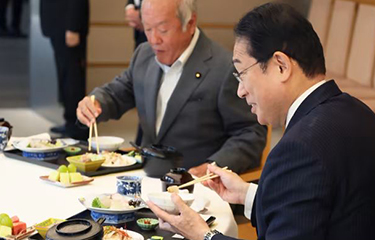
Photo courtesy of Japan Cabinet Public Affairs Office
