





Japan has received the green light to release treated cooling water from the controversial Fukushima Daiichi nuclear power plant into the Pacific Ocean, prompting some of Japan’s neighbors to increase seafood testing requirements or expand the number of Japanese prefectures covered by import bans over fears of radiation contamination.
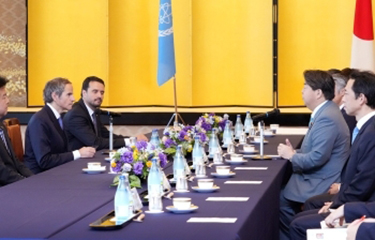
A positive review from the United Nations International Atomic Energy Agency, which the plant received on 5 July, was the last step in getting full approval for the release, the exact timing of which remains unknown.
According to the Export and International Affairs Bureau of Japan’s Ministry of Agriculture, Forestry, and Fisheries, most of the 55 countries that introduced measures on Japanese seafood after the Fukushima Daiichi Nuclear Power Station accident in 2011 have eliminated them. Prefectures banned by other countries differ depending on the importing country.
South Korea, which is trying to mend fraught relations with Japan under new president Yoon Suk Yeol, will maintain its current ban on marine product imports from eight Japanese prefectures: Aomori, Iwate, Miyagi, Fukushima, Ibaraki, Tochigi, Gunma, and Chiba. Imports from other prefectures require a test certificate for radioactive materials but may still be subject to testing during customs clearance. Even a tiny bit of radiation detected in imports will result in a swift ban of the products, local authorities have said.
“The government once again reiterates that the people need not worry about the safety of seafood on our table,” Park Ku-yeon, the first deputy chief of the South Korean Office for Government Policy Coordination, told the Yonhap News Angecy.
Taiwan retains a ban on a few Japanese products, such as mushrooms, but for seafood, it simply requires a test certificate if the product’s origin stems from the prefectures of Fukushima, Ibaraki, Tochigi, Gunma, Chiba, Iwate, or Miyagi. The country lifted its ban on food products from five Japanese prefectures in early 2022.
The Taiwanese government held an inter-ministerial meeting on the release, at which it confirmed the safety of Japan’s plan but committed to close, continued monitoring.
“According to the results of the IAEA review, it is believed that Japan’s emission operations comply with international safety norms and standards, and the radiation impact on the population and the environment can be ignored,” the meeting report stated.
Chinese officials have said that, upon the water release, the country will immediately begin to conduct radiation tests on food from all parts of Japan while maintaining its ban on seafood imports from nine prefectures: Fukushima, Gunma, Ibaraki, Tochigi, Miyagi, Nagano, Saitama, Tokyo, and Chiba. It requires a certificate of origin for seafood from other prefectures. Imports of rice remain banned from a 10th prefecture – Niigata.
Hong Kong currently just requires a test certificate from the five prefectures of Fukushima, Ibaraki, Tochigi, Gunma, and Chiba. However, Hong Kong Secretary for Environment and Ecology Tse Chin-wan said the territory would ban food imports from 10 Japanese prefectures – Tokyo, Fukushima, Chiba, Tochigi, Ibaraki, Gunma, Miyagi, Niigata, Nagano, and Saitama – if the water release goes forward as planned.
“Having considered the final report of the IAEA, relevant information provided by Japan, opinions of the experts [on the] mainland, and risk assessments, the [Hong Kong] government has come to the view that there is currently no guarantee that the purification system can operate continuously and effectively in the long term after the commencement of the discharge plan and that the plan will not pose any potential risks to food safety and marine ecology,” he said.
Macau currently bans seafood from Fukushima, while requiring a certificate for the nine prefectures of Miyagi, Ibaraki, Tochigi, Gunma, Saitama, Chiba, Tokyo, Niigata, and Nagano. The special administrative district announced on 15 July that it would ban imports from all 10 prefectures in response to the release plan.
Chinese Foreign Ministry Spokesman Mao Ning urged the country to “stop pushing ahead with the plan, openly consult with neighboring countries, and responsibly handle nuclear-contaminated water.”
Russia has not added new requirements besides a test certificate regulation, but the Federal Service for Surveillance on Consumer Rights Protection and Human Well-Being, also known as Rospotrebnadzor, plans to increase testing of Japanese imports in response to the release.
“In order to prevent food produced in Japan, including fish, fish products, seafood, etc., with a higher concentration of radionuclides from flowing into the territory of the Russian Federation, Rospotrebnadzor has ordered its territorial departments to ramp up sanitary and quarantine controls as regards the importation of said goods and tighten turnover control,” Rospotrebnadzor announced.
The country lifted its ban on imports from some prefectures in March 2018.
Taking a different tack, the European Union lifted all import restrictions on food, including seafood, from Japan on 9 July.
“We have taken this decision based on science, based on evidence and based on the assessment of the International Atomic Energy Agency,” Commission President Ursula von der Leyen told CNN.
However, the E.U. urged Japan to continue monitoring its food exports for radioactivity.
“This includes in particular fish, fishery products and seaweed close to the release site of the contaminated cooling water,” it said. “It is also important that the Japanese government makes all the results publicly available.”
Japanese government officials have issued assurances stricter customs clearance processes or outright bans on its products could severely bottleneck cargo shipments of seafood due to the time needed to complete rigid inspections for radioactive materials.
Domestically, the release plan has also faced opposition, with local tourism businesses on nearby Honshu Island known for ocean swimming and fresh, local seafood urging the Japanese government to delay the release until mid-August, which marks the end of the summer busy season. The government has said any further delay to the release are not an option, as it will run out of room to store cooling water from the reactor in early 2024.
The timeline for the release did not suffer delays after the Tokyo Electric Power Company publicized information regarding corrosion to the reactor’s base in early April.
Photo courtesy of Ministry of Foreign Affairs of Japan
