






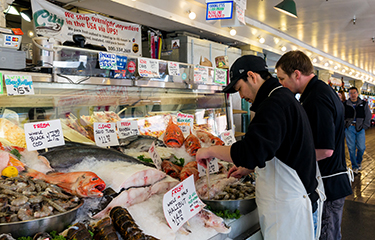
The U.S. retail outlook for the fourth quarter of this year is dreary, providing an ominous outlook for seafood sales, according to new data and insight from major U.S. grocery chains and organizations.
Though overall U.S. retail sales are up 4 percent compared to last year – thanks largely to growth in e-commerce and mail-order sales – grocery chains are releasing uninspiring financial reports that have led them to readjust their guidance for the rest of the year.
After reporting only a 1 percent increase in sales in the second quarter, Cincinnati, Ohio, U.S.A.-based grocery chain Kroger issued a lower sales forecast for the back half of 2023.
“Looking forward, we believe inflation will continue to decelerate [but] the environment will remain challenging for consumers,” Kroger Chief Financial Officer Gary Millerchip said. “We, therefore, expect identical sales without fuel will be at the low end of our full-year guidance range and slightly negative in the second half of the year.”
Kroger had a 1 percent Q2 incline in identical sales excluding fuel, underlying growth of 2.6 percent, and operating losses of USD 479 million (EUR 446 million). However, Kroger will likely realize significant cost savings and profitability if its merger with Albertsons comes to fruition.
Similarly, New York City-based consulting firm Bain and Company is forecasting U.S. retail sales will increase by only 1 percent adjusting for inflation this holiday season, which would be the lowest growth rate since 2018. Retail sales in November and December are expected to reach nearly USD 915 billion (EUR 853 billion), with 90 percent of the growth coming from e-commerce and mail-order sales, Bain said.
“Retailers are facing new challenges this year and are overcoming headwinds from higher interest rates amid increasing debt,” Bain Americas Retail Practice Head Aaron Cheris said. “That being said, several tailwinds may boost holiday retail growth, with prices remaining elevated as compared to last year, even as inflation slows.”
Another warning sign of a dreary holiday retail season is new data showing a slowdown in the growth rate of the U.S. economy, National Retail Federation Chief Economist Jack Kleinhenz said in the organization’s September Monthly Economic Review.
“Progress has been made on combating inflation, but higher prices remain,” Kleinhenz said. “While consumers are still spending, the composition of their spending continues to favor services over retail goods, and even then, there was less momentum going into the third quarter.”
Consumer confidence “took a bit of a hit in August as high prices and interest rates weighed on shoppers’ decisions,” Kleinhenz said in an NRF statement.
The Conference Board Consumer Confidence Index fell to 106.1 from July’s 114, while the University of Michigan Consumer Sentiment Index, a monthly survey of consumer confidence levels in the U.S. conducted by the University of Michigan, dropped from 71.6 in July – the best reading since October 2021 – to 69.5 in August.
“While consumers are constantly faced with conflicting choices when balancing time, health, taste, money, and more, the trends are pretty consistent,” Lakeland, Florida, U.S.A.-based 210 Analytics Principal Anne-Marie Roerink told SeafoodSource. “Unfortunately, those trends mean sustained volume pressure for [products like] fresh, frozen, and shelf-stable seafood as people look to balance their budget to make it to the end of the month.”
Personal consumer spending increased 0.8 percent from June to July and 6.4 percent compared to last July, largely due to initiatives like Amazon’s Prime Day, special deal days offered by other retailers, and entertainment-related events.
However, spending growth is not likely to remain at this pace given continuous inflation woes, high interest rates, and a depletion of excess savings combined with the expiration of a student loan moratorium dating back to the Covid pandemic, Kleinhenz said.
“With spending outpacing income, the savings rate dipped from 4.3 percent in June to 3.5 percent in July, suggesting that consumers are digging into their finances to support household spending,” Kleinhenz said..
Additionally, the U.S. Bureau of Economic Analysis now estimates that gross domestic product grew at a 2.1 percent annual rate adjusted for inflation in the second quarter rather than the 2.4 percent forecasted for the period, Kleinhenz said.
Another sign of trouble brewing in the U.S. retail sector is the fact that gross domestic income, which measures the value of wages, rent, interest, and corporate profits earned during production, rose by a modest 0.5 percent annual rate. Averaged together, GDP and GDI increased only 1.3 percent in the second quarter.
Photo courtesy of cdrin/Shutterstock
