






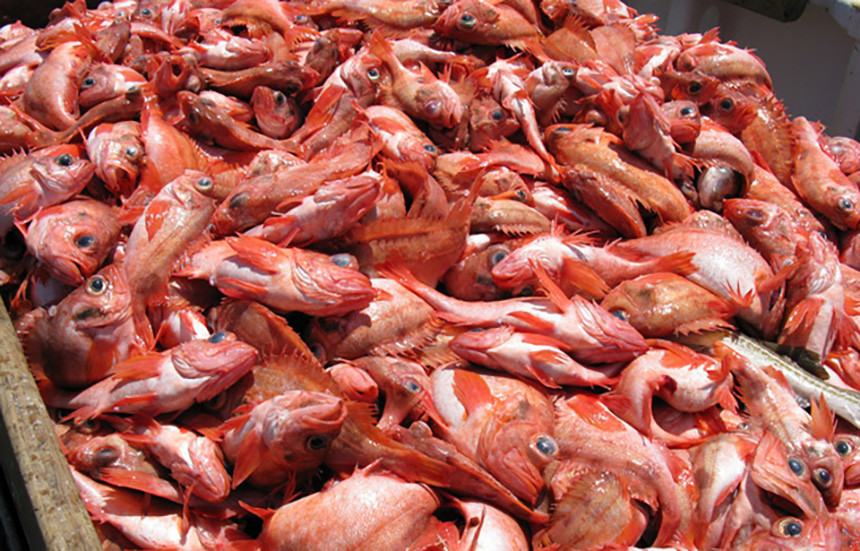
Multiple provinces in Canada are pushing to get access to a developing fishery for redfish – which consists of two species of redfish that live in the Gulf of St. Lawrence and Laurentian Channel areas – with groups from Nova Scotia, New Brunswick, and Newfoundland and Labrador all pushing for access to quota.
The redfish fishery, made up of deepwater redfish (Sebastes mentella) and Acadian redfish (Sebastes fasciatus) has been under a moratorium since 1995 after the stock collapsed. In recent years, populations of both species have recovered to a great extent, enough so that Canada’s Department of Fisheries and Oceans has already been running an experimental fishery in what it deems the Unit 1 area.
New Brunswick Agriculture, Aquaculture, and Fisheries Minister Margaret Johnson said the return presents a “real opportunity” for the province, which has been preparing for the reopening of the fishery.
The Fish Food and Allied Workers Union (FFAW), which represents thousands of fishermen in Newfoundland and Labrador, has also been advocating to get a significant portion of the future redfish quota. The union has engaged in a member campaign calling for support in getting the inshore fleet access to the quota.
“A commitment from federal government for a significant portion of redfish to be landed and processed in this province will support 1,000+ harvester and plant worker jobs, creating tens of millions of dollars in annual economic development, but the full value of this new fishery cannot be fully quantified in numbers,” FFAW said. “A community-based fishery will revitalize revenue streams, improve infrastructure, invite new investments, create and sustain employment, bring stability to the region with the decline of northern shrimp, and establish a renewed sense of place and cultural connection for communities.”
That push, however, has run into heavy opposition from Nova Scotia. Nova Scotia Fisheries and Aquaculture Minister Kent Smith has asked the Canadian government to ensure a significant portion of the quota is given to the province, as it has spent millions of dollars on preparing to be allowed to fish the species again.
Smith sent a letter to Canada Minister of Fisheries and Oceans Diane Lebouthillier urging her to keep allocations mostly limited to the province.
"To change these established allocations would bring significant economic hardships to these Nova Scotia-based fleets and the hundreds of jobs in coastal Nova Scotia communities that they support,” Smith wrote, adding that Nova Scotia getting the portion of the quota it has prepared for would be essential to ensuring future investment in the seafood industry.
"Furthermore, the apparent trend of altering longstanding quota agreements threatens to destabilize investment in seafood infrastructure, as well as market and product development," he said.
Smith told SeafoodSource that keeping the fishery inside Nova Scotia would align with the province’s years of preparation and the fact it pioneered the first fishery before it was closed and held 40 percent of the quota.
“It was Nova Scotian companies that pioneered redfish harvesting in that neck of the woods,” he said. “I’m trying to advocate as best as I can that we have Nova Scotian companies that have been expecting to have Unit 1 come back online, and they’ve made the corresponding investments.”
Smith added the investments would be for naught if the quota was slashed from what the province expects to receive.
“Nova Scotians laid so much groundwork for this,” he said.
Lebouthillier did not respond to Smith, but during a Radio-Canada broadcast, she said the quota will be equally divided, the CBC reported.
"Will everybody be happy? I wouldn't think so because it is hard to find a solution that would suit everybody, but I can tell you that everybody will have their fair share," she said.
However, for Nova Scotia, that “fair share” would mean a reallocation of quota away from the province.
Scotia Harvest President Alain d’Entremont told the CBC that if that happens, the company will be heavily impacted.
"I just don't see how we do without it. I don't see what the alternative is because if those quotas are not going to be respected, if those transactions lead to some harm with communities or to existing participants in favor of others, this is a zero-sum game,” he said. “There's only a certain amount of quota, so it's very disappointing to think about the alternatives."
Photo courtesy of FishWatch, Public domain, via Wikimedia Commons
