






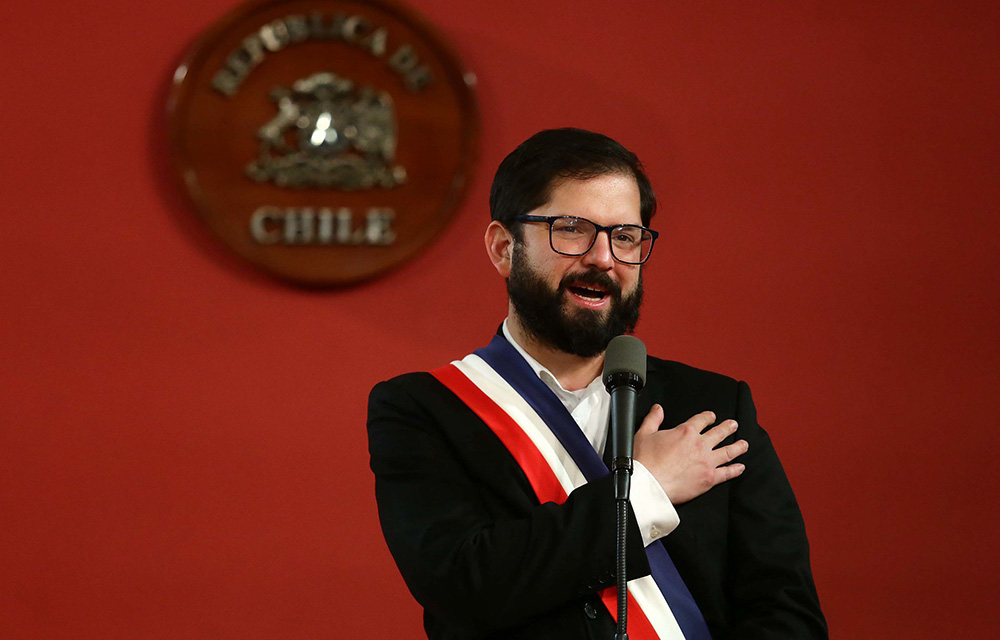
Chile President Gabriel Boric has signed a bill that seeks to replace the country’s highly contentious fisheries law, which Boric and others claim has allowed for instances of corruption in the nation’s fishing sector.
“The past, present, and future of our country is inextricably linked to the sea. We have to say it: The current fishing law has no legitimacy and does not meet the standards that democracy demands,” Boric said in a nationally televised speech. “Despite the fact that social organizations participated in good faith [in passing the current law], there were those who put their private interests above the common interest during its processing that left evidence of bribery and influence-peddling, which are unacceptable in legislative activity in a democracy. We need a new fisheries law for Chile – [one] that is fair … and ensures resource sustainability.”
Boric's call for a new national fisheries law hearkens back to his first address to the nation on 1 June 2022. In the speech, Boric called for changing the fisheries law, which gives four large-scale private fisheries control over the vast majority of Chile’s marine resources, and implement one that was “free of corruption.”
The original law’s primary goal upon introduction in 2013 was to set quotas to limit overfishing, which at the time was an issue particularly affecting horse mackerel populations.
However, in an investigation referred to as the “Corpesca case” – named after one of the four large fishing companies – a number of Chilean parliamentarians were accused of accepting bribes in exchange for ensuring the bill favored larger seafood firms. Francisco Mujica, the CEO of Corpesca at the time, was also charged with bribery and tax crimes.
Vowing to create a law that “is going to be democratically legitimized and built on scientific evidence,” Boric said the new bill's creation included a participatory process composed of more than 200 meetings, which took place between September 2022 and February 2023 and involved nearly 6,000 attendees, including industrial and artisanal fishers as well as academics and scientists.
After not receiving an invite to the launching ceremony of the new bill, though, commercial fishing industry representatives are skeptical as to whether the bill will pass through a fully democratic process on the way to ratification.
National Fisheries Society (Sonapesca) General Manager Héctor Bacigalupo said he has yet to see a copy of the text. He insisted the bill “should contain clear long-term rules to ensure legal certainty that allows for investment, innovation, and strengthening of the fishing ecosystem.”
“Today, signals must be sent that provide certainty and not more uncertainty that affects investment and generates economic stagnation; it is not what Chile needs in these times of crisis,” he said in a statement.
According to information from Boric’s office, the newly penned bill aims to redistribute resources in favor of artisanal fishing while simultaneously prioritizing sustainability, including the mandatory institution of management plans for all fisheries, without exception.
If passed, the percentage of licenses allocated through public tenders to industrial fishers will increase from 15 percent to 50 percent. At the same time, the total allowed quota for the industrial sector will decrease from 85 percent to 50 percent.
The bill also seeks to improve the bidding rules for the auctioning of fishing licenses under the principles of transparency and the promotion of free competition, and it proposes setting maximum percentages of fishery resources that each bidder may be awarded in order to limit market concentration.
In addition, grassroots organizations and federations of artisanal fishers will gain legal recognition.
The Chilean Economy Ministry stressed that the bill’s main focus areas are sustainable fishing; equity in the fishing sector in terms of resource use; employing technical and scientific approaches toward decision-making; transparency in combating illegal, unreported, and unregulated (IUU) fishing activities; and food security.
The bill includes measures reinforcing the value chain and advancing economic support for fishing communities; promoting conservation and environmental protection measures while also providing social protection for artisanal fishing; deploying fisheries management strategies that integrate technological advances, environmental variations, and anthropogenic constraints into the modeling; disseminating accurate and timely information on traceability; and pushing Chilean consumption of seafood up toward the global average of around 20 kilograms per capita annually, from the 2021 figure of 16.5 kilograms per capita.
Photo courtesy of the Ministerio de las Culturas, las Artes y el Patrimonio, Gobierno de Chile
