





Prices in Russia for pink salmon have dropped 15 percent as a predicted record-setting catch has increased supply far above domestic demand.
A preliminary forecast of 375,000 metric tons (MT) of pink salmon made in February 2023 is likely to be surpassed, with 285,000 MT already caught, according to the Russian Association of Production and Trade Enterprises of the Fish Market. That’s nearly as much as the 2022 season, though Russia’s pink salmon run in larger numbers in alternating years.
“[It should be] 500,000 tons. If nature makes us happy, then perhaps it will be even better,” the association’s executive director, Alexander Fomin, told Osnova News on 2 August.
Fomin said the total should produce around 20,000 MT of salmon caviar, which will surpass domestic demand.
“There will definitely not be a shortage of caviar,” he said. “But we need to monitor the volume of exports. If exports to China increase, most of the fish may go there and to other countries in the Asia-Pacific region, and less will be offered to the domestic market than for export.”
Current wholesale prices for salmon caviar are RUB 3,500 to RUB 4,000 (USD 37.04 to USD 42.33, EUR 33.84 to EUR 36.67) per kilogram.
“This is much below the market, but if they will start to buy it, I think by the end of August, [prices will rise,” Fomin said.
Russia’s national catch of pink salmon in July was its largest in five years, according to the All-Russian Research Institute of Fisheries and Oceanography. In April, Russia Federal Fisheries Agency Deputy Head Vasily Sokolov announced the projected catch of all Pacific salmon in the Far East in 2023 would be an estimated 512,000 tons, which would make it the third-largest haul in recorded history after 2018 (678,000 MT) and 2021 (539,000 MT).
Frozen pink salmon is selling for an average of RUB 276 (USD 2.92, EUR 2.66), down 15 percent. It had been selling for as much as RUB 1,000 (USD 10.58, EUR 9.67) prior to the season’s start, according to Rosstat.
Vitaly Kornev, president of the Association of Production and Trade Enterprises of the Fish Market, said domestic salmon prices will depend on how much the country’s seafood firms are willing – and able – to export.
“Exports can play a role, because the ruble is now relatively weak,” he said.
Kamchatka’s pink salmon run came early this year, beginning on 1 June, and will account for at least 50 percent of the national catch, but the runs in Sakhalin, the Kuriles, Magadan, and Khabarovsk have yet to begin and will finish in September, according to Kornev.
“We will finally understand how the prices will develop within a month. So far, everything is going to the fact that there will be a fall [in prices] compared to last year: a more significant one for fish and a less significant one for caviar,” he said. “Last year, fishermen did not get their bearings in the market, because in the autumn about 100,000 tons were exported … [at a] significantly cheaper [rate] than they could sell on the domestic market. But the price in the range of RUB 250 [USD 2.64, EUR 2.41] for pink salmon is more or less balanced. At this price, you can sell something on the foreign market, and that, at the current price level, on the domestic market."
In June 2023, authorities from the regional government in Kamchatka signed a cooperative agreement with the retail chains Vkusvill, Hyperglobus, and Lenta to provide pink salmon, pollock, and herring to outlets in central Russia, with 3,000 MT of pink salmon having been delivered thus far this season. It’s part of a government-led effort to better distribute domestic catches through Russia.
“The project is moving on – not as fast as we would like, but we hope that it will give a result,” Panin said.
Panin said high transportation and processing costs are impeding that effort.
“Someone has to take over the function of transforming it into a product for consumers. No one buys fish in 20-kilogram boxes,” he said.
The effort will be boosted by a new law that comes into effect in September 2024 that will require Russian salmon companies to send a portion of their catch to the domestic market and to contribute to socio-economic development in the areas where they fish, which could impact the market in the future, according to RBC.
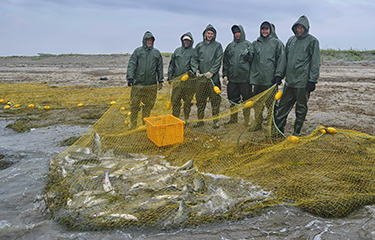
Photo courtesy of Konstantin Baidin/Shutterstock
