






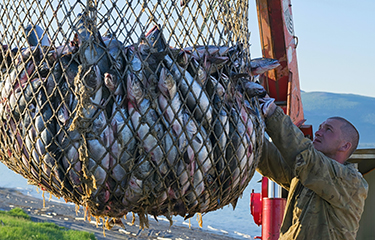
A preliminary forecast is predicting a huge season for Russian salmon, with an expected total harvest of 511,000 metric tons (MT) of Pacific salmon expected to be caught in 2023.
The prediction for the season, which begins in June, calls for landings of 375,000 MT of pink salmon, 91,000 MT of chum salmon, 35,000 MT of sockeye salmon, 9,000 MT of coho salmon, and a trace amount of chinook salmon.
Though 2022 saw the second-lowest global wild salmon harvest by volume since 2008, at around 720,000 MT caught in Canada, South Korea, Japan, Russia, and the United States, 2023 could see the global catch total surpass 1 million MT, according to Victoria, British Columbia, Canada-based Tradex Seafoods. Between Russia’s larger expected harvest and Bristol Bay’s sockeye run size forecasted at 51 million fish, on top of it being a higher-yield odd-year season for pink salmon, it could be “another exciting summer salmon season,” Tradex Foods President and CEO Robert Reierson said.
“This would make it one of the largest forecasts on record in recent years, and Russia almost always harvests more than what it forecasts,” Reierson said.
Salmon landings in Russia's reached 247,000 MT in 2022, according to the country's federal fishery agency, Rosrybolovstvo. That was far below the projected harvest total of 322,000 MT, comprised of 190,000 MT of pinks, 90,000 MT of chum salmon, 33,000 MT of sockeye, 8,000 MT of coho, and 510 MT of chinook salmon.
In 2021, Russia caught 520,000 MT of salmon in total, far above the pre-season forecast of 460,000 MT and second only to 2018, when 676,000 MT was harvested. The catch in 2021 was 4.5 percent higher than 2019's, which was 498,000 MT, and far ahead of the abysmal 2020 season, which saw a catch so low – 299,200 MT – it prompted calls for a new method of predicting the year’s harvest.
After dealing with two years of complications from the Covid pandemic, Russian salmon firms are now dealing with potential government intervention as a means of keeping domestic prices low. In 2022, catches were so much lower than expected that prices skyrocketed, and Russian Federal Agency for Fisheries Head Ilya Shestakov introduced a proposal banning exports of salmon and salmon roe. However, the proposal was rejected in January 2023, according to the Minato Shimbun.
Despite facing sanctions from many countries opposed to its invasion of Ukraine, Russia has managed to maintain some of its seafood-export markets, particularly in Asia.
Photo courtesy of Konstantin Baidin/Shutterstock
