






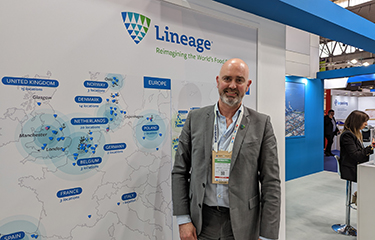
Since its entry into the European market, Lineage Logistics has rapidly acquired additional companies and resources in a push to become a complete logistical solution in the region.
Lineage has had a presence in the U.S. and at Seafood Expo North America in the past, but the 2023 edition of Seafood Expo Global/Seafood Processing Global in Barcelona, Spain was the first time the company had a presence at the Europe-based trade show. Lineage first entered the European market in 2017, with the acquisition of a Dutch company, Lineage Logistics Vice President of Business Development Europe Edwin Wentink told SeafoodSource.
Since that time, the company has had a “trail of acquisitions” throughout the bloc, gaining locations in Norway, the U.K., Spain, Italy, France, Belgium, and more, Wentink said.
“Now we have a network of 75 locations, 10 countries, and we’re getting to become a sizable force in Europe,” he said.
The company’s acquisition strategy, Wentink said, selects companies that have some aspect to them that can be integrated into Lineage’s wider operations, allowing the company to gain both additional locations and new resources.
As with its operations in the U.S., the ebbs and flows of the cold storage business are largely related to seasonal demand.
“For example in Spain, our current business is very much based on frozen vegetables,” Wentink said.
A good harvest will mean Lineage has to provide more space, while a bad harvest will leave extra room at its locations Spain, he said.
“Last year was a very poor harvest,” Wentink said. “Compared to normal, it was very empty.”
The company’s seafood operations are largely located along coastal areas near ports. Its locations in the Netherlands, Denmark, and Norway all carry seafood.
“If you look to Denmark, it’s very connected to Iceland and Greenland, so a lot [of seafood] comes in to Europe there,” Wentink said.
Automation in Europe is much more prominent in Lineage’s European operations compared to its U.S. operations, he said.
“I think in general, Europe is a little bit more space-conserving,” Wentink said. Space being at a higher premium requires the company to maximize its efficiency.
Labor, too, is a reason for Lineage to push for automation. Competition for labor in some regions of the E.U. is high, requiring the company to plan its operations around acquiring and keeping the talent necessary to run its operations.
The logistics portion of the business, and moving cargo from around Europe is also different from the U.S. and requires different areas of expertise. One example cited by Wentink is how the U.S. has a robust freight rail network, while in Europe any freight rail network is largely focused on mining or other materials, with food low on the priority list.
“I think what’s also different between the E.U. landscape and the U.S. is the barging,” Wentink said. “Short river logistics, short sea vessels, are different from a sustainability perspective and a cost perspective versus road [travel]."
As the company has continued to expand its presence in the E.U. – it just opened an expansion at a facility in the Port of Aarhus, Denmark – Lineage has also made a push to become a more-complete logistical solution for its customers. Some of its latest acquisitions allowed the company to begin developing a freight-forwarding service, which Wentink said Lineage is “now rolling out” in the Netherlands, Poland, the U.K., and a location in South Africa.
Unlike in the U.S., where shipping products across the country encounters few barriers between states, shipping products in the E.U. can be a complicated web of requirements and documentation. Shipments in Ireland post-Brexit, dealing with containers of fish that have been sold mid-transit, navigating complex sanctions that were put in place following Russia’s invasion of Ukraine, and more all add to the difficulty of moving cargo from one area to another.
Wentink said the company decided to embark on creating a freight-forwarding service after hearing about the difficulties its customers were encountering. While some customers want to be fully in control of their freight forwarding, he said, “others want convenience.”
“To that latter voice, we looked and we think we can offer warehouse customers a better solution, adding value to the Lineage brand and also to the customer,” Wentink said. “From a Lineage perspective, if you can help them with documentation, you can help them with freight-forwarding, if you can work with sizable businesses but who are less-dominant in exports, we can be that one-stop solution in creating our network.”
Photo by Chris Chase/SeafoodSource
