






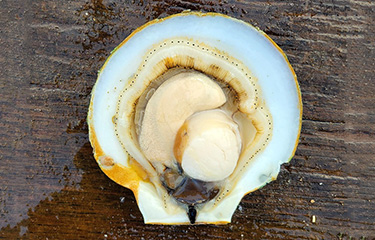
The New England Fishery Management Council (NEFMC) recently received the latest biomass surveys of the U.S. Atlantic sea scallop fishery, with signs pointing to the 2024 quota remaining relatively flat.
The surveys were conducted by the Coonamessett Farm Foundation, the University of Massachusetts Dartmouth School for Marine Science and Technology (SMAST), and the Virginia Institute of Science. The federal scallop survey was canceled in 2023 after mechanical problems sidelined the survey vessel, the R/V Hugh R. Sharp.
According to a report delivered to the NEFMC during its meeting in late September, overall scallop biomass remains low compared to the high levels recorded in 2015 through 2019, though the surveys found some positive signs for the future of the fishery.
The Atlantic scallop fishery in the U.S. Northeast has had to grapple with a big drop in biomass compared to the peak in 2019, when scallop landings hit nearly 60.5 million pounds. The large totals were largely thanks to the 2012 to 2013 year-class, which had some of the highest levels of recruitment in the fishery’s history.
That year-class ran its course after 2019 and the quotas and landings have dropped along with the biomass. The fishery landed 47.5 million pounds in 2020, a 21 percent drop compared to 2019; and then landed 43 million pounds in 2021. According to NOAA Fisheries, the total catch in the U.S. in 2022 reached 31.5 million pounds. The scallop quota for 2023 was set at just 24 million pounds.
The 2024 quota has not yet been set, but according to the the report, the surveys found five times more scallops in Georges Bank than in the Mid-Atlantic region. In the Mid-Atlantic biomass decreased in all areas except for Hudson Canyon, and the surveyors did not detect any signs of recruitment, which suggests “a large mortality event occurred in the Elephant Trunk Area,” a release from the NEFMC states.
Despite the poor recruitment in the Mid-Atlantic, biomass did increase between 2022 and 2023, the NEFMC said, “driven by growth of a large year class in Closed Area I and the Great South Channel.” Plus, smaller scallops from recruitment events in Nantucket Lightship South were not factored into the biomass estimates because those scallops are still too small and are “pre-recruits.”
The news comes as landings have begun to drop off in 2023, according to a report from Bristol Seafood. Landings in September were down 63 percent compared to September 2023 as the reduced quota began to have an impact, the Portland, Maine, U.S.A.-based company said.
However, scallop sizes were much larger in 2023, according to Bristol. Larger-sized scallops such as U10s and U12s, made up 30 percent of the catch, compared to just 17 percent of the catch last year. Smaller sizes, such as 20/30 graded scallops, made up just 7 percent of the catch compared to 25 percent last year.
“The result is a narrowing spread between U10 and 10/20s and a peculiar dynamic where boat prices for 20/30s sometimes exceed 10/20s,” Bristol said.
The overall scallop supply in the U.S. is also being influenced by the fishery in Japan. The 2023 scallop season in North Hokkaido has begun, but the release of water from the Fukushima Daiichi nuclear power plant has resulted in China – where most Japanese scallops are processed – banning all seafood imported from Japan. The U.S. government is assisting in the relocation of processing operations, with the goal of giving Japanese scallop producers and others in the country's seafood industry access to additional markets.
However, during Seafood Expo Asia in Singapore in September, Uda Takanori of Dogyoren – the Hokkaido Federation of Fisheries Cooperative Associations – told SeafoodSource there was also some pullback of orders elsewhere.
Photo courtesy of VIMS
