






Japanese seafood conglomerate Nissui is banking on healthy and convenient consumption trends as it concentrates its growth strategy on the United States and European Union.
In its 2023 integrated report, released 22 December, Nissui set the goal of achieving JPY 1 trillion (USD 6.7 billion, EUR 6.2 billion) in total sales and JPY 50 billion (USD 333 million, EUR 308 million) in operating profit by 2030, with 50 percent of net sales coming from outside Japan. To achieve this, Nissui plans to accelerate the growth of its Food Products and Marine Products businesses abroad and boost the profitability of its Fine Chemicals and Aquaculture businesses.
“The key strength of our group is our value chain – the ability to procure marine resources, add significant value, and market them internationally. In addition, we have a unique business model in which our three main businesses – Marine Products, Food Products, and Fine Chemicals – create synergy and mutually support one another, forming a robust framework,” Nissui said.
Nissui has allocated JPY 20 billion (USD 133 million, EUR 123 million) for acquisitions and JPY 120 billion (USD 800 million, EUR 740 million) for improving its food processing capacity and capabilities. A significant part of that investment will be focused on the U.S. and E.U., with the announcement Nissui will spend JPY 17 billion (USD 113 million, EUR 105 million) to add capacity at Gloucester, Massachusetts, U.S.A.-based Gorton’s – which manufactures and sells frozen seafood products in North America – and Plumerine, France-based Keranna Productions – which produces frozen and chilled fried whitefish and alternative protein products.
The company has set the goal of having processed products account for 40 percent of its food sales by 2030.
“With customers increasingly becoming more health-conscious and emphasizing convenience, we are proceeding with initiatives to realize a higher level of food processing and to create products prepared as foodstuffs, such as fish fillets, grilled fish, and pickled fish,” the company said. “By focusing on food processing that makes effective use of Nissui’s strengths in processing and distribution, we are able to provide high-value-added products and meet consumers’ needs in terms of health and convenience, and in doing so, we are aiming to reduce volatility and enhance profitability.”
Manufacturing more fried seafood products, health-oriented products, Asian-influenced products, and plant-based foods, with an expansion of product categories in North America and sales areas in Europe, are priorities, Nissui said in a supplementary document to its annual report. It celebrated the early successes of the strategy, such as Gorton’s February 2023 launch of a line of air-fried products and King & Prince Seafood’s expansion of its offerings of Asian foods, including shumai and takoyaki.
“These products are currently produced and exported from Japan, with plans to explore local manufacturing options,” Nissui said. “Making effective use of its sales channels that supply fried shrimp products to regional foodservice chains and of its production capabilities, King & Prince Seafood is expanding into fried white-meat fish products. Besides aiming to boost sales and operating profit, the company is also proceeding with the development of new sales channels for Asian foods such as shumai, which are becoming increasingly popular.”
In Europe, Nissui is also expanding Cité Marine’s production of chilled fried seafood and plant-based foods.
“Among the countries of Europe, the biggest consumers of seafood by volume are, in descending order, France, Spain, Italy, the United Kingdom, and Germany. In the chilled foods segment, where competition is limited, Cité Marine is expanding its sales channels, with a focus on chilled foods that effectively utilize seafood and agricultural materials, and which have a fresh appeal,” Nissui said. “In France, Spain, and Italy, consumers view chilled foods as being fresh products with a fresh image, and they are thought of as premium products to a greater extent than frozen foods. Chilled foods are placed on key customer circulation routes inside supermarkets, and product turnover is very high.”
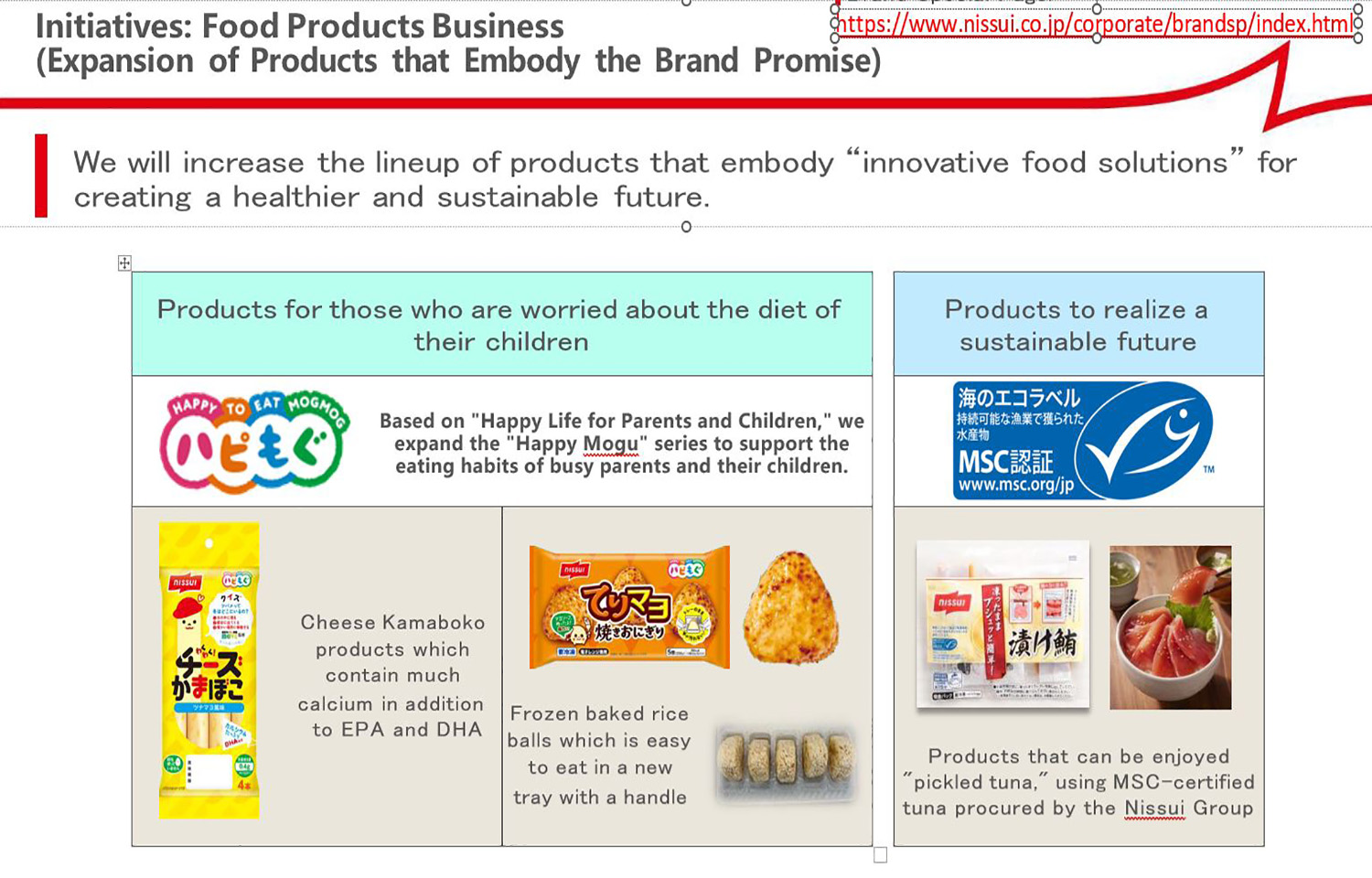
Nissui sees a huge opportunity in rising demand for sustainable seafood, specifically products with Marine Stewardship Council, Aquaculture Stewardship Council, and Japan’s Marine Eco-Label certification.
“Going forward, we will continue to respond to customers’ diverse needs, including the demand for convenience and for environmentally friendly products, by providing innovative food solutions that emphasize sustainability,” it said.
The company identified rising raw materials prices and availability – primarily due to climate change – as well as unstable supply of seafood and labor shortages in the U.S. and E.U., as its primary challenges to enacting its strategy.
“We are continuing to implement integrated measures to reduce costs in our processing business in North America, for example, by strengthening access to Alaska pollock resources and by enhancing production efficiency through adjustment of the product mix,” it said. “As a means of developing new sales channels, we are using e-commerce to expand into home delivery of processed seafood, with the aim of expanding sales.”
Nissui also pointed toward the impacts of stricter fishing rights regulations and of aquaculture as potential reputational risks “in relation to perceived failure to safeguard animal welfare or the environment,” as well as the “emergence of food tech and the increasing obsolescence of current aquaculture technology” as possible threats to its business.
Image courtesy of Nissui
