






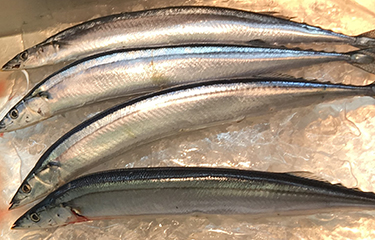
The 2023 fall saury fishing season in Japan has officially begun, with the initial catch sold at record high prices, but experts believe that landings throughout the season are likely to mirror last year’s abysmal catch totals.
Before the season began, the Japan Fisheries Research and Education Agency (FRA) released its “2023 saury long-term fishing forecast” on 28 July. It projected the volume of saury expected to migrate toward the Pacific coast of Japan from August to December this year will be at “a low level,” mirroring last year’s brutal start to the fall season. The forecast references data gathered from surface trawl expeditions conducted in June and July.
The report states that the ratio of 1-year-old fish in the catch is likely to exceed the 58.8 percent majority which the age group comprised last year, but at least “the catch of 1-year-old fish around September will mainly be in the 110- to 120-gram range, compared with last year's 100- to 110-gram range.” Larger fish tend to sell better and give fishermen a greater chance of fetching a decent price at local markets.
The report stated that since 2019 – the first of four straight years in which Japan has recorded record low saury catches – there have been delays in the arrival of Pacific saury to Japanese fishing grounds, and it speculates that light 1-year-old fish try to put on weight in northern waters as long as possible.
The fish typically spend the summer in international waters northeast of Hokkaido and migrate south along the coast when the waters cool. In recent years, though, warmer ocean water temperatures have kept the fish in the north longer, where vessels from China and Taiwan can continue to target the stock. This year will likely follow the recent pattern.
Nevertheless, the fishing season opened for large vessels on 20 August, with smaller vessels preceding the full opening by a few days.
At about 5 a.m. on 19 August, small-vessel fishermen landed the first saury catch – amounting to 469 kilograms – at Hanasaki Fishing Port in Nemuro City, Hokkaido, selling the batch at the Hanasaki Market shortly thereafter, according to Hokkaido News UHB.
The highest-selling saury from that first landing sold for a record high price of JPY 140,400 (USD 960, EUR 881) per kilogram, nearly a trebling of last year’s high price of JPY 54,000 (USD 389, EUR 339) per kilogram.
The price increase might have been due to the official forecast of another record low catch, but the report hinted that this might also have been a publicity stunt, highlighting that a local AEON supermarket was offering saury landed at nearby Akkeshi Fishing Port for a measly JPY 150 (USD 1.03, EUR 0.94) per fish the same evening. Estimating one fish to be about 150 grams, this pricing nets out to around JPY 1,000 (USD 6.85, EUR 6.28) per kilogram.
Three small fishing vessels landed another 1.1 metric tons (MT) at Akkeshi Fishing Port, and the highest selling price netted in this batch was JPY 35,000 (USD 241.96, EUR 222.72) per kilogram.
Typically, the national average price is much lower. The national average price in September 2018 was JPY 139 (USD 1.09, EUR 1.00), and the price fell in December to JPY 90 (USD 0.70, EUR 0.65). In 2020, the price was JPY 164 (USD 1.24, EUR 1.19) in September, falling to JPY 134 (USD 1.05, EUR 0.97) in December. The national price hit JPY 188 (USD 1.47, EUR 1.36) in September 2022, and the Tokyo price average was JPY 145 (USD 1.13, EUR 1.05) in December – highlighting the rise in price in both months.
While the FRA report predicted another poor year for saury landings, the surface trawl expeditions that supplied the report’s data found that sardines and mackerel were plentiful.
It also posited that sardines, which have been abundantly present in the waters around Japan in recent years, have affected the migration of saury.
“It is also conceivable that distribution of sardines and saury in the survey area are in a competitive relationship,” the report said. “It has been pointed out that the expansion of the distribution of sardines to low-temperature regions may have affected the distribution of saury.”
Schools of saury are likely to stick to the high seas throughout the fishing season, rather than coming near the coast. This is yet another factor that hurts Japanese fishermen since the country has a shore-based saury fishing fleet, rather than utilizing factory processors as China and Taiwan do. When saury are far out at sea, more time and fuel are necessary to catch the species, resulting in low profits for fishermen who may choose to attempt deep-sea saury fishing.
Traditionally, Japanese commonly grill and eat Pacific saury in the fall, as the fish is a staple food of the autumn season, along with chestnuts, matsutake mushrooms, persimmons, and sweet potatoes. The delayed migrations and poor landings of recent years have shifted eating habits, however, resulting in the fish becoming more of a winter option instead.
Photo by Chris Loew/SeafoodSource
