






Russian shipments of live and frozen crab to China jumped massively in 2023, as the country’s access to the U.S. and European markets has largely closed off.
Russia’s seafood industry has been dealing with bans and sanctions in response to its invasion of Ukraine in 2022. The U.S. announced its first bans in March 2022, and since that time, the administration of U.S. President Joe Biden has tightened those restrictions even further.
The European Union also introduced sanctions on Russian goods soon after the invasion, heavily restricting another of Russia’s traditional major markets.
The result is evident in trade data, which shows China importing massive amounts of Russian crab in 2023. According to Les Hodges of Les Hodges Seafood Consulting, China imported 40.9 million metric tons (MT) of crab in 2023 – a 75 percent increase in volume compared to 2022, which saw imports of 23.4 million MT. Of that, live king and snow crab imports totaled more than 30,000 MT, while frozen imports were just under 11,000 MT.
The higher volumes came with a drop in price; the average price for combined live king and snow crab dropped 11 percent to USD 23.56 (EUR 21.84) per kilogram, while frozen king and snow crab prices dropped by 39 percent to USD 11.09 (EUR 10.28) per kilogram, according to Hodges.
Recent stats released by Russia’s Federal Fisheries Agency (Rosrybolovstvo) indicate Russia sent 1.21 million MT of seafood to China in 2023 – more than double what it sent in 2022. That total comprises more than half of the country’s entire exports of seafood, as it sent 2.2 million MT of seafood to other countries in 2023.
Rosrybolovstvo said overall production in 2023 reached 4.4 million MT, which is 6 percent, or 245,000 MT, more than in 2022.
Russian crab companies are continuing to work to improve harvests and efficiencies, in part thanks to crab quota auctions that require companies to build new vessels as a prerequisite to accessing crab quotas.
Russian Crab, one of the largest companies in the country fishing for crab, recently launched the Kapitan Aleksandrov on its first voyage, complete with advanced live crab storage capabilities fitted with 32 isolated tanks that each have temperature, salinity, and oxygen content controls that the company said “makes it possible to ensure preservation of at least 98 percent of products.”
“At this stage, Kapitan Aleksandrov is the first project 5712LS crab fishing vessel in the Russian crab fishing fleet which is ready for harvesting,” Russian Crab Group of Companies Director Aleksandr Sapozhnikov said in a release.
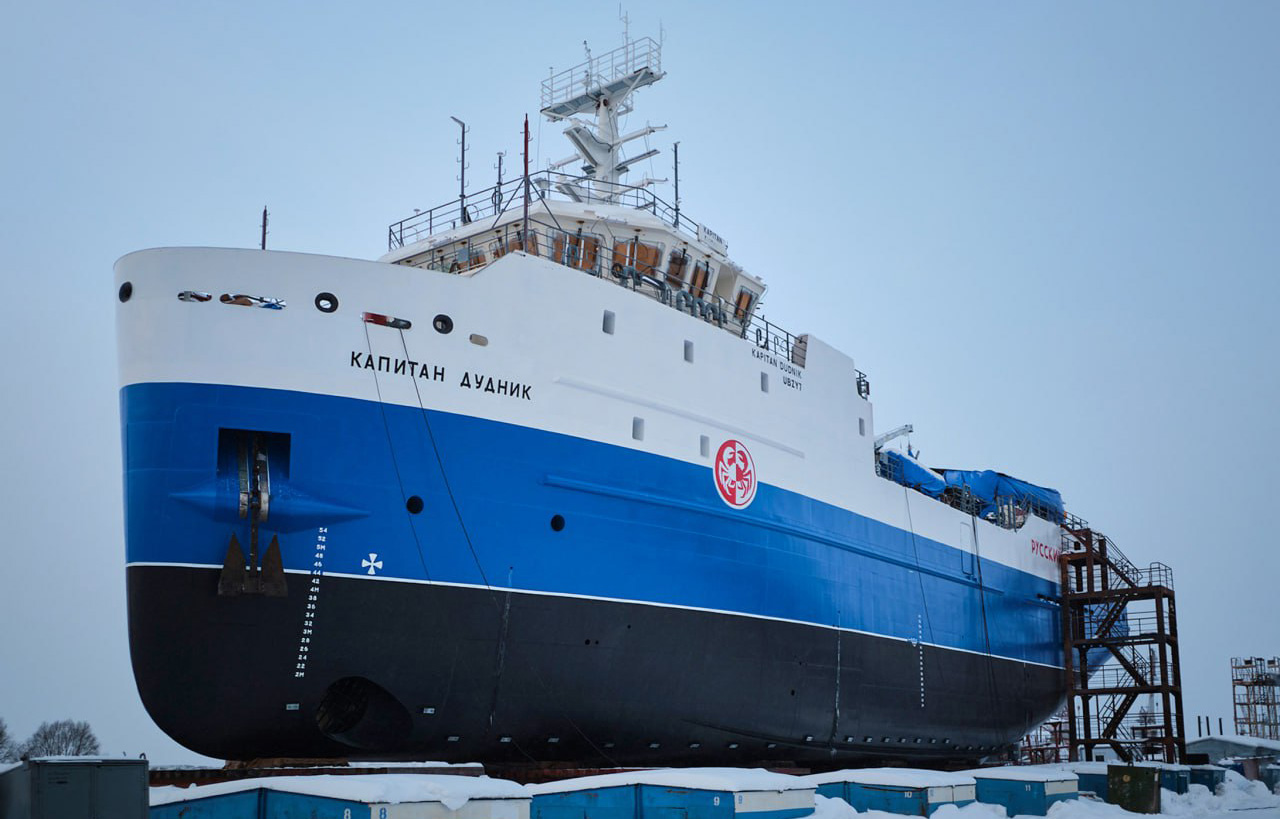
More recently, Rosrybolovstvo announced the launch of the Captain Dudnik, another crab fishing vessel built as part of the investment quota program for the Russian Crab Group of Companies.
“Modern crab catchers are distinguished by improved seaworthiness, doubled capacity for catching and processing catch, automation and digital control of technological processes, a new level of safety and comfort for the crew, and higher environmental friendliness,” Rosrybolovstvo said.
Rusisan Crab’s founder Gleb Frank emerged as a “crab king” soon after the first round of quota auctions in 2019, but since that time, he has sold the company off after the U.S. imposed sanctions on him, specifically targeting him for his relationship with Gennady Timchencko, who is allegedly a close partner of Russian President Vladimir Putin.
While Russian companies are investing heavily in the crab fishing industry, the contraction of the market and the drop in prices has compounded an existing cost problem.
Rosrybolovstvo chose winners in late 2023 of the second round of auctions bringing in an estimated RUB 214.5 billion (USD 2.3 billion, EUR 2.1 billion). That cost, however, could become a burden on the fishery as the Russian Association of Crab Harvesters estimated the industry could be facing more than RUB 500 billion (USD 5.4 billion, EUR 5 billion) in necessary investments over the next 15 years.
“At this stage, it is difficult to make accurate calculations, but this amount shows the real level of costs that investors participating in auctions will incur over a 15-year period,” the association's president, Alexander Duplyakov, told Fishnews.
Business leaders in the crab industry have further predicted that the challenging market conditions for crab – which have led to China’s dominance in Russia’s market – could eventually pose problems as the costs become a burden.
“Current economic conditions pose new challenges for us. The European and American markets are closed to us; in Russia, unfortunately, there is no demand for crab consumption. Asia remains the only buyer,” Antey General Director Andrey Polomar told Fishnews. “The Chinese, for example, value and love live crab, but they are not interested in fresh frozen crab. Therefore, we have to develop more and more new logistics routes.”
Photo courtesy of the United Press Service of Rosrybolovstvo
