






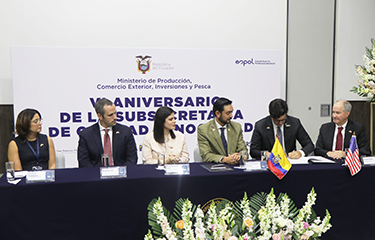
The U.S. Food and Drug Administration (FDA) has signed a regulatory partnership arrangement (RPA) with the Ecuador Vice Ministry of Aquaculture and Fisheries in an attempt to enhance the food safety of shrimp destined for the U.S. market.
The move results from a 2021 U.S. congressional mandate focused on improving shrimp-related food safety. It ordered the FDA to consider and develop new options for improving the regulation of imported farmed shrimp. The mandate included establishing an RPA with India, Indonesia, and Ecuador, the top shrimp exporters to the U.S. by volume. The recently signed agreement is the first such agreement to be finalized.
Under the RPA, the FDA will work closely with Ecuador’s seafood regulatory authority to reinforce food safety practices along the entire farmed shrimp supply chain, leveraging oversight systems with updated data and information before and at the port of entry.
The regulatory partnership is the first of its kind, according to the FDA, which said it performed a “rigorous assessment” of Ecuador’s farmed seafood safety system before entering the agreement. This included analyzing legal frameworks, inspection and enforcement capabilities, verification and audit programs, aquatic animal disease prevention and surveillance programs, illness outbreak responses, training, and laboratory resources.
“Through this assessment, the FDA is confident that Ecuador has key components of a food safety oversight system for shrimp and shrimp products intended for export to the U.S.,” the FDA said.
Daniel Legarda, Ecuador’s minister of production, foreign commerce, investment, and fishing – who also oversees the country’s vice ministry of aquaculture and fisheries – said the agreement would serve to further build U.S. confidence in Ecuador’s shrimp-farming industry.
“Trust is a fundamental link [throughout] the productive chain, especially in the international markets,” he said during the signing ceremony. “This regulatory agreement will generate higher trust in the main actor, which is the consumer, with the great commercial partner and great market that the United States is.”
Legarda said shrimp is Ecuador’s main non-oil export product, with the United States being the number-two buyer after China.
"Guaranteeing strict compliance with quality and safety standards is our priority,” Legarda said.
Ecuador Vice Minister of Aquaculture and Fisheries Andrés Arens said Ecuadorian and U.S. authorities will collaborate to share information on best practices, food safety policies, and regulatory approaches to address the safety of shrimp; ensure rapid notification and responses to adverse food safety events; promote and conduct training, including FDA import operations, basic hazard analysis and critical control points (HACCP), train-the-trainer HACCP, good aquaculture practices, and seafood decomposition detection; and participate in shrimp inspections, audits, and investigations.
“Today, we have an extremely organized subsecretary, a subsecretary that is equipped with all the [necessary] inputs and resources, not just physical or technological tools but also the human resources needed to serve [the shrimp industry],” he said.
Calling it “an historical day for our industry,” Yahira Piedrahita, executive director at Ecuador’s National Chamber of Aquaculture (CNA), said the agreement will further the bonds of trust necessary to improve trading ties between the two countries.
“Once the exporting companies are audited by the undersecretary for quality and safety [SCI, according to the acronym in Spanish], the FDA will have much more trust in the products that arrive from Ecuador to the U.S. The final consumer will also benefit from a product that has safety guarantees that have been previously audited by their own health agency [the FDA]. This means that Ecuador offers the U.S. consumer full guarantees regarding the quality and safety of the shrimp it places in the market,” she said.
The announcement comes just one year after Ecuador’s Vice Ministry of Aquaculture and Fisheries signed a confidentiality agreement with the FDA, as a first step in the process that eventually led to the RPA.
Under that agreement, FDA delegates received an invitation to visit and inspect aquaculture work areas regulated by Ecuador’s SCI, including hatcheries, farms, processing plants, feed factories, distributors, and laboratories. The agreement also called for planned meetings between representatives of the two countries’ aquaculture and export sectors.
In 2022, Ecuador’s vannamei production increased 88 percent by volume when compared to 2020. It has risen to become the world’s top shrimp producer, with 1.3 million metric tons (MT) farmed in 2022 – far above India and China, which tied for second place with 800,000 MT each in 2022.
Photo courtesy of the Ecuador Ministry of Aquaculture
