






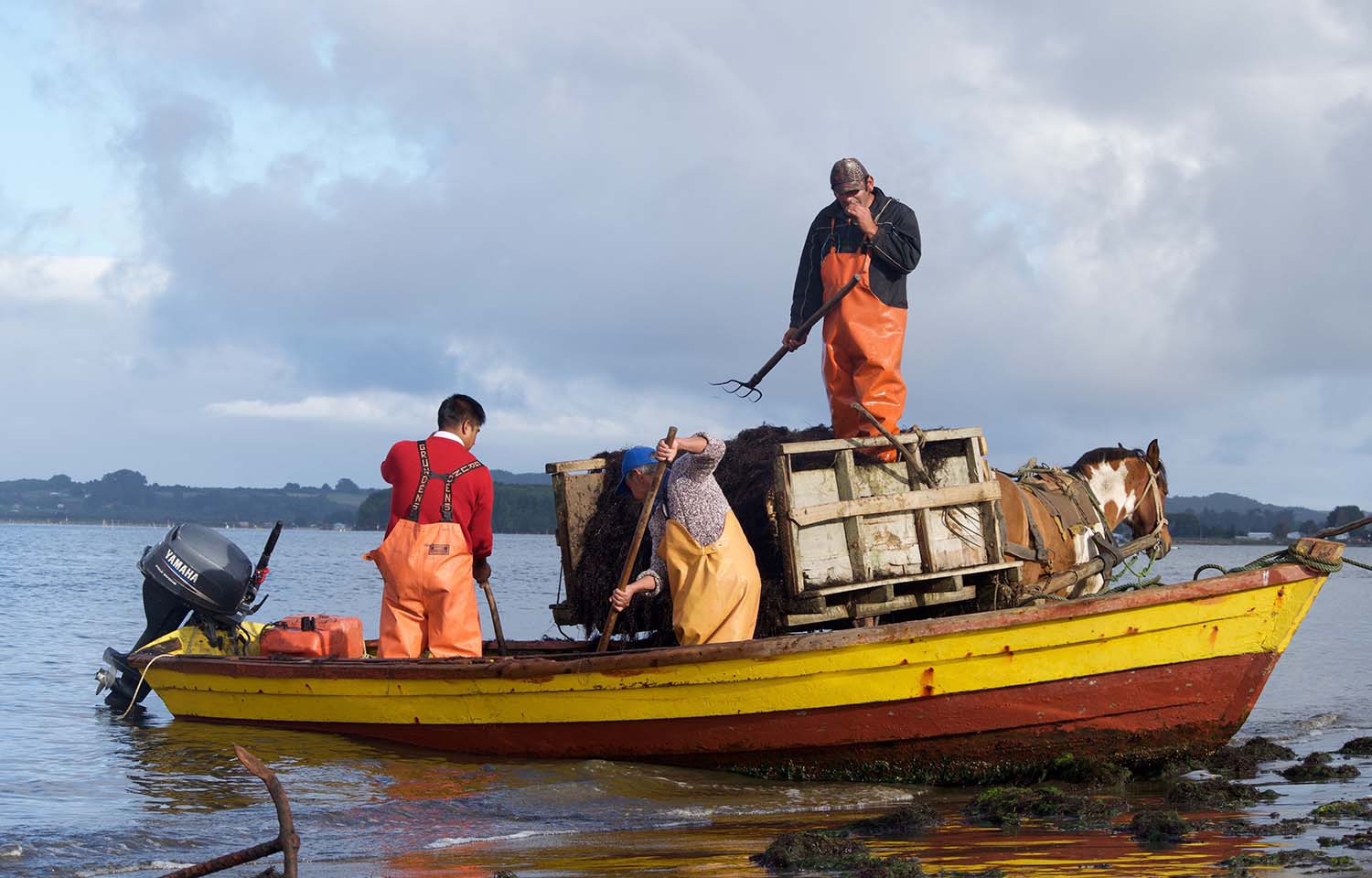
At the end of February, Chile’s salmon-farming industry avoided turmoil as the Regional Commission on the Use of Coastal Areas (CRUBC) rejected a request from two Indigenous groups requesting control of an area where a large percentage of the country’s salmon grow-out centers are located.
The area in question, covering more than 620,000 hectares, hosts over 300 aquaculture concessions – 45 percent of existing concessions in southern Chile’s Aysén Region and about 25 percent of the whole country’s salmon grow-out capacity.
The Indigenous communities Antunen Rain and Pu Wapi requested control under the Original Peoples’ Maritime Coastal Spaces (ECMPO) framework, which is a concept governed under Chilean legislation known as the Lafkenche Law.
Though the request was rejected, salmon company executives said that other shortcomings in the law need to be urgently addressed.
“The rejection of the request shows that sanity prevails in Chile. However, there will be no peace until this Lafkenche Law, which allowed this discussion [to happen in the first place], is made more rational,” Salmones Camanchaca Vice Chairman Ricardo García told Salmonexpert.
“Our greatest concern is the institutional or regulatory uncertainty, where we frequently encounter surprises. For example, ECMPO's irrational requests for over 600,000 hectares for only 38 Chileans, which is equivalent to 5 percent of the entire territorial sea of Chile, would [have resulted in] a benefit per person of 15 million square meters of Chilean maritime surface,” he said during Camanchaca’s fourth-quarter results call.
Chilean Salmon Council Executive Director Loreto Seguel called the request “unreasonable” due to its magnitude, the complex jurisprudence involved, and the conflict it would likely have generated between the communities in the area.
“Institutions must ensure the common good, and the collective must take precedence over the individual benefits, [which in this case would] threaten future development,” she said.
The word “lafkenche” means “people of the sea” in Mapuzungun, the language spoken by the Indigenous Mapuche people.
According to the Chilean Research Center on Integrated Disaster Risk Management (Cigiden), the Lafkenche Law “marked a milestone in the recognition and vindication of the territorial rights of Indigenous peoples in Chile … characterized by the ancestral use of marine resources that form the basis of their social structure and cultural practices” when it was established in 2008.
The promulgation of this law was important in two ways, Cigiden said. The first was in the drafting of the law itself, which arose from the demands of the Lafkenche communities through understanding and political advocacy with the federal government. The other was that the law set precedence since it was the first to recognize Indigenous customs as a source of law.
Cigiden said the establishment of Indigenous peoples’ coastal marine spaces under the law has brought about a number of conflicts, mainly due to the government’s, industry’s, and even NGOs’ poor understanding of Indigenous customs.
“As long as we fail to decolonize the concept, we will continue to have ‘conservation figures’ and not relationships of reciprocity and respect for the cycles of nature, which are the turning point when we talk about ‘biological protection zones,’” Cigiden said.
While the debate in Chile continues over the validity and reach of the Lafkenche Law, the salmon industry vowed to defend its interests.
“What could the option be? Should we leave Chile – abandoning our purpose and all the people who work with us? Of course not! We will continue and do things better every day,” García said.
The proposal’s rejection represents another win for the Chilean salmon-farming industry after the government rejected proposed changes to the country’s general fisheries law last summer. The changes would have barred the introduction of exotic hydrobiological species – such as salmon – from protected areas where concessions already exist.
