



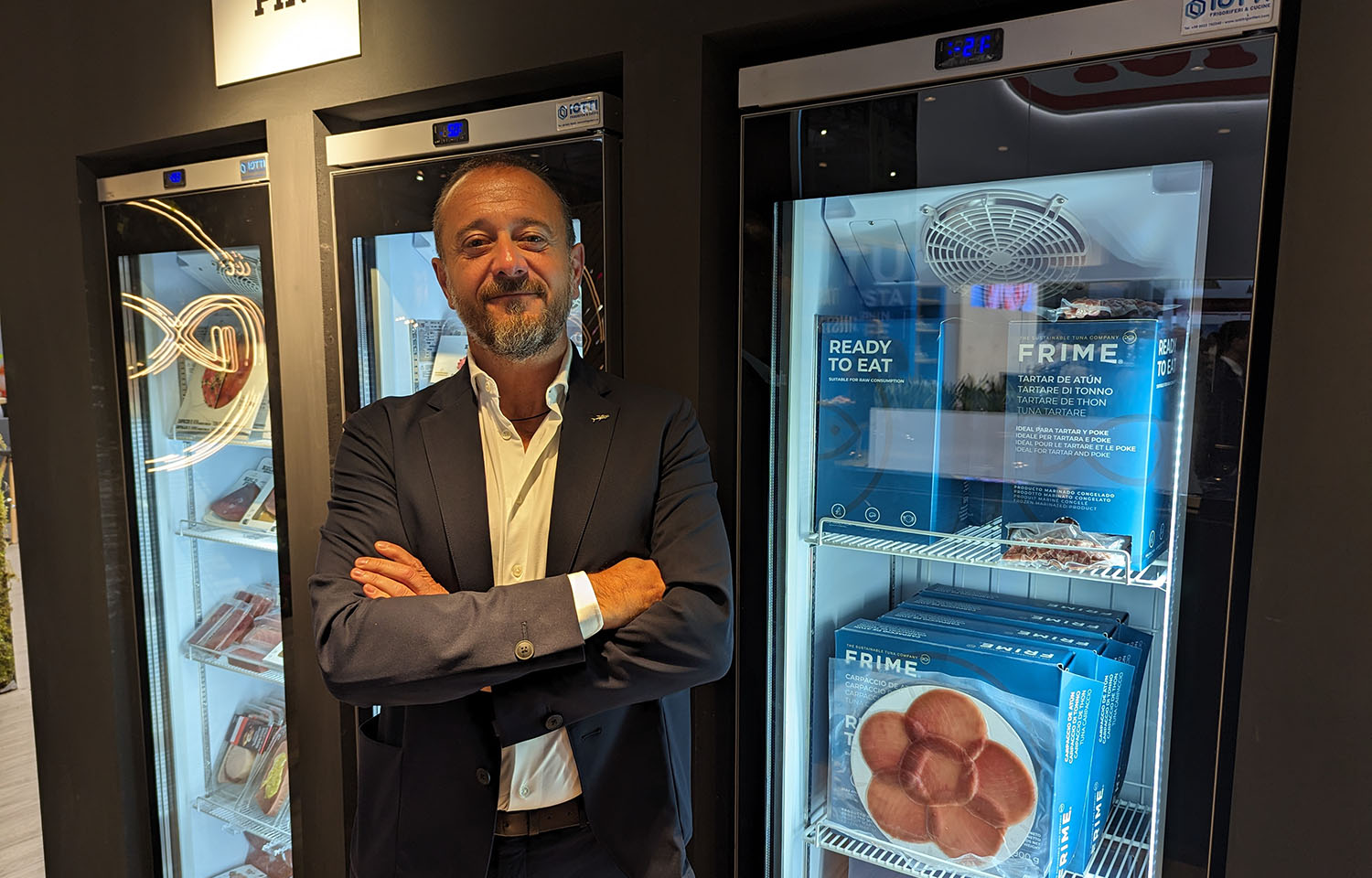
Frime President and Owner Salvador Ramon is on a mission to take the tuna industry to the next level.
Barcelona, Spain-based Frime, founded in 1977, specializes in yellowfin tuna products imported from all over the world. Ramon, the third generation of his family to run the business, told SeafoodSource during Seafood Expo Global – running from 23 to 25 April in Barcelona, Spain – Frime is now distributing its products to 16,000 supermarkets in countries across Europe.
“In the year 2000, we had 10 people in the company. Now, we have 700 people working in Barcelona,” Ramon said.
Ramon said Frime has seven different factories in Barcelona where it processes tuna into a range of different products, with a specialization in loins and slices. The company produces a range of ready-to-eat products, including marinated products.
“We have the biggest plant and tuna processing in Europe, here in Barcelona, all using robotics and all automatic,” Ramon said. “In tuna, we are the only company in Europe now that can sell marinated tuna that is ready-to-eat.”
In the last two years, Frime has also begun to expand into the U.S., using Camanchaca as a distributor.
“We are very happy because the customer in North America ... used to use the Vietnam or Asian-processed loins, and they are starting to love the value of the product we are doing here in Europe," Ramon said.
Ramon said that one of the big advantages Frime it has over other processing companies is its heavy emphasis on technology, which he said helps it create a superior product. He said the company’s robotic processing equipment, which uses artificial intelligence, allows it to process tuna into extremely consistent products.
“We put a lot of money into these new technologies that normally in the fish business nobody uses, because it’s a very traditional industry,” Ramon said. “We industrialized some processes with our own engineering.”
The result is Frime can get more consistent product sizes with higher yields and less waste, even with the high variability of tuna species, he said. The ultimate goal is to “salmonize” tuna – a big challenge given the species variability.
“We produce huge quantities of slices that are the same weight, same size, same quality, every day. Our specialty is to convert wild fish with different sizes from different oceans into a standard product,” he said. “That is easy to do with salmon, for example, because its farmed and you know exactly what is the size, because you grow the product. With tuna, it is wild, it comes from all over the world with different sizes and different kinds of fat content.”
Ramon the company has also invested heavily into what it calls a “white room” that allows customers to eat its products raw.
“We have a lab in the room [where] we can analyze something like 100 samples of histamines every 20 minutes. That means we have very high quality controls,” Ramon said. “We can guarantee to the final customer that you can eat this raw, that is a big innovation.”
Frime now regularly surpasses 1,000 metric tons of fresh tuna processing per month, and in 2024, the company will hit USD 220 million (EUR 205 million) in revenue, in large part due to the company’s expansion into supermarkets.
That expansion wasn’t easy, according to Ramon. The main driver behind it was the Covid-19 pandemic, which forced the company to pivot from its HORECA (hotel, retail, catering) customer base.
“I remember perfectly – 15 March, I lost 80 percent of our sales. I needed to put 500 people at home,” Ramon said.
But Frime continued to its workers, even as its HORECA business completely dried up, Ramon said.
“Our customers were traditionally the HORECA channel,” Ramon said. “Then we invented and put some new processes to the same products that we sold to sell to the supermarkets, pivoting from restaurants to retail.”
The pivot was immediately successful.
“We doubled the sales in three years,” Ramon said.
Ramon said he has aspirations for further growth, and has invested heavily into its processing facilities to further enhance product consistency and quality. Ramon said he wants to mirror the change that has taken place in the Norwegian salmon industry, which has moved from selling whole salmon to selling high-quality processed products.
“I want to 'salmonize' the tuna,” Ramon said. “I want to be the Mowi of tuna.”
