






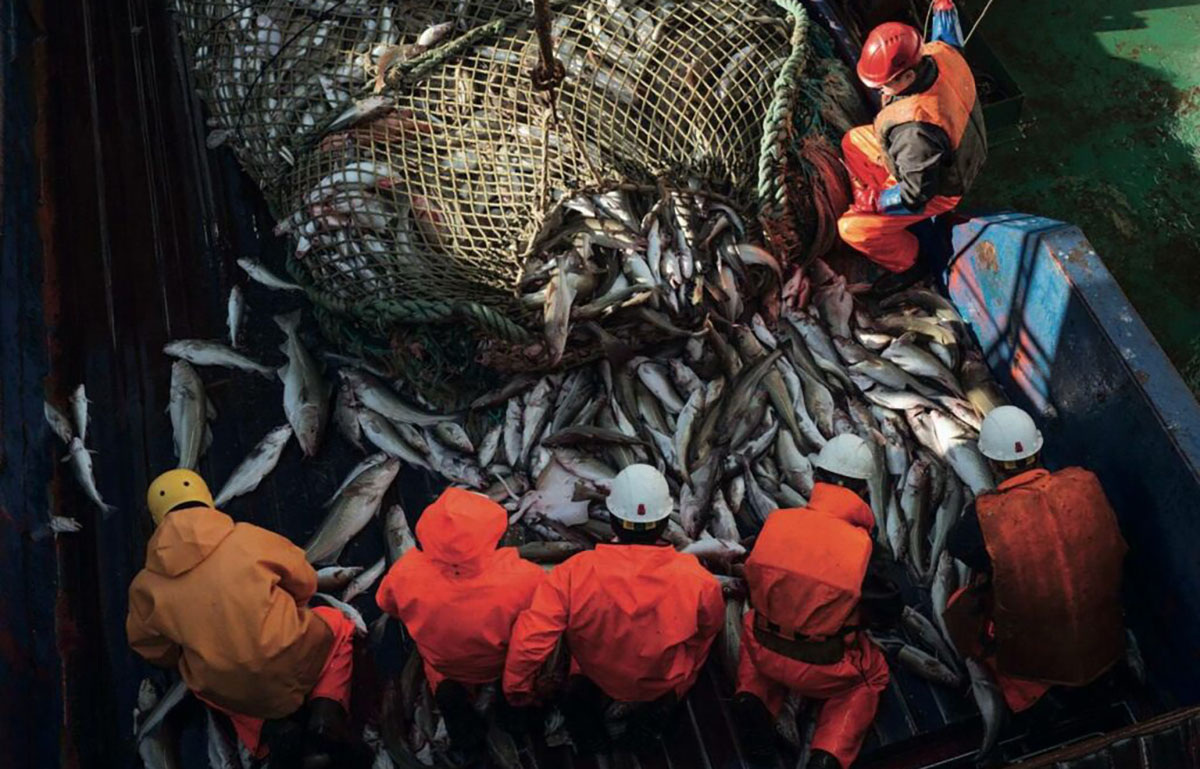
Russia’s catch across its fisheries thus far in 2024 is averaging ahead of 2023's numbers.
Russia’s Federal Fishery Agency (Rosrybolovstvo) is reporting fishermen have, as of 28 March, caught 1.38 million metric tons (MT) across multiple species – 2.3 percent ahead of 2023.
The current catch volume, according to Rosrybolovstvo, is largely thanks to the amount caught by fishermen in Russia’s Far East. So far, fishers in the Far East basin have caught 1.15 million MT of fish, up 6.7 percent compared to 2023. Much of that catch is made up of pollock – up 5.4 percent to 904,000 MT – and herring, up 28 percent to 138,000 MT.
The higher rate of catch has come during Russia’s “A” pollock season in the Okhotsk and Bering seas, which started on 1 January 2024 and is scheduled to come to an end in late April. Fishing restrictions and bans are scheduled to go into effect starting 1 April as spring spawning begins, Rosrybolovstvo said.
The fishing authority said 100 vessels have been fishing in the region, and 22 transport vessels have been supplementing their activity. Rosrybolovstvo said 35 inspectors are monitoring the transport vessels, while 10 observers from the Russian Research Institute of Fisheries and Oceanography (VNIRO) are on board fishing vessels.
The productive year so far has resulted in decreased prices for pollock and herring, Rosrybolovstvo reported. Fresh frozen pollock products in the Far East have dropped in price by as much as 22 percent since the start of the year, with cod and herring dropping 4.3 percent and 4.5 percent, respectively. In the central regions, pollock prices have dropped by 12 percent.
VNIRO also reported Russia's pollock and herring stocks have been stable in 2024, with size, weight, and sex characteristics remaining consistent, Fishnews reported.
As the “A” season winds down, Russia’s fishing industry is continuing to face widespread change in the face of investment quota programs that tie fishing access to promises from companies to invest in and enhance the country’s infrastructure – whether that be through new vessels or processing plants.
Association of Fisheries Enterprises of Primorye President Georgy Martynov told Fishnews 2023 was a difficult year for companies trying to implement the second stage of investment quotas. Smaller enterprises, he said, are struggling to meet the requirements of the government.
“We see that the industry is over-leveraged. According to our estimates, the loan burden is approaching RUB 1 trillion [USD 10.8 billion, EUR 10 billion],” Martynov said. “The implementation of the shipbuilding part of the program is not going well.”
The first stage of the investment quotas resulted in companies being required to build at least 106 new vessels, but soon after, shipyard delays started to put the program at risk. According to Martynov, those problems have persisted, and only 22 vessels have been delivered by the end of 2023.
“There are also questions about the quality of construction and about the equipment of the fleet under construction,” Martynov said. “Fishing industry experts, for example, say that the engines currently available for installation consume more fuel. This means that the cost of production will increase.”
