


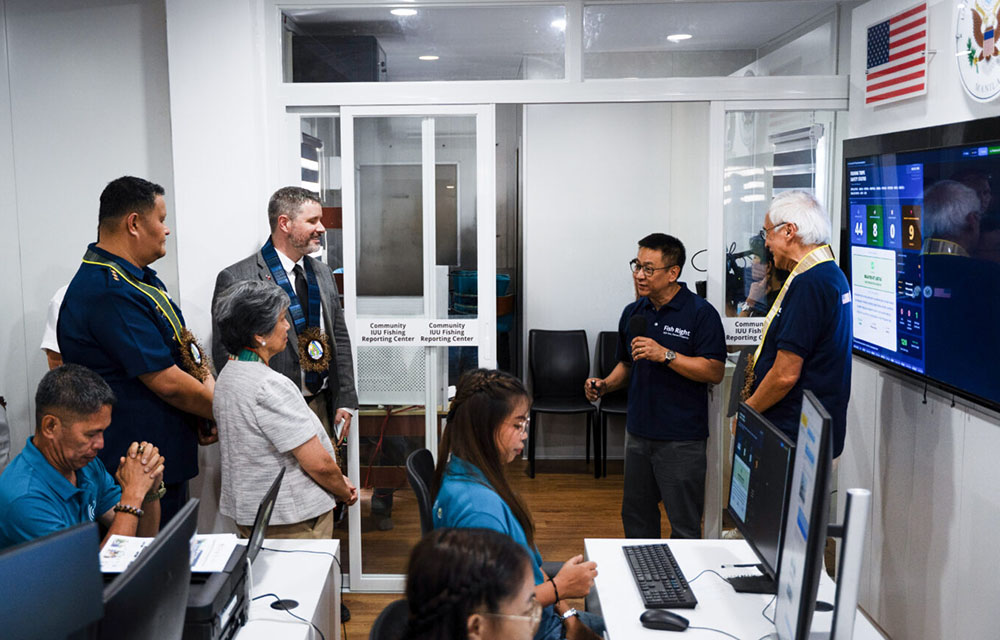
The U.S. Embassy in the Philippines has launched a new initiative to gather community reports of illegal, unreported, and unregulated (IUU) fishing around the Southeast Asian nation and share them with authorities.
“Illegal, unreported, and unregulated [IUU] fishing is both an economic and a national security challenge. It depletes fish stocks, disrupts supply chains, distorts markets, threatens food security, and places responsible fishers and legitimate businesses at a disadvantage,” U.S. Embassy Officer Taylor Fincher said in a release. “Addressing illegal fishing and related maritime concerns is an important area of cooperation between the United States and the Philippines.”
The Community IUU Fishing Reporting Center will serve as a community hub for receiving reports on suspected IUU fishing activities, as well as other unusual or illicit activities. Those reports will then be forwarded to Philippine government agencies for follow-up action. According to the embassy, the center will utilize American technologies, including Starlink and data visualization software EarthRanger.
“By providing fisherfolk with a safe and accessible way to report suspected illegal fishing and other unlawful maritime activities, this Community IUU Fishing Reporting Center empowers coastal communities to become active partners in protecting our fisheries,” Philippines Department of Agriculture Undersecretary for Fisheries Drusila Esther Bayate said in a release.
The new center was launched by the embassy through its Fish Right Project in partnership with the Palawan Council for Sustainable Development. The Fish Right Project was launched as a seven-year partnership between the Philippines government, the University of Rhode Island, the Sustainable Fisheries Partnership, and the United States Agency for International Development (USAID), the last of which was effectively defunded and absorbed into the U.S. Department of State last year. In June 2026, the University of Rhode Island Coastal Institute was awarded USD 24 million (EUR 21 million) by the State Department to continue the work done under the Fish Right Project.
“The small-scale industrial fishing fleet in the western Philippine part of the South China Sea faces many challenges, including declining resources and reduced access to traditional fishing grounds,” Coastal Institute Director Elin Torell said in the university’s announcement. “Through the Fish Right Program, we hope to empower these fishers as trusted observers at sea while improving real-time coordination, reporting, and access to information for those working at sea.”
Separately, the U.S. Department of State has put out a call for an NGO partner to help identify evidence of forced labor and IUU fishing in the seafood supply chain.
“By increasing transparency and accountability in global seafood supply chains, the program will help combat unfair competition, support responsible business practices, protect marine resources, and reinforce a level playing field for the U.S. seafood sector,” the State Department said in its announcement.
While the NGO will be tasked with focusing on East Asia and the Pacific, among other regions, the Philippines is excluded from the work order, as is Indonesia.
