




Vietnam’s lobster-farming industry is facing a deepening seed shortage after regional suppliers have gradually tightened exports, disrupting formal trade of live juveniles.
According to Vietnam’s Directorate of Fisheries, the Southeast Asian nation has not yet developed commercial-scale artificial production of lobster juveniles, leaving farmers dependent on either wild-caught seed or imports from Southeast Asian suppliers such as Indonesia and Malaysia, both of which have gradually implemented stricter export restrictions.
For instance, in Indonesia, lobster seed exports are subject to permit requirements under Marine Affairs and Fisheries Regulation No. 7/2024, which aims to keep more seed for domestic farming, encourage exports of larger lobsters, and protect wild stocks.
“For a while, there was a legal way for Vietnam to import baby lobsters via an investment agreement where Vietnam companies were required to invest in Indonesia. However, this was terminated about a year ago,” an Indonesia-based industry source who requested to remain anonymous told SeafoodSource.
The strain brought on by tightening exports is especially acute in Khanh Hoa, one of Vietnam’s main lobster-producing provinces, where annual demand for lobster seed is estimated at 60 million to 70 million juveniles.
Recorded imports in the coastal province completely bottomed out in the first half of 2026, according to Vietnam’s Directorate of Fisheries. This zeroing of imports came after the province imported 41.5 million lobster juveniles in both 2020 and 2021 before volumes peaked at 83 million in 2022. Imports then dropped to 59 million in 2023 and again to 11.92 million in 2024 before recovering to 33.07 million in 2025.
As imports have cratered, local wild-caught seed in the province meets only about 5 percent of actual demand, and any remaining supply comes from nearby Gia Lai and Dak Lak provinces.
Meanwhile, Khanh Hoa’s lobster farming industry has undergone rapid growth. The province had 74,443 lobster cages in 2023, producing 1,800 metric tons (MT). By 2025, the number of cages had jumped to 126,552, with output reaching 12,749 MT. In the first six months of 2026, Khanh Hoa had 137,136 cages and produced 10,271 MT of market-size lobster, the Directorate of Fisheries said.
In an attempt to maintain the industry’s momentum, instances of illegal imports have ramped up.
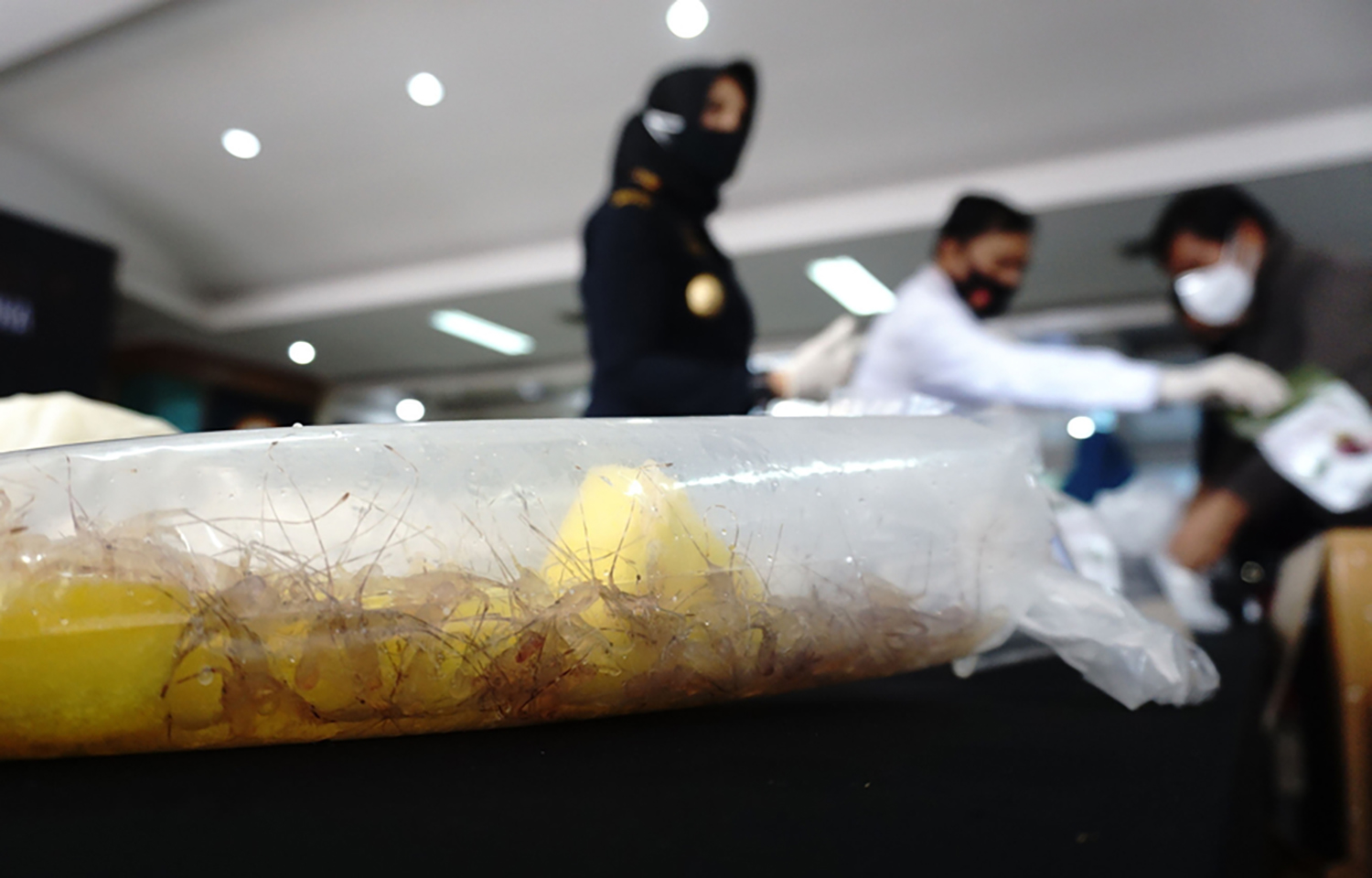
On 17 August, Khanh Hoa police found more than 180,000 live lobster juveniles in the checked luggage of two passengers arriving at Cam Ranh International Airport from Singapore. The police opened a criminal case over the allegedly illegal cross-border transport, estimated at VND 7 billion (USD 268,327, EUR 231,926), and initiated proceedings against two suspected passengers – one Indonesian national and one Vietnamese citizen.
Elsewhere, in Indonesia, customs officers at Soekarno-Hatta International Airport in Jakarta stopped a Singapore-bound shipment in October 2025 and seized 172,611 lobster seeds packed in eight suitcases, Antara reported. Four suspects were arrested in the case.
A month before that incident, police in Cianjur, West Java, intercepted a vehicle carrying seven boxes containing 50,000 lobster seeds.
Malaysia has reported similar attempted shipments.
In June 2026, the Malaysian Maritime Enforcement Agency said it stopped a Singapore-bound lobster seed shipment at Tanjung Belungkor jetty, with seized goods valued at about MYR 2.7 million (USD 669,000, EUR 575,000). The case was handled under Malaysia’s Fisheries Act of 1985, which requires a Fisheries Department permit for live-fish imports and exports, according to New Straits Times.
The illicit activity is largely being driven by a fast-growing export market.
Lobster has emerged as one of the brighter spots among Vietnamese seafood export species, supported by demand for live and premium seafood in China, according to the Vietnam Association of Seafood Exporters and Producers (VASEP).
Vietnam exported USD 585 million (EUR 505.3 million) worth of lobster in the first half of 2026, which was up 44.3 percent from a year earlier and accounted for around 10 percent of the country’s total seafood export revenue.
China is the largest destination for lobster from Vietnam, purchasing volume worth USD 841 million (EUR 726.5 million) in 2025.
Export growth has been led almost entirely by green lobster. In 2025, green lobster exports totaled USD 843 million (EUR 728.2 million), accounting for 98.3 percent of Vietnam’s total lobster exports. Sales of tropical rock lobster, a higher-value product linked to the premium segment, decreased to about USD 4.6 million (EUR 4 million) because of technical barriers in China, VASEP said.
To address the seed shortage, the province is seeking more investment in research to develop artificial lobster seed production, and at the trade level, Khanh Hoa will work with national ministries and agencies to facilitate lobster seed imports from such suppliers as Indonesia, the Philippines, Myanmar, Sri Lanka, and Singapore, Vietnam’s Directorate of Fisheries said.
