






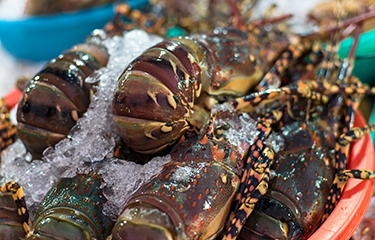
Vietnamese exporters of tropical rock lobster have had to temporarily halt their shipments to China due to new regulations pertaining to the protection of endangered species.
During a recent meeting with Vietnam’s National Authority for Agro-Forestry-Fishery Quality, Processing, and Market Development, Chinese customs officials said that wild tropical rock lobsters were a new addition to the list of endangered species declared by Chinese authorities, adding that in May, the country amended its law on wild animal protection to prohibit the fishing, consumption, and trade of the crustacean species.
To export tropical rock lobster to China, foreign companies must now demonstrate their lobsters are farm-raised and not caught directly from the sea. This process entails solely using lobster larvae that are at least two generations removed from the wild. If they meet Chinese customs criteria, farms harvesting tropical rock lobster must then register with Chinese authorities, undergo inspections, and attain a listing on the Chinese customs’ digital portal.
The move has left Vietnamese companies scrambling to comply so they can maintain business with China – the top destination for Vietnam’s live tropical rock lobster, spiny lobster, and green lobster. But origin tracking is a challenge for Vietnamese lobster farms, most of which operate at a small scale and rely heavily on seed from foreign countries, leading to illicit importation of seed.
According to the Vietnam Association of Seafood Exporters and Producers (VASEP), from January to August of this year, Vietnam exported USD 76 million (EUR 69.4 million) worth of lobster to China – a 42 percent year-over-year decline. Comparatively, in 2022, Vietnam’s lobster exports to China surged to USD 257 million (EUR 234.8 million), thanks to heightened consumer demand following the Covid-19 pandemic.
Highlighting the unexpectedness of the restrictions, in September 2023, approximately 6 metric tons (MT) of lobsters perished at a Vietnam-China border gate, as the lobsters were unable to reach Chinese cold storage facilities promptly after the cargo failed to pass Chinese customs clearance.
Linh Phat Seafood, a Vietnamese lobster exporter, confirmed to local authorities in a statement on 7 November that due to the tightened rules on sales of tropical rock lobster, the company has temporarily suspended exports to China.
Similarly, Nguyen Thi Anh Thu, the director of Thanh Nhon General Trading and Seafood Company – a lobster exporter based in Ho Chi Minh City – said her company’s sales of tropical rock lobster to China have been suspended, and that Chinese buyers are more interested in green lobster.
As a result, prices paid for rock lobster in Vietnam dropped sharply in November 2023, ranging between VND 1 million and VND 1.3 million (USD 41.40 and USD 53.90, EUR 37.90 and EUR 49.20) per kilogram, down nearly 50 percent from the same month last year.
The Vietnamese Department of Fisheries has recommended that local farmers reduce the cultivation of tropical rock lobster and instead consider raising green lobster in light of the changing market conditions in China.
However, China can also turn elsewhere for lobster supply, as major lobster suppliers to China include Canada, the U.S., New Zealand, Cuba, India, Brazil, and Mexico. Vietnam ranks 14th among foreign lobster suppliers to China, holding a 1 percent market share.
Vietnamese lobster production is plagued by additional challenges, as exports predominantly flow through small-scale sales via inland border gates with China, creating risks for local lobster farmers who have to deal with fluctuating prices and pressure from middlemen to lower prices. Additionally, sales opportunities of small-scale exports are shrinking as Chinese authorities gradually impose stricter import conditions to encourage large-scale official shipping channels, Thanh Nien Online reported, quoting a Vietnam Association of Seafood Exporters and Producers representative.
To alleviate some of the pressure facing the nation’s lobster farmers, the Vietnamese Ministry of Agriculture and Rural Development has launched a project aimed at boosting domestic lobster production and exports, targeting a total annual output of 3,000 MT and export turnover of USD 200 million (EUR 182.7 million) by 2025.
The main provinces engaged in Vietnamese lobster farming are Phu Yen and Khanh Hoa in the north-central part of the country, along with Kien Giang in the Mekong Delta region in the country’s south.
Photo courtesy of MielnickiStudio/Shutterstock
