






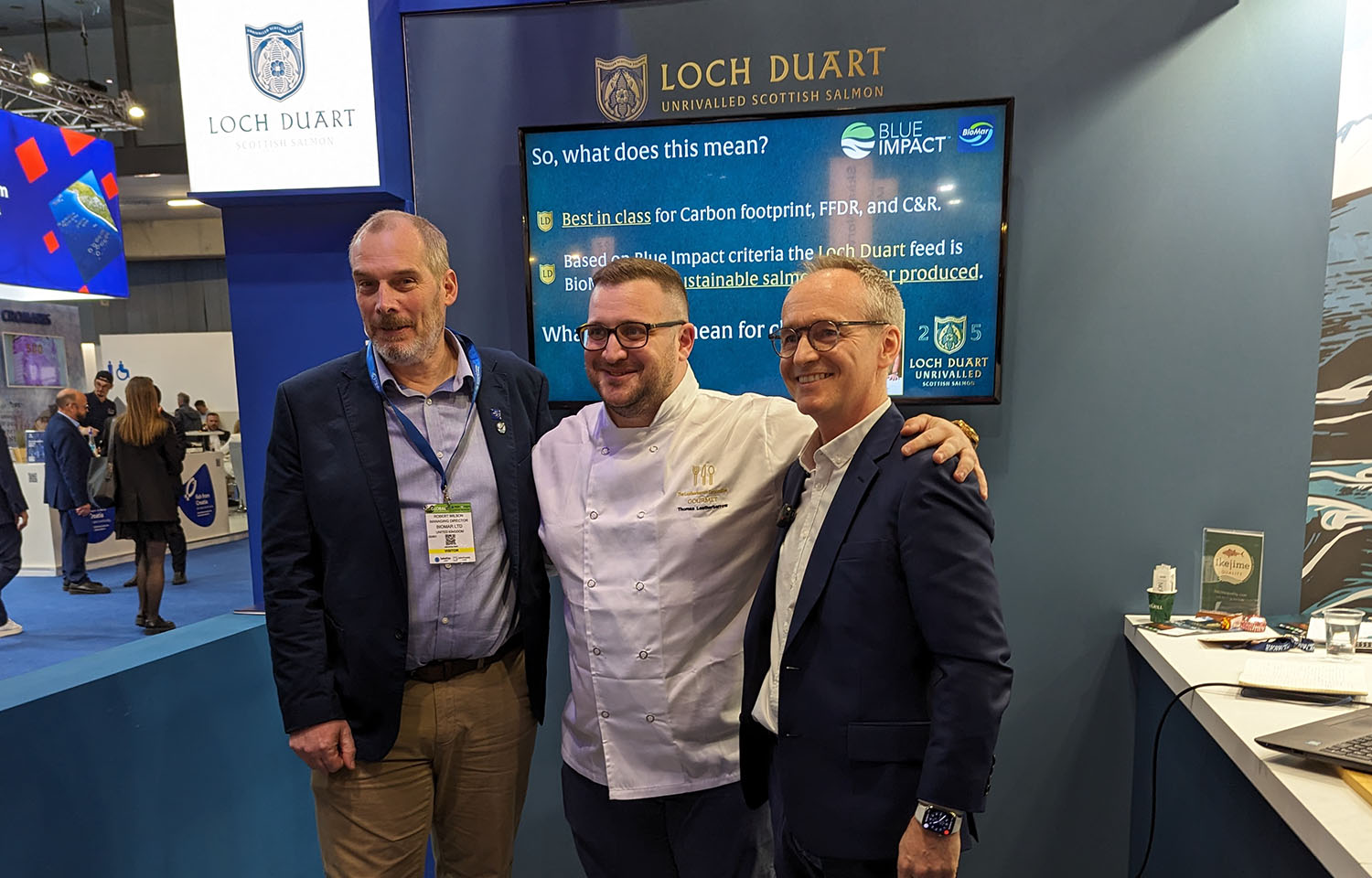
Scottish salmon-farming company Loch Duart is celebrating its 25-year anniversary by hitting multiple feed-based environmental impact targets years ahead of schedule.
The company, which farms salmon in Northwest Scotland, announced a partnership with BioMar to create a special version of the company’s “Blue Impact” feed, allowing it to exceed its carbon, ingredient, and forage fish dependency ratio (FFDR) targets ahead of schedule. BioMar debuted its Blue Impact feed in 2022, and Loch Duart announced it was using the feed in June 2023.
As part of its switch to the new feed, Loch Duart set a goal of reaching below 2 kilograms of carbon emissions per kilogram of feed, an FFDR of below 0.7, and a circular restorative ingredients goal of having 25 percent of the marine ingredients used in its feed coming from sustainable byproducts of other fish ingredients.
During a special reveal of the results at the 2024 Seafood Expo Global in Barcelona, Spain, on 23 April, the company revealed that it met or exceeded most of those metrics.
BioMar UK Managing Director Rob Wilson told SeafoodSource that the company has had multiple aquaculture companies pick up the Blue Impact feed, but Loch Duart was a special challenge due to its marine ingredient commitments.
“The big challenge with them is the Label Rouge,” Wilson said. “Label Rouge means 15 percent marine content. In other diets, where you don’t have that restriction, you can replace some of the content with algal oil. We can’t do that here.”
Label Rouge, a French certification, is an important label of quality for many Scottish salmon producers, and Loch Duart is no exception.
Not being able to use any alternative algal oils or ingredients forced BioMar to find a way to still use marine ingredients in a regenerative way.
“The big challenge was to find that balance and make it sustainable,” Wilson said.
The solution for Loch Duart was to source trimmings and byproducts from the production of other sustainable fish species and use them in a Blue Impact feed specifically tailored to Loch Duart.
Loch Duart Sales Director Chris Orr told SeafoodSource the results speaks for themselves. The company far exceeded its carbon emission targets, with just 1 kilogram of CO2 emissions per kilogram of feed. That total is half the company’s target and 56.5 percent less than standard feeds, Orr said.
The FFDR was also much lower than the target, reaching just 0.33. That, too, was less than half of the company’s target. The company also beat its byproduct target of 25 percent regenerative ingredients and managed to achieve 40 percent – meaning a significant portion of the company’s marine ingredients are now coming from sustainable sources and byproducts rather than wild-caught fisheries.
Wilson said the results have also exceeded BioMar’s expectations.
“When we went back to our sustainability team and said ‘This is our results in the first year,’ they said, ‘This is brilliant,’” he said. “It’s a 10-year contract, and they’re already in the blue in two.”
Orr said that a key part of the new feed, above and beyond standard metrics, is the company’s commitment to filtering its omega-3 oils to remove any PCBs or toxins. While there aren’t any requirements to filter for the toxin yet, Orr said the company wanted to get ahead of what it sees as a potential future requirement.
“It came out of speaking with a number of our American customers, who are very concerned about the level of plastics,” Orr said. “They were asking us these questions, and we were thinking, ‘If this is what it’s like now, we should really get ahead of this.’”
The oils in Loch Duart’s feed are now triple-filtered, removing dioxins and contaminants at a high level, Orr said.
“It’s not mandatory, but we decided to do it as part of our strategy,” Orr said.
The additional filtering and sourcing requirements come with a cost, though. Wilson said sourcing byproducts for the feed will eventually be a limiting factor.
“There’s a limited amount of supply for that in the world, so it’s not something that everyone can do,” he said. “But, it fits in with Loch Duart, and we’ve got a few tie-ins with processors now.”
That additional layer of requirement results in the feed costing more – which translates to a higher product cost – but Orr said the additional price is worth it to fit into Loch Duart’s vision of a high-quality product with a low environmental impact.
“Some of the numbers today are very much lower than the rest of the global industry,” he said. “It’s important, and it will become more important. I don’t think that the level of understanding within the global economy has reached its peak yet.”
He added that the great success Loch Duart and BioMar have had through their work on a special Blue Impact feed are an example of how industry collaboration can pay dividends.
“Sometimes, when you put your mind to it and you work with a collaborative partner, you can make it happen,” he said. “Sometimes, you just need to put your chips on the table.”
