


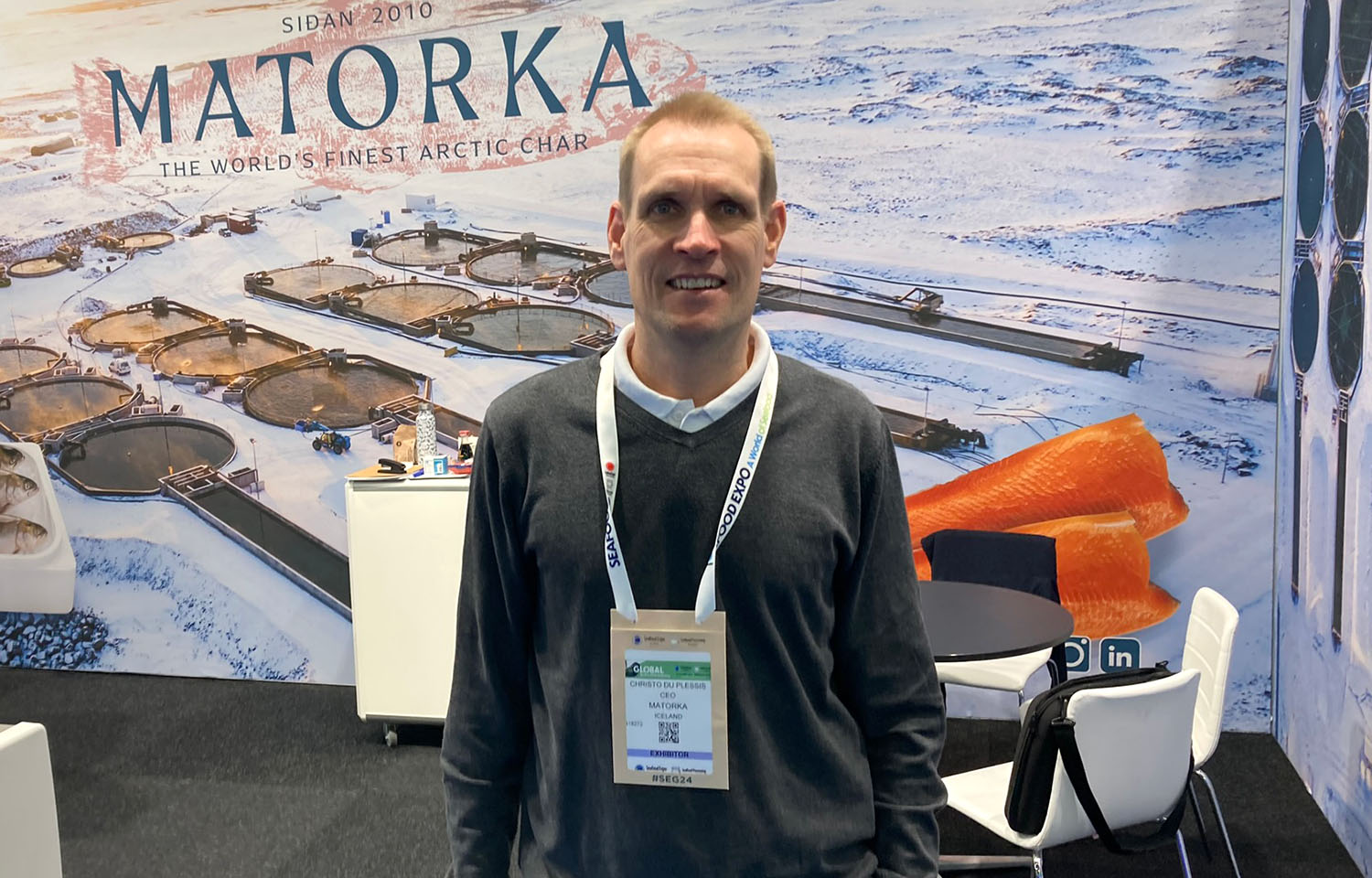
Iceland is the perfect place to grow fish in land-based facilities, with the exception of volcanos and earthquakes, according to Christo du Plessis, the CEO of land-based Arctic char-farming firm Matorka.
Beginning in October 2023, the area around Matorka’s farm in Grindavík, Iceland, experienced the first of what eventually became several hundred volcanic events and earthquakes, with a peak quake occurring 10 November 2023 that destroyed one of the company’s tanks, resulting in the loss of 75 metric tons (MT) of fish and damaging some of the company’s other infrastructure.
“It caused some problems – to put it mildly,” du Plessis told SeafoodSource at the 2024 Seafood Expo Global.
Since then, Grindavík has been largely abandoned, and Icelandic authorities have limited access to the farm for safety reasons, according to du Plessis. In the times when staff are allowed onsite, they have scrambled to make repairs and harvest fish, which they then had to bring to Hafnarfjörður – around 40 kilometers away – for processing at a third-party facility leased on 22 November.
“We're getting used to it. It's a new normal. We have eruptions from time to time, but there's no threat of lava to us, so that's good,” du Plessis said. “In the first weeks, it's all adrenaline. But after that, it has just been like a humming noise of uncertainty. Will we have an eruption? Which way will the lava flow? How will it affect the farm?”
On 29 May, the volcano near Grindavík erupted for the fifth time since December. The continual eruptions are a nuisance, according to du Plessis. The farm has to use back-up generators when the power is cut, and s
“It has been tough for the guys on the farm, but they've been absolute troopers,” du Plessis said.
Most frustrating to du Plessis was the fact that Matorka was on track for a banner year in 2023 and had plans to expand from 2,200 MT in 2023 to 7,000 MT on site by 2028. It still achieved a record harvest and recorded break-even EBITDA, but its positive moment was disrupted, which forced it to push back and rethink its expansion plan, du Plessis said.
“In October, before the event, we had done early-look meetings with about 12 investors and had gotten very positive feedback,” he said. “We haven't abandoned any expansion plans, but of course, we think that investors will not be too happy to invest in Grindavík at the moment.”
Pivoting, Matorka is now looking to expand elsewhere in Iceland.
“Despite all of the problems we’ve faced, our results give us the confidence to go forward. We believe there's still enough traction, and we've had good support from our shareholders,” du Plessis said. “We have put together quite a team, and that's something that's not everywhere in land-based farming – it's a scarce resource. We really put the team together for growth. Our ambition is still to grow to 10,000-plus MT in the next five years.”
Matorka is still producing fish five days a week at its existing site when possible, and the company was insured for its biomass losses and is also receiving remuneration from Iceland’s national disaster insurance program. So, the company’s cashflow remains solid, according to du Plessis. As for conversations with investors, it’s a positive sign for him that they remain centered on the company’s underlying financial model, rather than natural disasters.
“I'm pretty sure we'll find investors and discussion as always just on the value,” he said.
Arctic char prices are stable because production is so low – only 8,000 to 9,000 MT annually worldwide, according to du Plessis.
“That’s nothing. For such a beautiful fish, it deserves more,” he said. “For now, because it's not a commodity, it's literally business-to-business agreements that drive the market, so what we've seen is slightly increased but very stable prices for the last two years.”
The primary markets for Arctic char are the U.S. East Coast, Canada, and Europe, he said.
“Of course, we have a healthy local market as well in Iceland because in Iceland, they prefer this much more than salmon,” du Plessis said.
Matorka remains committed to spending generously on marketing to “put Arctic char on the map,” according to du Plessis. Most of the world’s Arctic char is farmed in Iceland, so the two can be marketed as a pair, he said.
“When people think of Iceland, they automatically think about the conditions of the water, of the renewable geothermal electricity we have here, and of the pristine natural environment,” he said. “Iceland is the perfect place to farm Arctic char because it is naturally occurring here. Within Iceland, we have the space to do more farming, and the government and local communities are happy to have us.”
That has been evident on the community response to the disasters, du Plessis said. The government and local service companies Matorka has worked with to continue operations have been “amazingly helpful,” he said.
“They just said, ‘Tell us what you need.’ Then, they sent in people immediately to help, and it was fantastic. It's like a textbook case for how it should be done. If only the rest of the world could function that well,” du Plessis said. “That's what I love about Iceland: It has a strong sense of community, and everybody rolls up their sleeves to get in and help.”
