




Strict environmental regulation and a shortage of suitable sites have constrained the expansion of traditional open-cage salmon farming in Norway.
However, a new closed farming concept developed by MMC First Process could provide fresh scope for increasing production volumes in the country’s fjords, according to the firm.
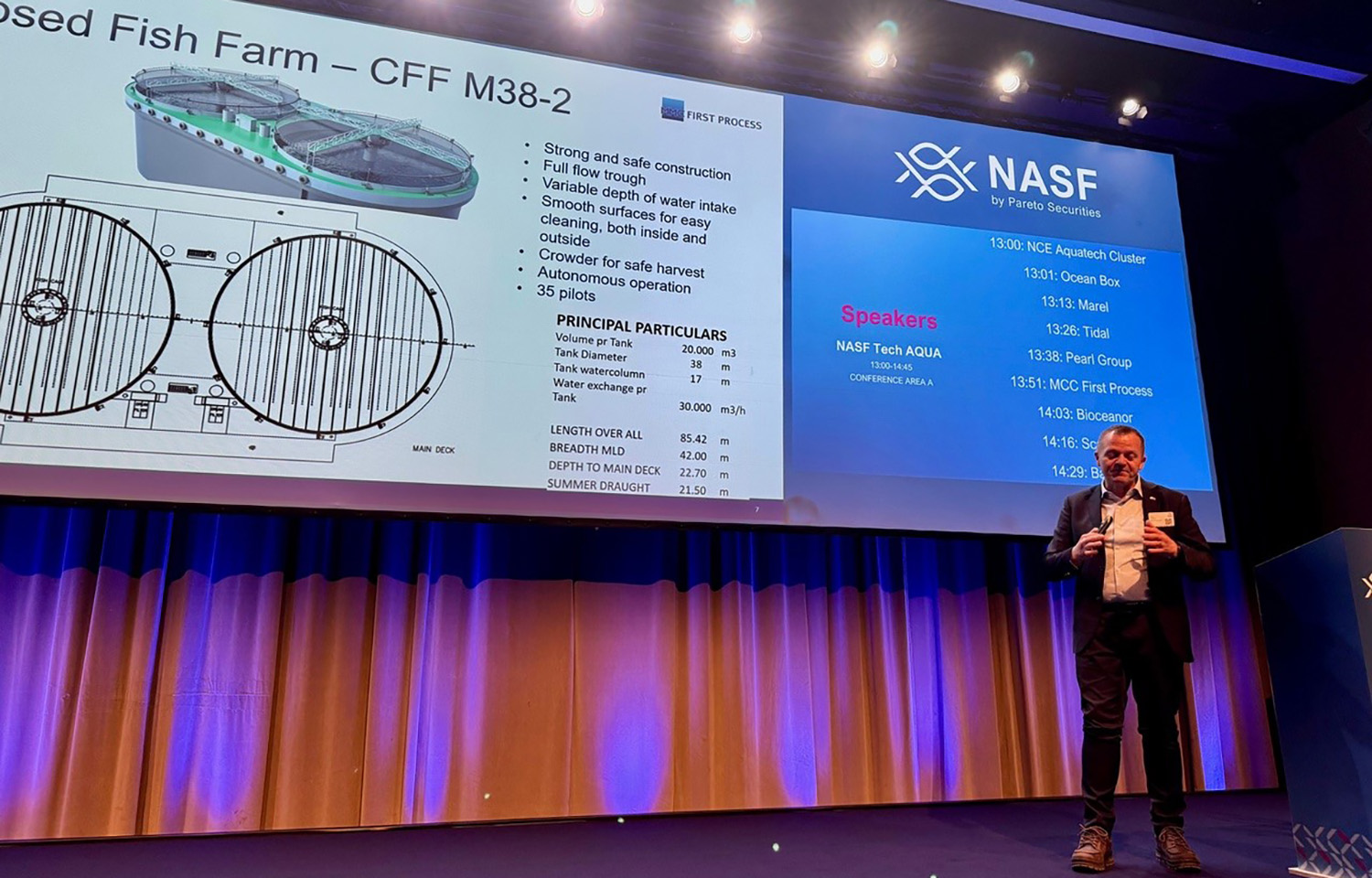
Speaking at the 2026 North Atlantic Seafood Forum in Bergen, Norway, MMC Sales Director Børre Waagan said the company’s new Closed Fish Farm (CFF) system offers a practical alternative where conventional cage farming faces limitations.
Over the past 40 years, MMC has evolved from its specialized roots in pelagic fish handling to become a leading supplier of solutions for the aquaculture industry, including developing technologies for live fish handling. Its CFF innovation consists of autonomous, steel-built units available in two-tank and three-tank configurations, designed for towing and docking at sea.
Aimed at improving fish welfare, eliminating sea lice challenges, and reducing pollution, the CFF features a full-flow water system, adjustable water intake, and a discharge system with sludge treatment.
Waagan said at the conference that the solution, which requires little in the way of operations personnel, offers significant production efficiency, reduced costs, and environmental benefits, with estimated energy consumption of 1 to 1.4 kWh per kilogram and a lifespan of at least 50 years.
MMC also claims that with its CFF, the feed conversion ratio (FCR) is below 1, fish mortality is between just 1 and 2 percent, and compared to traditional at-sea cage farming, the production costs are reduced by as much as NOK 18 (USD 1.85, EUR 1.60) per kilogram.
CFF has 35 comparable pilots in the form of wellboats and land-based holding tanks, Waagan said.
“That is because this technology is nothing new. We are merely taking our technology that has already been developed and putting it into our closed fish farm,” he said.
There are, he said, a number of ways such units can be used.
“These days, post-smolt is a big issue. We can stock [the CFF] with normal smolt of 80 grams, or it can be 200 grams or even more, Waagan said. “Because the farming itself is closed, the fish are then easily transferred to a wellboat where, according to the production that is needed, they are either transferred to traditional sea cages or to another closed facility.”
Estimated production in traditional sea cages is typically 20 to 30 kilograms per cubic meter per year, but MMC’s estimation with CFF is approximately 90 kilograms – very similar to what is achieved in land-based farms, Waagan said.
“Maybe the biggest difference is that we have a 100 percent flow-through system in our CFF, and according to our calculations, that means closed production only needs one-third of the volume to produce the same amount as in open sea cages. Turned the other way, CFF gives three times the biomass with the same amount of water. “We think this shows we have big growth opportunities in the fjords with a system like this,” he said.
The technology is also maturing as Norway is incentivizing the use of closed containment systems like CFF.
Last year, the he Norwegian Directorate of Fisheries announced it would allow farmers in sea lice “red” zones to increase their production capacity if they enclose their production units, with Minister of Fisheries and the Oceans Marianne Sivertsen Næss saying at the time it would “contribute to the development of new forms of operation with a lower environmental impact than today's open cages.”
