




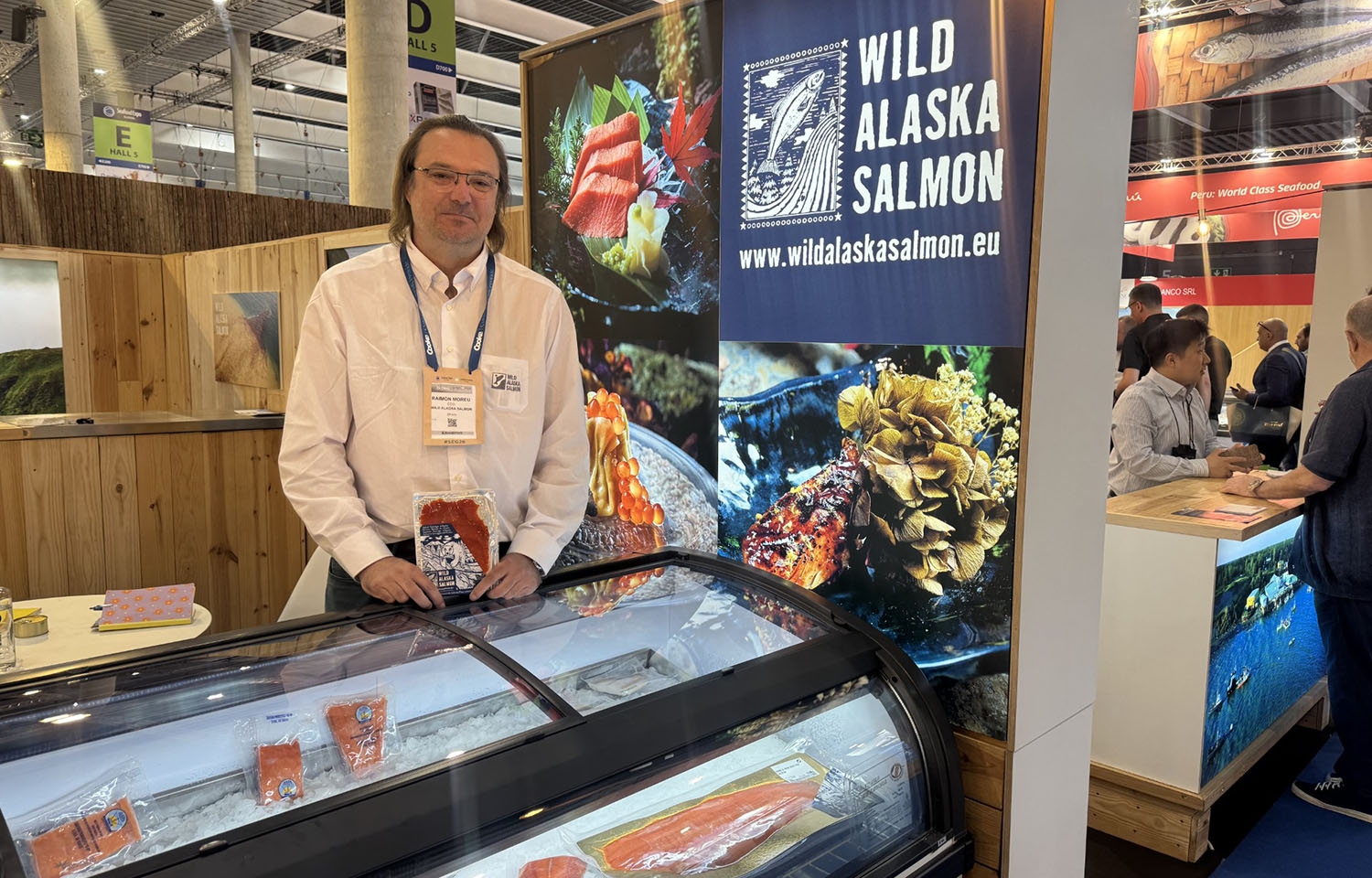
In 2008, Raimon Moreu Soler traveled from his home in Catalonia, Spain to San Francisco, California, U.S.A. to see the world, and unknowingly, try wild Alaskan salmon for the first time.
That chance encounter would lead him on a 16-year career path as an entrepreneur of Barcelona, Spain-based salmon importing company Wild Alaskan Salmon. Soler said his biggest concentration of clients are in Spain, Italy, Portugal, Greece, Austria, and Lithuania, and he only sources from the state of Alaska.
“I had never sold a kilo of fish in my life, and I was traveling around the U.S.A. in 2008, and I bought a motor bike in San Francisco,” Soler said at Seafood Expo Global/Seafood Processing Global, which took place 21-21 April in Barcelona, Spain. “I traveled all the country back to Mexico and then up to Alaska, then to New York, and then I put the bike on a boat to Barcelona. During these travels, I tasted wild salmon in San Francisco.”
It helped that the company he had been working for was in duress, and Soler was already looking for a new opportunity. Growing up, he always ate fresh, wild caught fish in Catalonia, and tasted the difference – he preferred wild caught. During his travels, he saw the impact farmed fish was already having on the market and tasted the difference. It was then that he traveled back to his bed and breakfast and hatched a plan to launch his own company.
“I’m a small company so my goal has always been the quality,” Soler said. “I look for the companies that can supply the best quality, and I try to check with each company where the best quality is, because I’m looking for the European customer and it’s better to bring quality over [quantity], in my opinion.”
Quality and high-end salmon are his specialty, he said, and his main species of salmon are sockeye, coho, and king. He also sells types of caviar, black cod, and often tries out new product formats like canned sockeye salmon in olive oil.
Adorning the “wild Alaska” label is important to Soler, because he said he can assure customers that he’s selling a “real, healthier, better looking, and better tasting” product, even if the price is higher than farmed salmon.
“It’s very easy for me to sell. You don’t want to buy it, go buy farmed [salmon]; that’s up to you,” Soler said. “But there are some people who are looking for the quality, the health, the sustainability, and that’s the people I focus on.”
It hasn’t always been easy, though, and the beginning of his career involved many travels to Alaska and hours of advocacy that wild caught was superior to farmed. Soler said he’s traveled across the state of Alaska from Bristol Bay to the Kenai Peninsula, to King Cove, to Port Moller, to Valdez. He added that, in the beginning, the newness to buyers led to a lack of interest, and he was constantly battling retailers to invest in real, quality, wild caught products.
“When you come to Europe, farmed salmon is everywhere and it’s so easy to buy. It’s quite cheap, so when you try to sell a much [more] expensive frozen fish, they tell you you are crazy,” Soler said. “I focus on the quality of the sockeye and the coho salmon and luckily there’s people who are looking for that quality.”
After establishing why his product was superior to competitors on the market, Soler said he traveled around to numerous chefs and retailers to provide samples in hopes prospective customers would have the same reaction to the product that he had had in San Francisco in 2008. He also visited distributors, international customers, and fish markets.
“One thing I’m very proud of is I always thought we could sell in the fish stores and in many stores around Catalonia, Spain, and in Europe,” Soler said. “Many people wanted wild fish, and I wanted them to have the option to buy wild salmon.”
He sources salmon from around the entire state and receives the product frozen in Spain. Another battle was convincing consumers that freezing the fish does not affect the quality, and that’s something Wild Alaska Salmon has proven, Soler said.
“It’s unbelievable that there is still a big catch of wild salmon. It’s something that we didn’t know here in Europe for general knowledge, but it’s sustainable fishing,” Soler said. “That’s very important for Alaska as a state, and also for me being an optimistic young guy. I’m not anymore, but you’re looking at someone who spent their life making an honest living, and it made sense, totally.”
With volatile prices affecting U.S. exports, Soler said his company has remained largely unaffected by tariffs placed by the Trump administration. That’s been welcome with the commercial fishing season fast approaching in Alaska, where product numbers remain out of Soler’s control.
"Honestly there’s not much I can do, I just have to pray that there’s enough catch, the prices [can go] from low to high, but we plan in advance,” Soler said. “Summer season is when the fishermen are doing their catching, but the work is not done both with customers and suppliers. If you are an educated customer, you know you need to pre-secure your fish, otherwise you will not have any.”
The most rewarding part, Soler said, has been generating the ability to make an honest living doing something he wholeheartedly believes in, knowing he’s supporting something that promotes health benefits and does not harm the planet.
“I think and I hope young people can appreciate these things, otherwise it will be lost,” Soler said. “We need good food, real food, and when I traveled to the States for the first time and I saw the sign ‘real food,’ I didn’t understand what it meant, because here, everything was real, but now I’m beginning to see how retailers and supermarkets more and more are 20 years ahead [of Spain]. Young people in the future may not even have the chance to buy real meat, real fish, and that’s what Alaska means to me.”
