
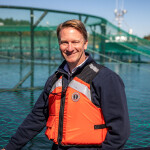

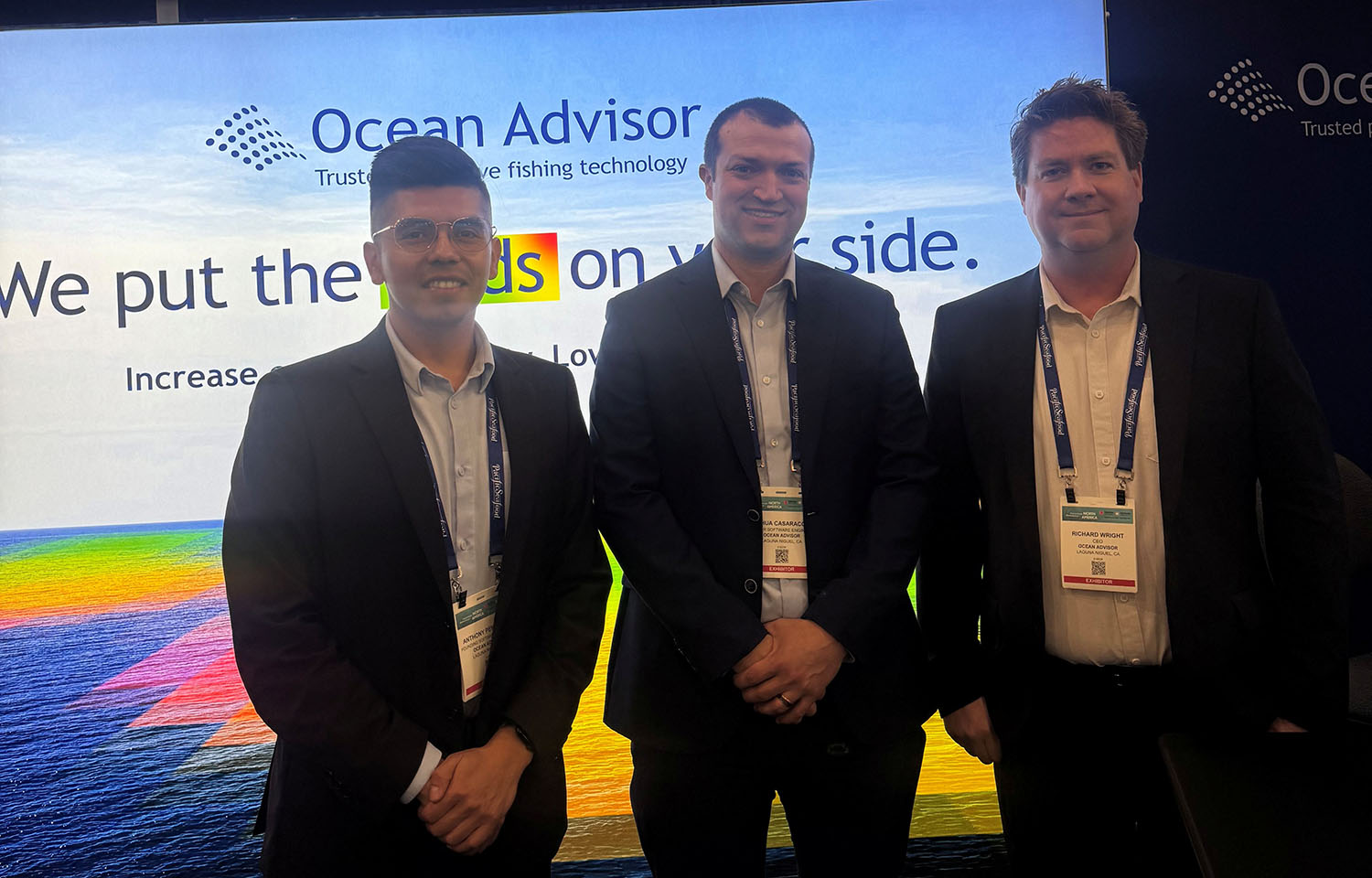
Richard Wright spent over 20 years in the oil and gas industry as a geophysicist, director, and manager in frontier oil exploration.
Now, he’s applying that background to the seafood industry via the creation of a new company called Ocean Advisor.
“There’s a lot of transferrable science and technology,” Wright said at the 2026 Seafood Expo North America (SENA), which took place in Boston, Massachusetts, U.S.A., from 15 to 17 March. “My background [of going] from geophysicist to scientist, I’ve spent a lot of time studying how the Earth functions and how we scientifically measure that, and that became the basis for this company. I’ve been involved in over 50 geophysical papers over my career. The system basis for Ocean Advisor is four-dimensional seismology, probabilities, and looking at the ocean environment naturally, which actually has a lot of noise.”
Based in Laguna Nigel, California, U.S.A., Ocean Advisor creates predictive technology for large offshore commercial fishing clients to better increase their probability of finding areas with a high volume of fish.
Like sonar or other fish-finding technology, Ocean Advisor utilizes different software systems to predict the areas that have the highest probability for strong catch totals on a daily basis. Ocean Advisor generates these daily species probability maps via a proprietary, science-backed AI prediction platform that uses ocean measurement data, remote sensing data, geophysical data, and self-built artificial intelligence models.
“If we only know 10 percent of what’s going on deep in the sea where fish are but could potentially move that number from 10 to 12 or 13 [percent], it could be a big advantage in sustainability and in economics, even though we still have to be very humble and understand that we don’t know much about what’s going on [in the deep sea],” Wright said. “[We are trying to] keep that humility but then use data to try to sort out probabilities and really put the odds on the side of our clients.”
Wright said that last year, the company launched daily species catch probability maps with a color-coded key to indicate the volume and likelihood of catching fish in one area of the ocean compared to another. A red area, according to Wright, may indicate that that section has a low probability catch rate, while a green area may indicate that there is a high probability of catching fish on a certain day.
“That’s what we exist for – to help the fleets and captains affirm they’re targeting and efficient for good catching,” Wright said. “It has a big sustainability aspect, too, because of course if you’re catching more efficiently, you’re reducing the tow time in the water.”
Wright said the predictive models are a “fairly unique approach” because they transfer some of the same geophysical scientific and probability principles from the oil and gas industry. Therefore, he said he was comfortable starting this company, even with a background outside of the seafood industry, because Ocean Advisor uses a “very strong, rigorous, scientific approach” that measures outcomes in a data-centric manner.
“Understanding the natural environment has lots of uncertainty, but that’s OK,” Wright said. “We don’t need to figure it all out. We need to figure out enough to make a prediction that’s within a certain uncertainty. That’s our approach.”
In addition to helping clients improve their catch rates, Wright said that sustainability is at the forefront of Ocean Advisor’s work. By better understanding which fish are where, fishers within a quota-managed fishery can reduce their tow time, fuel consumption, and carbon emissions. Wright said some clients have seen a 50 percent reduction in carbon emissions, measured per kilogram of catch.
“It allows you also to, in certain cases, spread your effort to different parts of the fishing ground. Rather than all going to one spot, it allows you to potentially find areas within the zone to disperse the effort so it’s not all concentrated,” Wright said. “This really gets into vessel timing, [analyzing] when we should have vessels out there from an optimal standpoint. With anything in science, there are no silver bullets, but there are probabilities on your side. That’s really what the whole point of this business is.”
Wright declined to name specific clients but did share that the company has expanded globally, operating in the Atlantic, Pacific, and Indian oceans.
“The effort folks make to provide food for the world, they do it in difficult conditions, and I love the people that we’re working with,” Wright said. “It’s just been tremendous in ways that we can do things … and do it the right way.”
As for the future, Wright said he plans to continue expanding Ocean Advisor’s technological capabilities worldwide in an effort to help commercial fishermen secure more catch in a more sustainable way.
“These are very important things that basically allow our clients to deliver the seafood to the market to keep people around the world supplied with their great seafood in different regions but doing it in a much more sustainable way so that there’s less carbon emissions, less cost, and less tow time at the bottom of the ocean,” Wright said.
