

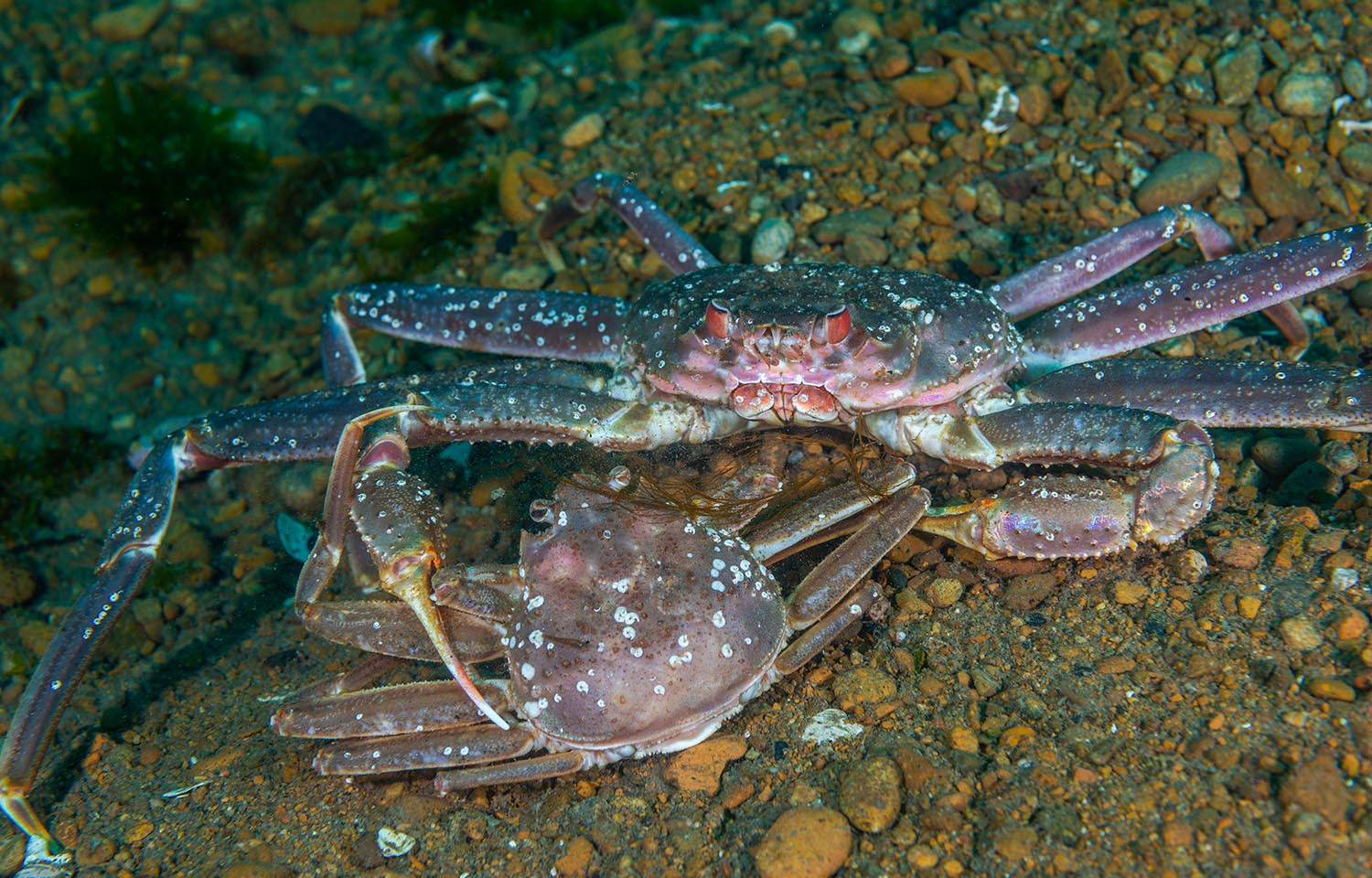
The U.S. state of Alaska has canceled the forthcoming 2026 Kodiak commercial tanner crab season to let the population recover to a harvestable level.
The harvest levels set by state regulators for Kodiak tanner crab had been declining rapidly since peaking in 2023, when the state government set a record high quota of 5.8 million pounds.
That large harvest was short-lived, however. Regulators authorized 3.5 million pounds for 2024 and then just 560,000 pounds for the 2025 season.
Now, the Alaska Department of Fish and Game (ADF&G) has determined the population has shrunk to a point that it cannot support a commercial harvest, according to regulations.
Alaska regulations require a minimum harvest level of 100,000 pounds to open a section of the Kodiak district for commercial tanner crab harvesting. While the crab populations in two sections met abundance thresholds, regulators determined that there were not enough crabs to set a harvest level that high. The remaining sections of the Kodiak district were all below the state’s abundance thresholds.
Similarly, the South Peninsula and Chignik 2026 seasons were canceled after the ADF&G’s survey revealed that the population could not support the regulatory minimum harvest level of 200,000 pounds for those areas.
The cancelations aren’t entirely unexpected; fishers were predicting the large 2018 cohort that had supported a commercial fishery was fading out. Researchers claim the tanner crab populations come in waves; the 2018 crop had enabled a boom in crab harvests for a few years, but now, fishers must wait for the next group to emerge. Another large bump was detected in 2023, and while researchers predict it to reach maturation in 2027, it appears to be only half the size of the 2018 cohort.
Prices for Kodiak tanner crab have also fluctuated wildly over the last few years. After opening the season with an agreed-on price of USD 8.10 (EUR 7.14) per pound during the 2022 season – double the price offered in 2020 – commercial fishers kept their vessels tied to the dock the following year when processors offered just USD 2.50 (EUR 2.29) per pound. For the 2025 season, Alaska Pacific Seafoods began the season offering USDE 5.75 (EUR 4.93) per pound for Kodiak tanner crab.
Earlier this year, a Kodiak commercial crabber was sentenced to a year in prison for illegally transporting his catch to the state of Washington to sell at a higher price. According to the U.S. Department of Justice, Corey Potter directed the captains of his two crab catcher vessels in Alaska to take their catch of live Tanner and golden king crab to Seattle, Washington during the 2024 season. However, the catch was infected with Bitter Crab Syndrome – a fact that was known by Potter – leading to many of the crab dying before arriving in port. The entire catch of 4,200 pounds of tanner crab had to be disposed of in a landfill by the Washington Department of Fish and Wildlife. The two captains received fines of USD 20,000 (EUR 17,944) and USD 10,000 (EUR 8,971), respectively.
“Crabbing is a vital component of Alaska’s fishing industry. Mr. Potter blatantly disregarded state and federal fishing laws and ignored the concerns of other fisherman when he directed his two captains to execute the illegal transport, resulting in the reckless loss of over 5,000 pounds of crab,” U.S. Attorney for the District of Alaska Michael J. Heyman said at the time of sentencing. “The laws protecting this industry help ensure Alaska’s fisheries are sustainable for years to come. My office will continue to work with state and federal law enforcement partners to prosecute federal criminal violations that jeopardize Alaska’s fisheries.”
While the Kodiak tanner crab fishery will be closed in 2026, fishers operating in the Bering Sea will be able to harvest nearly twice as many crab during the 2026 season, which kicked off earlier this month. State regulators set a total allowable catch of 11.3 million pounds – the largest harvest since 2015. Researchers are also observing more snow crab – tanner crab hybrids and have increased the Bering Sea snow crab harvest to allow fishers to target the growing hybrid populations.
