



The U.S. Department of the Interior auctioned off the first offshore wind energy leases in the Gulf of Maine on 29 October, despite continued opposition from New England commercial fishers.
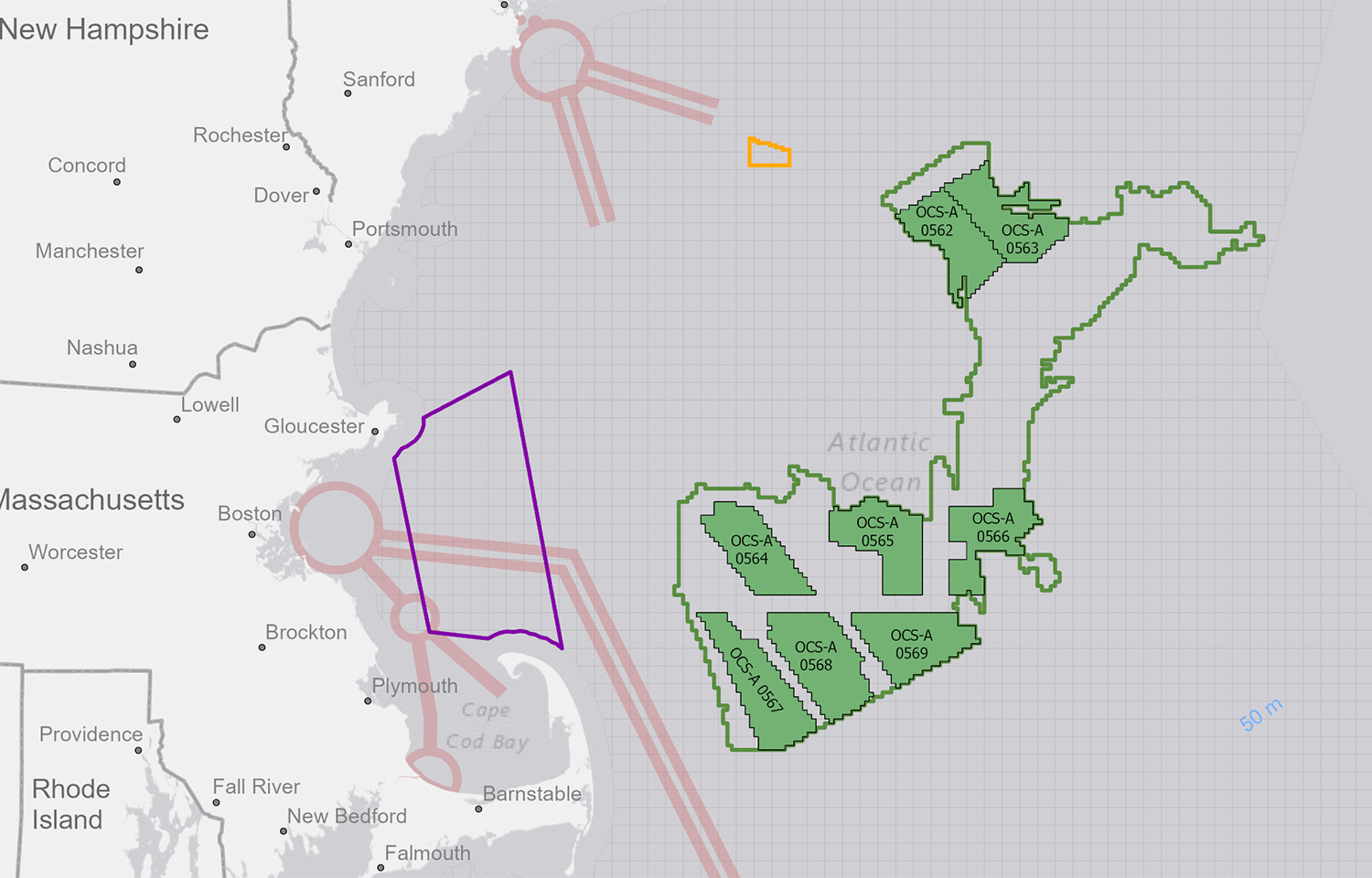
The auction included eight areas on the Outer Continental Shelf off the New England coast that winning bidders could develop for wind energy operations. The government claimed that if the leases are developed to their full capacity, the sites could generate 13 gigawatts of energy – enough to power 4.5 million homes.
On 29 October, the Bureau of Ocean Energy Management (BOEM) announced that it had selected two provisional winners from the auction: Avangrid Renewables and Invenergy NE Offshore Wind. The bids will bring in USD 21.9 million (EUR 20.3 million) to the government for four of the lease areas.
Avangrid Renewables won Lease OCS-564 – a 98,565-acre area – with a bid of USD 4,928,250 (EUR 4,562,072) and Lease OCS-568 – a 124,897-acre area – with a bid of USD 6,244,850 (EUR 5,780,918). Invenergy NE Offshore Wind won Lease OCS-562 – a 97,854-acre area – with a bid of USD 4,892,700 (EUR 4,529,219) and Lease OCS-567 – a 117,780-acre area – with a bid of USD 5,889,000 (EUR 5,451,594).
Lease OCS-562 is located off the coast of Maine, while the remaining leases are located off the coast of Massachusetts.
The auction, first announced in September, has faced stiff opposition from New England fishers, who question how wind energy installations will impact the environment and the commercial fisheries they rely on.
"The government put our livelihoods and our coastal communities up on the auction block,” New England Fishermen's Stewardship Association (NEFSA) CEO Jerry Leeman said. “The areas slated for industrialization cover prime, multi-generational fishing grounds that will likely close forever, jeopardizing our ability to make a living and support partner businesses on shore."
Leeman said the location of six of the sites will block access to much of Georges Bank, which separates the Gulf of Maine from the Atlantic Ocean, creating more congestion around near-shore fisheries.
The location of the sites up for auction has been highly contested, with fishers trying to prevent the sites from overlapping with key fishing grounds. In March, Maine Governor Janet Mills and the state’s congressional delegation announced that they had successfully worked with BOEM to exclude Lobster Management Area (LMA) 1 from proposes wind energy areas.
“We appreciate that the bureau has heeded our concerns and the majority of the concerns of Maine’s fishing communities in its final designation of wind energy areas for the Gulf of Maine,” the officials said in a joint statement. “This decision preserves vital fishing grounds and seeks to minimize potential environmental and ecological impacts to the Gulf of Maine.”
BOEM said that it “prioritized the avoidance of offshore fishing grounds, sensitive habitats, and existing and future vessel transit routes” in selecting areas with “sufficient acreage to support the region’s offshore wind energy goals.”
Earlier this year, the state of Maine and BOEM reached an agreement on a floating offshore wind research lease in the Gulf of Maine.
"This floating research lease represents a continued investment in innovative offshore wind technology and research, and will help Maine embrace a secure, sustainable energy future – while striking an important balance with the needs of our fisheries and fishing communities,” U.S. Senator Angus King (I - Maine) said of the research lease. “For years, the University of Maine has worked to develop a floating offshore wind facility, and this partnership is a tremendous step forward in cementing our state as a renewable energy leader.”
East Coast fishers are already engaged in the next battle over offshore wind energy leases. In August, BOEM asked for a proposal to develop 13.4 million acres of ocean off the coast of New Jersey, Delaware, Maryland, Virginia, and North Carolina.
In October, officials from New Bedford, Massachusetts, U.S.A., came out in opposition to the new plan, claiming it would harm existing commercial fisheries.
"BOEM has painted with too broad a brush,” New Bedford Mayor Jon Mitchell said in a statement. “As the port where the fishing and offshore wind industry intersect more than anywhere else, New Bedford is committed to the successful coexistence of both industries. We believe that the new Mid-Atlantic call areas must be cut back from existing scallop and other fishery access areas, which still would leave ample room for nearby states to achieve their offshore wind capacity goals.”
The New Bedford Port Authority (NBPA) also raised concerns with the proposal, despite claiming that it supports wind energy development in general.
"Our grave concern about [the proposed wind energy area] is that it unnecessarily includes some of the most critically important scallop fishing areas on the East Coast," NBPA Executive Director Gordon Carr said. "What is stunning to us is that all that data is and was available to BOEM prior to setting the boundaries of the proposed call area."
New Bedford is home to Vineyard Wind, America's first large-scale offshore wind farm. In March, Vineyard Wind established the Fisheries Compensatory Mitigation Program to compensate fishers in Massachusetts, Rhode Island, Connecticut, New Jersey, and New York who have suffered an economic impact from the construction, operation, and decommission of the offshore wind energy project.
“The launch of these funds are the latest example of our commitment to working with the fishing industry to create successful programs together,” Vineyard Offshore Fisheries Manager Crista Bank said. “In addition to these funds, we’ve also employed dozens of fishing vessels to work on different scopes of the project, a model we hope to expand as we develop projects around North America. By working together, we can power healthy communities and environments with 100 percent clean energy and the fishing industry can continue to provide healthy locally caught seafood.”
Still, not all fishers view the Vineyard Wind project as a success.
"As the Vineyard Wind debacle shows, offshore wind development is an environmental and economic travesty,” Leeman said. “We regret the Gulf of Maine is one step closer to industrialization."
The Biden administration had held five offshore wind lease sales prior to start of the Gulf of Maine auction.
“The growing enthusiasm for the clean energy future is infectious,” U.S. Department of the Interior Secretary Deb Haaland said in September. “The Biden-Harris administration’s unwavering commitment to building a vibrant and sustainable offshore clean energy sector is strengthening our fight against the climate crisis and building a healthier, more resilient planet for generations to come.”
