




Chilean sustainable manufacturing firm Aysén Recircular has created a business model in which it takes expanded polystyrene (EPS) from Chile’s salmon-farming firms and repurposes it into panels used to build houses.
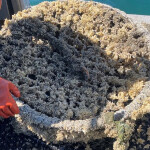
EPS is a material widely used in floats and buoys and considered one of the most complex to properly recycle once its useful life has run its course. The process begins with Aysén Recircular receiving buoys and industrial floats from salmon-farming centers at its plant in southern Chile’s Aysén region. The discarded gear is then opened up to extract the interior material, EPS, which is then converted into blocks that are used for the interior of prefabricated panels.
The resulting structural insulated panels (SIPs) are considered high-performance building panels with a rigid EPS insulation core sandwiched between two structural boards. SIPs provide better thermal insulation, airtightness, and structural strength compared to traditional building materials, resulting in faster construction times and reduced energy costs than typically achieved under traditional framing.
Those characteristics become all the more important when considering the region in which these materials are being produced. Most areas of Southern Chile are rural, with large distances between towns and points of purchase making materials more expensive to acquire. The handling of industrial waste is also often considered a difficult problem to solve in the area.
Those issues presented Aysén Recircular Founder Fernando Soto with an opportunity.
Where others saw waste, he viewed EPS as a raw material that could remain in the region, offering a solution as it is reused in home construction.
“We have an innovative model of joint work where we link two industries; on the one hand, we solve this whole problem of EPS for salmon farming, which is a super complex waste to recycle, and on the other hand, we contribute to construction by manufacturing these SIP panels,” Soto said. “One thing that is very important to us is that the circular economy is effectively carried out – that is, that waste can be recovered and it remains in the localities where it is generated.”
Cold climatic conditions also provide additional challenges in the region, and this process responds to a need that is specific to the cold, storm-prone seasonality found in Aysén, which provides short windows of time for construction. The prefabricated panels allow builders to cut down on construction time and reduce the generation of debris.
Salmon-farming firm AquaChile recently highlighted this development, transforming a complex waste into an input with economic and social value.
“Fernando's work is a clear example of how the industry and local entrepreneurs can collaborate effectively,” AquaChile Aysén Community Relations Leader Bernardita Lazo said. “We provide the material that has already completed its production cycle, and he, with great operational capacity, reintegrates it into the community, transforming it into a key input for the housing development of our region.”
According to Aysén Recircular’s website, the company has repurposed nearly 4,000 buoys and floaters, weighing some 88 metric tons that take up almost 6,000 cubic meters of volume, into more than 5,900 prefabricated SIP panels that have been used in the construction of over 100 houses. Besides AquaChile, collaborating salmon-farming firms include Cermaq, Cooke Chile, Mowi, and MultiX.
“Fernando Soto's experience shows how a solution born in Aysén can generate value from a specific industry challenge, bringing together sustainability, innovation, and local development,” AquaChile said in a release.
